
Daily Agenda
An intelligence look at the terror-free Türkiye process: Will in Imrali and weapons in Qandil!

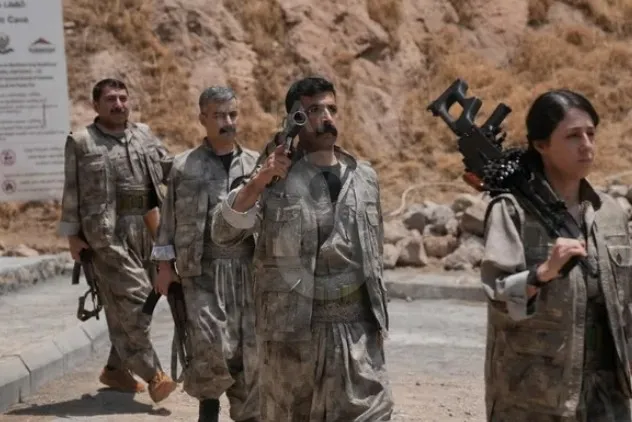
The statement from Kandil on the first anniversary of the PKK’s dissolution congress on 5-7 May 2025 clearly revealed this fact. KCK Executive Council Member Mustafa Karasu and KCK Presidential Council Member Sozdar Avesta appeared in front of the cameras with the members of the armed organization and announced that they changed the name of the organization to “Apoist Movement Management”. However, the striking point was this: While the new name was announced, the old KCK titles continued to be used. So the name had changed, but the structure, staff and weapons remained in the same place.
THE MAIN MESSAGE GIVEN BY KANDIL
In fact, the message Kandil gave was quite clear. Abdullah Öcalan is considered the natural leader of the organization, but the control of the weapons and the schedule of the process were wanted to be kept in the hands of Kandil. The moral authority of Imrali was recognized, but the operational will was not left to the process and Öcalan.
On the contrary, Ankara is following a clear sequence. According to the information I have obtained from the sources of the Ministry of Intelligence and Justice, the state has made its decision: First the weapons will be laid down, then the law will come into effect. At the center of the process will be MİT’s detection and confirmation mechanism. For the state’s mind, the main issue is no longer words, but concrete data on the field.
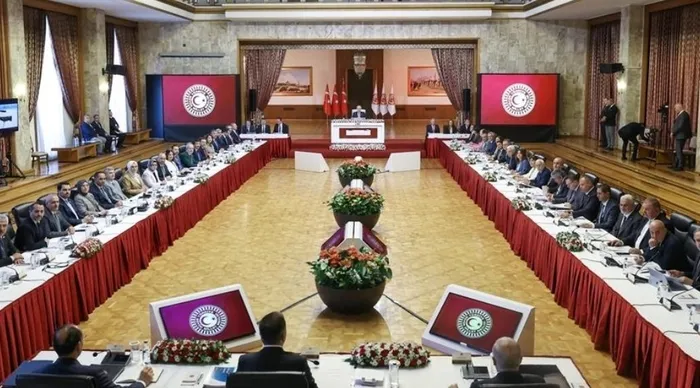
The draft law prepared by the Ministry of Justice has two main pillars. The first of these is the return of members of the organization who are not involved in crime, and the second is how the disarmament process will be managed technically. MİT’s detection and verification system was discussed in detail at the Cabinet’s May 4 meeting. The meeting held by President Recep Tayyip Erdoğan and MHP Chairman Devlet Bahçeli in the Social Complex showed that the political consensus on the Ankara front still continues.
THE FORMULA OF THE STATE IS NET
The person who formulated this framework most clearly was Devlet Bahçeli. The sentences used by Bahçeli in the Turkish Grand National Assembly group meeting clearly revealed the ranking of the state. Bahçeli said that Abdullah Öcalan’s legal situation can only be evaluated after the dissolution of the organization with all its elements and the delivery of weapons. So Ankara’s formula was clear: First termination, then delivery, then the legal process will begin.
The “Peace Process and Politicization Coordination” model proposed by Bahçeli is also based on the same ranking logic. In this model, no status discussion is opened without laying down weapons. The sentence “Türkiye without terrorism is not surrender, it is not compromise, it is not bargaining” describes the red line of the state itself.
However, Kandil’s statements argue the opposite. The most critical part of Mustafa Karasu’s statement was this: “Linking legal steps to laying down arms does not reflect the truth.” This sentence is actually a direct objection to Ankara’s model. Because Qandil is still trying to impose the “law first, then weapons” formula.
But even the statement itself contains a serious contradiction. On the one hand, it is said that “we have withdrawn our armed forces beyond the border”, and on the other hand, the statements are made with armed cadres. Even this image is enough to show the organization’s true intentions regarding weapons.
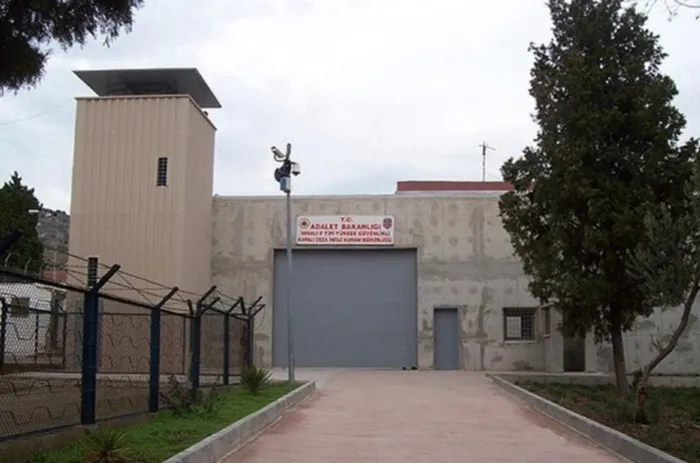
IMRALI WILL QANDIL PRACTICE
The sentence “Öcalan should manage disarmament”, used by KCK Member Murat Karayılan at the PKK 12th Congress, seems at first glance to be a commitment to the İmralı will. However, intelligence officers read between the lines differently. Kandil actually implicitly says: “Öcalan is the leader, but we also have control of the weapon.” The real knot of the process occurs right here.
Because Öcalan’s call for February 27, 2025 is still on the table today. However, Kandil wants to decide alone how the call will be reflected on the field. This is exactly the point that Ankara does not trust.
One of the invisible but most critical details of the process was that the DEM delegation could not establish direct contact with Öcalan for about a month. This is not an ordinary technical problem. Because the will coming from İmralı gives Kandil time and bargaining space every day that he cannot reach the field directly.
As a matter of fact, it is noteworthy that Karayılan’s interview with the organization’s ANF broadcast on April 30 and Karasu’s statement on May 5 coincided with the same period. One speaks from the military wing, the other from the political wing, one after the other, but repeats the same discourse. This shows the intelligence officers that a coordinated line of resistance has formed within the organization.
FOR THE FIRST TIME DEM IS THIS POLITICALLY DARE!
Another statement that made this picture even more remarkable came from DEM Co-Chairman Tuncer Bakırhan. Bakırhan clearly stated that they support the framework put forward by Bahçeli. More importantly, he directly rejected Qandil’s “Middle East is boiling” thesis.
Bakırhan’s following sentence was quite critical: “If regulations are made for democratic politics and the PKK does not do what is necessary, we will be the first to criticize.”
This statement shows for the first time in such a sharp and bold way that there is a clear distance between DEM and Kandil that has not been seen in a long time.
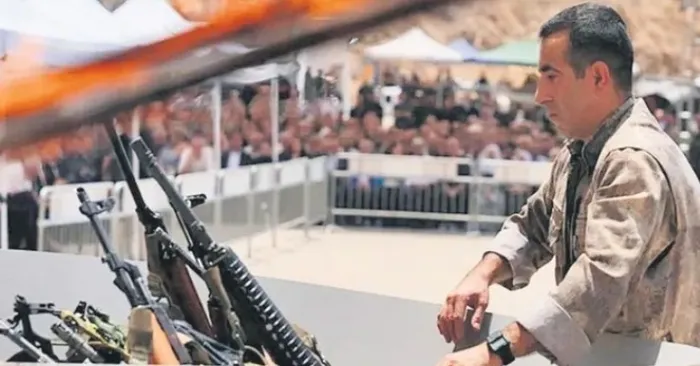
PKK’S INVISIBLE ECONOMIC BACKNESS
There are three basic calculations behind Karasu and Karayılan’s statements. The first is to keep bargaining. The second is to reposition the PKK within the regional equation. The third is to preserve the economic order, that is, the status quo, of the structure, which is nearly fifty years old.
As a journalist who has been closely following the European leg of the PKK since 2007, I can clearly say that the shell company chains stretching from Luxembourg to Rotterdam, from Paris to Brussels, constituted the invisible economic backbone of the organization. For the PKK elite monks, weapons are not only an ideological tool, but also the main center of the economic and organizational order.
The structure, which extends from drug trafficking to the pressure on the European Kurdish diaspora to black money networks operating through restaurants and front companies, still constitutes the main power of the organization today. Karayılan’s statement “our security is our weapons” is actually the code for the continuation of this black economic order.
2015 WILL NOT BE ALLOWED A REPEAT
The tension within the organization is becoming increasingly visible. It is known that there were serious conflicts in the upper management during the decision to terminate the PKK at the 12th Congress. The latest statements of Karasu and Karayılan should be read as a reflection of this internal struggle.
Senior managers of the intelligence agency now read this picture differently. Because for the state, the issue is not just organizational statements, but real data experienced in the field. This was the main reason for the breakdown in the 2013-2015 peace process. At that time, Qandil calculated the conjuncture, put the gun on the table again with the dream of establishing a new state in Syria, and the process collapsed.
This time, the state mind does not want to return to the same ground again. For this reason, preparations for the law are progressing together with the intelligence and military double verification system.
It is also noteworthy that in Mustafa Karasu’s statement, non-organizational names such as Osman Kavala and Can Atalay, other than Selahattin Demirtaş, were brought to the agenda. Because these topics are put forward as part of the political bargaining area, not the direct disarmament process.
Ankara’s approach is very clear here too. Öcalan’s physical conditions or political arrangements will only be evaluated after the complete disarmament and surrender.
THE CRITICAL QUESTION IS NOW!
At this point today, the critical question is: Does Kandil really not want to read the process, or is he trying to keep a new armed ground open in a controlled manner?
Because there is a third space in the middle that is getting narrower.
One of the clearest facts that my nearly twenty years of field observation has shown me is this: It has not been possible for an independent Kurdish politics to gain ground in Türkiye without breaking Qandil’s armed tutelage. Many political figures, from Leyla Zana to Hatip Dicle, from Dicle to Selahattin Demirtaş, experienced the harsh impact of this shadow in different periods.
I can say this: What is remarkable today is that both Öcalan and the DEM administration are so openly approaching unarmed politics for the first time. The resisting structure seems to be the old tutelage reflex in Qandil.
THE STATE IS NOW MEASURING THE FIELD
As a result, the state’s position is now clear. Weapons will be released unconditionally. MIT’s detection and confirmation mechanism in the field will work predictably. As for the legal process, the whole process will come into play in a planned manner, step by step, when the specified order comes.
The fate of this process will no longer be determined by Ankara’s statements, but by Kandil’s real decision on the field.
Last word: The state will no longer measure the words floating in the air, but the field clearly.
Vegetables, fruits… Cheese, olives… Shoes, bags… Home textiles… T-shirts, shirts, towels, sheets… Whatever comes to your mind.
Laleli District Market… It’s quite crowded.
– Hey market tradesmen… Your fellow countryman Özgür Özel left CHP… He founded a party… New Party… What do you say?
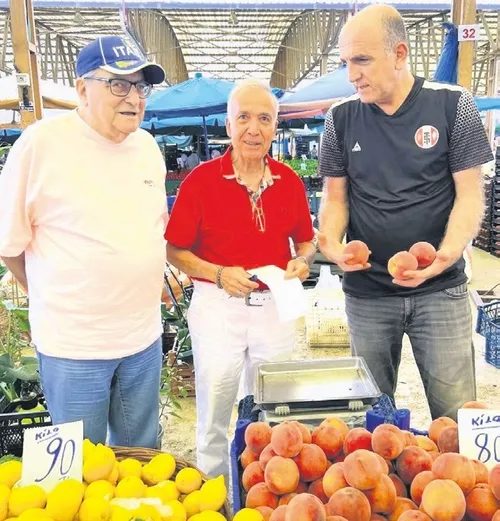
Cenk Gülçimen… He sells peaches and lemons… He said:
– A good opposition is always needed.
A customer… A retired teacher… He said, “That’s right.”
– It will not constantly fight and insult… It will call what is right right, it will criticize what is wrong… It will tell the truth… An opposition that will give confidence is truly Türkiye’s most important need.
***
HERE IS THE OPPOSITION
When I listened to the marketer Cenk Gülçimen and the customer, the retired teacher… I said, “The late Professor Turan Güneş also said that.”
The friends next to me… Ertuğrul Aytaç… Tarkan Kayhan… And the marketers… Those who came to shop… They asked:
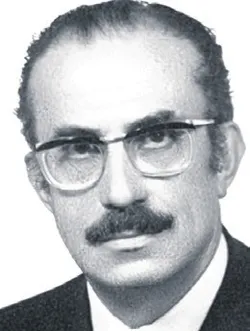
– What did Turan Güneş say?
Legendary Minister of Foreign Affairs… Turan Güneş, a politician and statesman who was on duty during the 1974 Cyprus Peace Operation, said:
“In our country, opposition is divided into two as constructive and destructive… The opposition that says everything is right is constructive… The opposition that says everything is wrong is destructive.”
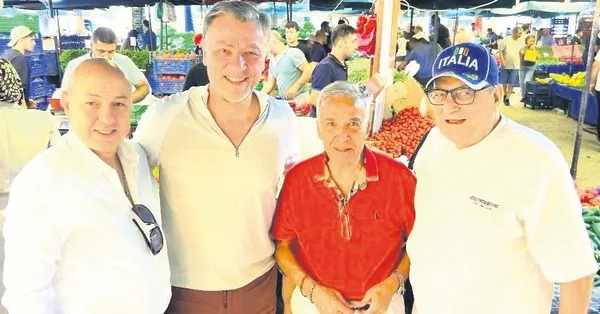
“He was right,” said someone in the crowd. The other said, “Where did he say it?” he asked. I explained… Prof. Güneş’s book… Analysis of Turkish Democracy.
Turan Güneş’s words are written in this book. This time everyone started asking me for this book… Maybe 10 people.
“Look at the bookstores,” I said:
– If you can’t find it, call Professor Hurşit Güneş… Have him send you his father’s book if he has extra.
***
NOTES FROM THE MARKET
Keep wandering… The market is clean… Prices are cheaper than Istanbul… Bodrum.
– Hey market tradesmen… More… What else do you say?
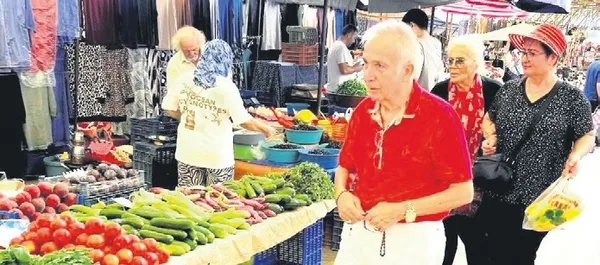
A bunch of the answers we received:
 Mr. Özgür did the right thing by establishing a new party… Congratulations.
Its name is the New Party, but… Those with it are old… Some of them have been members of parliament for three or five terms.
If I were Özgür Özel, I would not establish the party with 90 MPs… Tomorrow, they will all want to be MPs.
Özgür Bey is loyal… That’s why he took 90 MPs with him.
***
CHAT WITH ÖZGÜR ÖZEL
It’s around 11:00… Continue chatting with the marketers.
And the phone… In front of us is Özgür Özel.
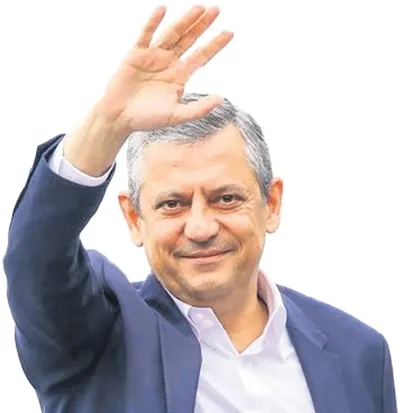
– Mr. Özgür… I’m in Manisa… I’m at the neighborhood market… With your permission, I’ll turn up the phone… Hear what the market vendors say.
Özgür Özel, “Hello friends, how are you?” he said.
Marketers… Some thanked… Some wished success… Meanwhile… Customers in the market also joined the conversation. Özgür Özel and the people in the market liked the phone call.
***
ENGINEER SAID…
After the phone was hung up… An engineer… He came to market with his wife… He said:
– I wish you hadn’t hung up the phone… I was going to say a few words to Mr. Özgür.
– What were you going to say?
– I was going to say the following… Don’t speak for those who remain in the CHP… Don’t say hurtful words… Don’t insult… Conditions may change tomorrow… You may need to see them face to face again.
The engineer’s words… found a response in the crowd.
Ertuğrul Aytaç handed over a pen and paper:
– Write these down too… Write them in the newspaper… True words.
***
COMMON SENSE
Interestingly… We heard similar words from the engineer from Manisa from CHP Istanbul Deputy Oğuz Kaan Salicı a few days ago:
What happened went beyond division… The pomegranate peel cracked.
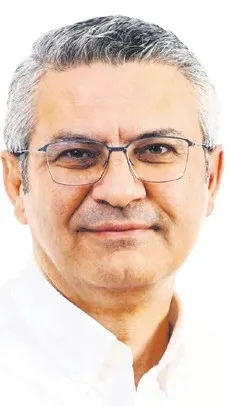
While some of the social media are shouting cheerful slogans, we are heartbroken.
The MPs who left are sad, and so are those who remain.
Let’s not break each other’s hearts.
Yesterday we were seeing each other face to face… We will greet each other again tomorrow.
***
WRITING IS A MUST
There are also retirees in the market.
No… We are not talking about retirees who come to market. Retired marketers… BAĞ-KUR retirees… SGK retirees… Civil servant retirees… EYT retirees.
I congratulated… There is no shame in marketing… They do it well… It’s their bread and butter. But I also have to write this… Retirees are in trouble… I listened to retirees in Manisa the other day… They are in trouble.
***
NEW PARTY’S ‘LUGGAGE’ PROBLEM
Market shopkeeper… He refers to Özgür Özel as “Brother”… He says his name but does not want it to be written:
– Abi Özgür would have done better if he had not taken some MPs with him when establishing the New Party.
– For example, who?
– They have heavy baggage… When the election comes up tomorrow, they will all be a burden on Özgür Abi… Is the Chairman obliged to carry these on his back?
– Who?
The marketer starts laughing… And other marketers. Just marketers? Both the friends we went to the market with… And the customers.
***
‘GAS’ CASE
It’s past 12:00… And our phone is ringing.
The caller is İbrahim Onaylı… Kebab shop.
“I’m waiting” he says:
– Manisa kebab is ready… And your dessert… Also, there are customers who want to talk to you.
– Thank you, İbrahim… All of them are prohibited… We will stop by to drink tea another time.
Marketers… They are glad we didn’t go to dinner. But… They don’t want us to go hungry either. Some want to offer peaches… Some want to offer cherries.
And… The conversation goes on and on. This time the speaker is a businessman… His business is olives and olive oil:
– Mr. Özgür should not listen to the words of the trolls… He should not get angry… He should not act with someone else’s mind.
***
TOMORROW… ‘LIKE A MOVIE’
Party provincial-district chairmanship… It’s me… No, it’s me… Get out… I won’t go out… You will… I’m not going out, the police will take it out.
The problem experienced in many provinces of Türkiye… It’s like a movie… There is both fighting and laughter.
We will tell you tomorrow…
Daily Agenda
AK Party Eskişehir Provincial Minister Gürhan Albayrak: We will not let Eskişehir residents lose their rights! Public receivables of 550 thousand liras must be accounted for
AK Party Eskişehir Provincial Chairman Gürhan Albayrak made remarkable statements about the three political programs held at the Atatürk Culture Art and Congress Center (AKM) belonging to Eskişehir Metropolitan Municipality, during the term of former CHP Eskişehir Provincial Chairman Talat Yalaz. Albayrak stated that the CHP Provincial Congress held on October 19, 2025, the program held on March 8, 2026 with the participation of CHP Chairman Özgür Özel, and the local organization of the group meeting held in the past weeks were carried out by the then CHP Provincial Chairman Talat Yalaz and his team.
NO PRICE HAS BEEN PAID
Reminding that according to the fee tariffs published by Eskişehir Metropolitan Municipality, AKM’s rental fee for 2025 is 150 thousand TL and the rental fee for 2026 is 200 thousand TL per program, Albayrak stated that a total of 550 thousand TL rental fee should be collected for the three programs in question. Albayrak claimed that, according to the information they obtained, none of these fees were paid, and also said that there were claims that there was no previously prepared request letter, contract or protocol regarding the allocation of the halls.
IF PAYMENT HAS BEEN MADE, SHARE THE DOCUMENTS
Albayrak called on both Talat Yalaz and Eskişehir Metropolitan Municipality Mayor Ayşe Ünlüce on the issue and asked the following questions: “Who applied to the Metropolitan Municipality for these three programs? Have the rental fees of the halls been paid? If so, will the invoices and payment receipts be shared with the public?” Addressing the municipal administration, Albayrak said, “With what written request, decision and legal basis was the AKM allocated? Has a total of 550 thousand TL been accrued and collected? If not, why was this fee not collected? Who gave the instruction for free use?” he said.
ESKİŞEHİR PEOPLE’S RIGHTS WILL NOT BE Abolished
Arguing that Talat Yalaz’s expulsion from CHP or turning to a new political formation will not eliminate his financial and political responsibility for the programs carried out in the past, Albayrak said, “Parties may change, signs may change; the rights of Eskişehir residents will not be eliminated.” he said.
WE WILL BRING THE ISSUE TO THE ASSEMBLY AGENDA
In his statement, Albayrak also stated that they will bring the issue to the agenda of Eskişehir Metropolitan Municipality Council and stated that they will demand official and written answers to all questions. Gürhan Albayrak said, “Our expectation is clear. If payment has been made, disclose the documents to the public. If not, hold the people of Eskişehir accountable for why the public receivable of 550 thousand liras has not been collected.” He completed his statement by saying.
Daily Agenda
The Iraqi Minister first insisted and then signed! Who did the Development Road Project disturb? Here’s what’s behind the scenes
After President Recep Tayyip Erdoğan and Iraqi Prime Minister Ali al-Zaydi had a one-on-one meeting at the Presidential Complex and chaired the meeting between delegations, agreements were signed between the two countries.
“Education and Academic Cooperation Memorandum of Understanding” was signed by Police Academy President Murat Balcı and Iraqi Prime Minister and Armed Forces Commander’s Private Secretary General Abdulemir Shammari. The “Memorandum of Understanding in the Fields of Youth and Sports” was signed by Minister of Youth and Sports Osman Aşkın Bak and Iraqi Minister of Foreign Affairs Fuad Hüseyin. The “Memorandum of Understanding on Cooperation in the Field of Industrial Property” was signed by the Minister of Industry and Technology Mehmet Fatih Kacır and the Iraqi Minister of Finance Falih Sari. The “Memorandum of Understanding on Railway and Road Transport through the Fishhabur-Ovaköy Border Gate” and the “Framework Memorandum of Understanding on the Development of Transportation Infrastructure within the Republic of Iraq in Exchange for Natural Resources” were also signed by Minister of Transport and Infrastructure Abdulkadir Uraloğlu and Iraqi Minister of Transport Veheb Selman Muhammed.
The agreement ceremony was marked by Iraqi Minister of Transport Veheb Salman Muhammed’s insistence on signing the Memorandum of Understanding regarding the Development Road Project. Following the intervention and instruction of Iraqi Prime Minister Ali Zaydi, the relevant agreements were signed.
(Minister of Transport and Infrastructure Abdulkadir Uraloğlu and Iraqi Minister of Transport Veheb Selman Muhammed signing the agreement)
It was noteworthy that President Recep Tayyip Erdoğan also warned about what happened during the signing ceremony and asked for additional information from the Minister of Foreign Affairs Hakan Fidan.
After the images attracted the attention of the world media; SETA Foreign Policy Researcher Can Acun gave striking answers to Sabah.com.tr’s questions about the Development Path Project, the changing balances in the Middle East and President Erdoğan’s determined diplomatic moves.
SETA Foreign Policy Researcher Can Acun
WHAT LIES BEHIND THE SCENES?
Can Acun emphasized the importance of the Development Road Project in terms of the national security and commercial interests of both Iraq and Türkiye. He pointed out that the project is at a critical angle for the continuity of global logistics lines. Can Acun said, “A while ago, I carried out various field studies in Iraq in the context of the Development Road Project. I had the chance to meet with many main actors there. I also met with the officials of the Bedir organization and political structure, to which the Minister of Transport is affiliated. All of them stated that they definitely supported the project in these meetings and that it was seriously important for the future of Iraq.” he said.
Can Acun said, “There is a new government in Iraq, a new Prime Minister, a cabinet formed by him and a certain struggle within the framework of internal political balances.” he said.
Stating that highways, train lines, various industrial zones and new agricultural areas will be created with the Development Road Project, Can Acun said, “We see that it is a project exceeding 20 billion dollars.” he said.
Drawing attention to the closure of the Strait of Hormuz and the events in Babülmendep, Can Acun said, “In this sense, we can talk about an equation in which the Development Road Project has become much more important. Apart from the highway and train line, it is also very possible to transport oil here.” he used his words.
THE AXIS OF THE DISCUSSIONS IN IRAQ
Emphasizing the size of the economic volume that will be created with the Development Road Project, Acun pointed to Iraq’s internal balance. He stated that there are discussions between different political groups in the country on many issues, from how the process will work to the routes to be used, whether Hashd al-Shaabi elements will play a role in security or not, to the sharing of the financial share and revenue that will arise.
Can Acun said, “This signature issue in Türkiye should be evaluated in this context. We should not read it as a party against the project, but on the contrary, we can read it as a manifestation of Iraq’s internal balances in the context of sharing the new wealth that may occur here.” He included his statements.
HOW DOES IRAN APPROACH THE PROJECT?
While many evaluations were made on social media about its closeness to Iran after Iraqi Minister of Transport Veheb Salman Muhammed resisted signing, Can Acun touched on Tehran’s approach. Acun noted that Iran has an ambivalent position. Can Acun said, “Although Iran seems to support the project from the outside, it may have an impact in terms of breaking the blockade it has currently created in the context of the Strait of Hormuz. It can also be seen as a project that can reduce Iran’s strategic importance in the connectivity corridors. In this context, it may try to use various influence forces within Iraq. However, almost all the actors within Iraq, that is, even the groups working closely with Iran, have to officially support the project. Because I think this project is really critical for the future of Iraq.”
The multilateral diplomacy traffic that President Recep Tayyip Erdoğan has recently established with Iraq, Gulf countries (UAE, Qatar) and regional actors plays an important role in creating both peace and economic prosperity in the Middle East. While Türkiye’s role in the international arena becomes stronger day by day, the Development Path Project will make a significant contribution to these steps.
Can Acun opened a separate parenthesis to the developments in the Middle East and said, “There is currently chaos in the Middle East in the context of the aggressive policies of the United States and Israel. We see that Iran has responded to this and closed the Strait of Hormuz, which is the biggest trump card it has, and the conflicts have even deepened, and in the context of Yemen, the Houthis have started to cut off the Bab al-Mandeb, and ships belonging to various countries, especially Saudi Arabia, have begun to blockade.” he said.
“THE ALTERNATIVES PUT OUT BY Türkiye ARE CRITICALLY IMPORTANT”
Noting that America’s blockade against Tehran has created a very serious global energy crisis in the region and the world, Can Acun said, “We see that 20% of the world’s oil and petrochemical industry is produced in the region and exported to the world through these straits. But now there is a serious interruption and there is uncertainty about the future. Therefore, I think the new global logistics lines put forward by Türkiye and new alternatives in terms of new energy supply security are of critical importance for the world and the region.” he said.
President Erdoğan emphasized the Development Road Project at the joint press conference with Iraqi Prime Minister Ali al-Zaidi:
The war environment drives us to deepen our cooperation not only in defense but also in the fields of energy and transportation. The Development Road Project has become more important than ever in the face of current developments.
Can Acun noted that President Recep Tayyip Erdoğan demonstrated the geographical and strategic importance of Türkiye with the diplomatic steps he took. Acun said that Türkiye has emerged as a country that can protect these lines with both its political will and military deterrent power.
Can Acun said:
Zangezur Corridor seriously manifests itself as the Middle Corridor. At the same time, Türkiye attaches strategic value, attaches importance and seriously supports the Development Road Project. However, there are alternative corridors. The Hejaz Line from Saudi Arabia to Türkiye again passing through Syria; Again, transportation of oil and energy resources in Kirkuk to the world via Türkiye and Ceyhan; In fact, Türkiye has serious proposals and efforts to open the oil produced on a scale that can include Kuwait in the Persian Gulf with the Development Path to the world from here via the Iraq-Türkiye line.
PRESIDENT ERDOĞAN’S REGIONAL ADOPTION POLICY…
Now we see that the world attaches great importance to this. Because the current situation does not seem sustainable in any way. There is an outage that could cause a global energy crisis. Therefore, the security of the region and these straits and the possibility of supply shortages for the future will always be on the table, and investment in alternative corridors will increase. In this sense, I think the strong political will and strong military deterrent power of Türkiye, which President Erdoğan has included with his regional ownership policy, will enable alternative corridors to be implemented in this sense.

Daily Agenda
Minister Tekin evaluated the international reflections of Türkiye’s new practices in education
The new curriculum, digitalization steps and the rise in international student success research that the Ministry of National Education has implemented in education in recent years are reflected in the reports of international organizations and attract the attention of education circles. Türkiye’s rising graph, revealed by the new curriculum within the scope of the Turkey Century Education Model, the steps taken in the field of digitalization, and research such as the Program for International Student Assessment (PISA) and the International Mathematics and Science Trends Survey (TIMSS) conducted by the Organization for Economic Co-operation and Development (OECD), are among the headlines that attract attention in the international arena. The Turkey Century Education Model, which emerged as the product of a ten-year long-term study by the Ministry and started to be gradually implemented in the 2024-2025 academic year, centers on skill-based learning, values education and the holistic development of students as well as knowledge transfer. In various international meetings and diplomatic contacts between countries, Türkiye’s new curriculum approach is followed by many countries, especially OECD member countries, and evaluations are made that the skill-oriented structure of the model is compatible with global education trends.
At the G20 Education Ministers Meeting held in the Republic of South Africa in November last year, the Ministry of National Education’s breakthroughs and outstanding practices in the field of education were cited as an example to the world by UNICEF. UNICEF Global Education and Adolescent Development Director Pia Britto stated that the “value and skill-based” Türkiye Century Education Model has been appreciated internationally. Pointing out that face-to-face training for teachers to prepare for the new curriculum stands out as exemplary practices, Britto stated that Türkiye is among the countries that successfully implement national standards in early childhood education with its centralized education system. In the news made by an agency from Azerbaijan, it was stated that the Turkish Century Education Model deals with value education, character development and national spiritual identity together with academic development, thus Türkiye has achieved a comprehensive transformation not only in infrastructure but also with an education model that overlaps with its own values.
“WE EXPECT Türkiye’S SUPPORT ON THE USE OF TECHNOLOGY IN THE FIELD OF EDUCATION”
While positive opinions about Türkiye’s progress in the field of digitalization in education were included in some reports, it was stated that Türkiye’s experiences in this regard were appreciated in the meetings held at the ministerial level. While the United Nations Development Program (UNDP) reports draw attention to Türkiye’s global leadership in educational technologies, the report emphasizes that Turkey is the only country in the world with interactive whiteboards and internet infrastructure in almost all of its classrooms. In her meeting with Minister of National Education Yusuf Tekin, Kyrgyzstan Minister of Education Dogdurkul Kendirbaeva stated that they watched Türkiye’s use of artificial intelligence and technology in education with appreciation and said, “We expect Türkiye’s support in the use of technology in the field of education.” he said. Former Head of the European Union Delegation to Türkiye, Ambassador Thomas Ossowski, also stated that they are proud of the successful projects carried out with the Ministry of Education and that Türkiye can be a role model for other countries in many areas, especially digitalization in education. In the “Education at a Glance 2025 Report” published by the OECD and presenting comparative data on education systems, it was emphasized that Türkiye showed a strong increase in education. The report revealed that Türkiye stands out among OECD countries in increasing inclusiveness in education and bringing the young population into education.
“NOT BECAUSE THEY FOUND A MAGIC WAND, BUT BECAUSE THEY BUILT CONSISTENT SYSTEMS”
Türkiye’s ranking in the latest application of TIMSS, conducted by OECD as well as PISA, attracted the attention of representatives of many countries and institutions. The Japanese education delegation visited the Ministry and examined Türkiye’s rising success in PISA research and its practices in the field of measurement and evaluation. In his meeting with Minister Tekin, OECD Secretary General Mathias Cormann stated that Türkiye is one of the few countries showing a trend in the right direction in the last 10 years of PISA results. OECD Director of Education Andreas Schleicher pointed out that Türkiye’s moves in the field of education show that it can turn things around in crises, and said, “Not because they found a magic wand, but because they built consistent systems, mobilized local resources to make education sustainable, and invested in workforce policies where better skills translate into better jobs and better lives…” UNESCO Deputy Director-General for Education and former Italian Minister of Education Stefania Giannini also emphasized that Turkey is one of the bright examples of countries that come from different perspectives and challenges, produce solutions and make progress.
STUDENTS WERE MONITORED WITH THE MONUMENT RESEARCH IN THE YEARS WHEN PISA AND TIMSS WERE NOT APPLIED
Minister of National Education Tekin made statements about the practices implemented by Türkiye in education and their reflections in the international arena. Tekin explained that they have improved the education and training system since the 2010s, both with the monitoring and evaluation units they established within the Ministry and in terms of international indicators. Stating that they have established a system within the Ministry that analyzes, monitors, evaluates and reports physical infrastructure, academic success and human resources practices through artificial intelligence, Tekin said, “Where, which of our schools needs what, all our general manager friends and friends in relevant units can see it electronically. This is about physical infrastructure and technological infrastructure.” made his assessment. Reminding that they started the Monitoring and Evaluation of Academic Skills (ABIDE) research, which is one of the national monitoring research of the Ministry, regarding their academic achievements, Tekin stated that they monitored the academic achievements of students by conducting this research in the years when PISA and TIMSS were not implemented.
Reminding that organizations such as OECD and UNESCO publish reports on education and training processes at routine intervals, Tekin said, “These organizations publish reports with names such as ‘Education Outlook’ and implement cycles to monitor academic skills, as in the PISA and TIMSS examples. In these two evaluations, we were determining and implementing our policies based on both internal and external evaluations.” shared his knowledge.
“THE POINT WE HAVE REACHED IN TERMS OF INDICATORS IS IMPORTANT”
Tekin said, “Especially during the July 15 period, with the tutelage structures and practices over the Ministry blocked, Türkiye’s achievements in international reports began to gain upward momentum.” he said. Referring to the international reports published on education in Türkiye, Tekin continued his words as follows: “It is clearly stated that Türkiye exceeds the international averages in issues such as the schooling rate, the number of students per classroom, the number of students per teacher, the use of technology in education. This is important for us and we continue to take steps to ensure its continuation and not fall behind in this sense. This will continue as education and training has been given first priority in all our budgets since the date our President became prime minister. Therefore, physical and technological infrastructure and similar financial resources.” “The problems related to these issues have been largely solved. I say largely because we live in an earthquake zone. Such needs will arise as earthquake strengthening, earthquake controls and analyzes are carried out. We have schools that have completed their economic life, the process of demolishing and rebuilding them will continue, but the point we have reached in terms of indicators is important.”
“WHEN OUR CURRICULUM BECAME SKILL-FOCUSED, THESE ACHIEVEMENTS STARTED TO INCREASE”
Minister Tekin told them in international environments in 2013-2014, “Since your programs are still focused on providing information to children, there is no possibility of your children being successful in international exams.” He reminded me that it was said. Stating that when they wanted to make a skill-oriented program, they encountered obstacles from the tutelage forces whose interests were harmed, Tekin said, “When those structures were closed and our education programs and curriculum became skill-oriented, these successes began to increase.” expressed his opinion. Türkiye Century Education Model regarding Türkiye’s education system: “You do not have a skill-oriented structure.” Emphasizing that they prepared it to eliminate criticism, Tekin said that the new curriculum was prepared by taking the opinions of international structures, teachers and academics.
Reminding that the 59th PISA Board of Directors Meeting was held in Türkiye in May last year, Tekin continued his words as follows: “After the presentation we made to them there, it was decided that these program changes should be translated into different languages and explained to different countries. Delegations from many countries started to be requested from us to explain these, and our friends are telling this. This has started to be reflected in the scores.” Tekin stated that Türkiye achieved great success in terms of international indicators in the recently announced TIMSS scores and emphasized that it ranked 4th in 4th grade science, 7th in 8th grade science, 8th in 4th grade mathematics and 10th among OECD countries in 8th grade mathematics.
“WE WANT OUR CHILDREN TO BE STRONG WHILE COMPETING IN THE INTERNATIONAL ARENA”
Reminding that PISA 2025 results will be announced in Bratislava, the capital of Slovakia, on September 8, Tekin stated that OECD has high expectations from Türkiye. Minister Tekin said, “We want our children to be strong while competing in the international arena, but on the other hand, we do not want them to move away from the values that make us who we are. Therefore, we look at the issue in this way. While talking to the officials of other countries, we share that these should be included in education programs in order for that country’s own future to be embraced by its children, for children to internalize world peace, and for ending human rights violations and wars in the world.” he said.
Daily Agenda
Clear statement from the Ministry of Foreign Affairs: We confirm our full support to the Turkish Cypriot people.
In his statement on his social media account, Ministry of Foreign Affairs Spokesperson Öncü Keçeli said, “We appreciate the efforts made by UN Secretary General Antonio Guterres regarding the Cyprus issue since the beginning of his duty. In this period when there is still no common ground for a solution between the two parties on the island, we believe that focusing on progress in important areas of cooperation within the scope of the process initiated by Secretary General Guterres in 2025 will serve to build trust.” he said.
Öncü Keçeli said:
On the other hand, we emphasize once again that the solution perspective will not materialize unless the uncompromising attitude of the Greek Cypriot side changes and its actions that negatively affect regional security are stopped. We hereby draw attention once again that solution models that have been tried and exhausted over decades are a thing of the past. As the homeland and guarantor state, we reiterate that a fair, comprehensive and sustainable solution to the Cyprus issue can be reached on the basis of the realities on the Island, the sovereign equality and equal international status of the Turkish Cypriot people. As always, we confirm our full support for the Turkish Republic of Northern Cyprus and the Turkish Cypriot people.
Daily Agenda
President of Religious Affairs Safi Arpaguş: We must be able to introduce our children to our own civilization values
According to the statement made by the Diyanet, Arpaguş spoke at the Childhood Quran Teaching Workshop themed “Educational Activities for Children in Quran Courses: Evaluation and Future Perspective” organized by the General Directorate of Educational Services.
Stating that early childhood is the most critical phase in which a person’s identity, personality and character are shaped, Arpaguş said, “In this respect, we see Quran courses for ages 4-6 as not only a teaching process in which the skill of reading the Quran is acquired, but also as a strategic education area that aims to protect the child’s nature, support his spiritual and moral development, and contribute to the construction of a solid identity and personality.” made his assessment.
Drawing attention to the importance and sensitivity of childhood, Arpaguş continued as follows:
“We should measure our success in teaching the Quran not by how much students memorize, but by their ability to establish a relationship of love and trust with the Quran that will last a lifetime. What is more important than a child of four or five years old knowing all the letters is that he comes running to the Quran lesson. What is more valuable than memorizing long surahs for a child at that age is that he can learn the love of Allah in a compassion-centered way. Therefore, we measure our success criteria not only on the amount of memorization, recognition of letters or the level of applying the rules of tajwid, but also on participation in the lesson, desire to learn, social “We have to read through multidimensional indicators such as interaction and positive attitudes towards the Quran.”
Arpaguş stated that they aim to develop a Quran education model that brings together knowledge and wisdom and transforms it into morality, and said, “In order to bring our children together with our own civilization values, we have to develop a strong pedagogical approach centered on wisdom, as in the Islamic education tradition. When we can do this, we will achieve great success in Quran education and we will have come a long way towards raising faithful, knowledgeable, moral and personality generations.” he said.
Emphasizing that they are trying to make the most of the realities revealed by science and the possibilities and opportunities of the age in terms of preparing children for the future in the best possible way, Arpaguş said, “We are constantly trying to update our educational programs and course materials with the contributions of child psychologists, child development experts, pedagogues, academics and educators in the field. Our workshop held here today is a manifestation of this sensitivity.” made his assessment.
Deputy President of Religious Affairs Hüseyin Harikalar, Chairman of the Mushaf Examination and Reading Board Osman İyişenyürek and General Director of Educational Services Sedide Akbulut also attended the workshop.


-

 Economy2 days ago
Can diesel prices fall after Trump-Russia deal?
-
 Politics2 days ago
Türkiye-France defense cooperation spark concern in Greek media
-
 Politics2 days ago
Türkiye presses Greece to hand over FETÖ members, crime bosses
-
 Economy2 days ago
Tehran’s once-bustling bazaar struggles as war dampens demand
-
 Economy1 day ago
Top oil execs drop from major event schedule after Riyadh attacks
-
 Sports2 days ago
Bezzecchi wins Indonesian GP to hand Martin championship lead
-
 Sports2 days ago
Deadly Houthi strike on Riyadh airport draws int’l condemnation
-
 Economy1 day ago
Türkiye says 17 funds settled, eyes Atlas deal this week