
Economy
About 6,000 Audi workers protest over threatened plant closure

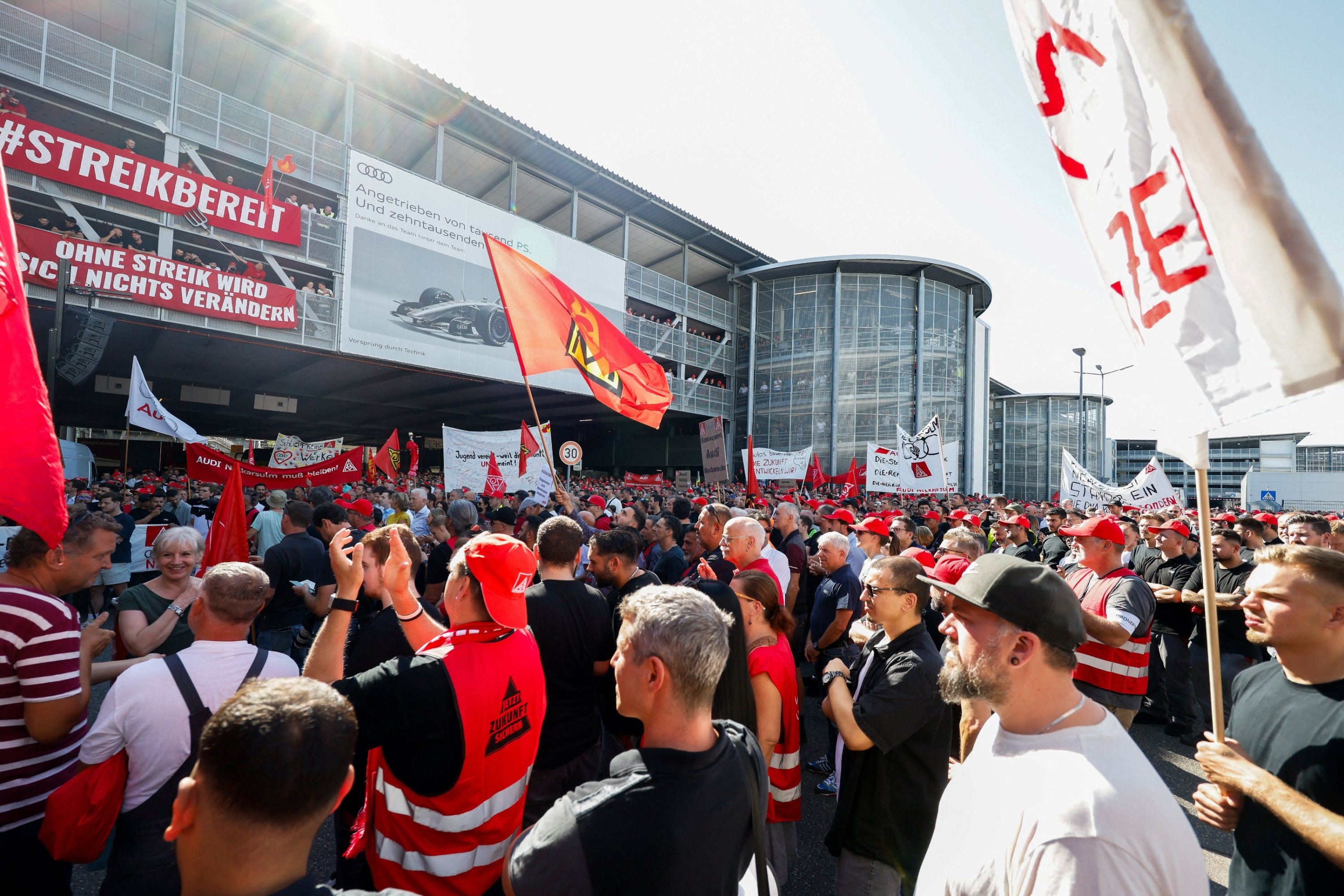
Thousands of Audi workers protested Wednesday against the possible closure of the German automaker’s Neckarsulm plant, as parent company Volkswagen moves forward with a restructuring expected to involve tens of thousands of job cuts.
The protest came as rival premium carmaker BMW announced thousands of job cuts, the latest blow to employment in Germany’s auto industry, where high costs, growing Chinese competition and U.S. tariffs are forcing painful restructuring.
“We are scared of factories closing and endangering our future,” Audi worker Melih Cevlik said at the protest in Neckarsulm.
About 6,000 people took part, according to the works council.
Workers demanded clarity from Volkswagen, whose CEO Oliver Blume has warned Neckarsulm is among four German plants that could close after 2030 if no alternative solution is found.
“The staff wants clarity because they’re worried about coming to work. Many families are worried, too,” Audi trainee Frank Wojko said against the din of rattles waved by protesters.
Blume has sought to avoid plant closures and floated alternatives including defence partnerships and production of Volkswagen’s Chinese models, which are not currently sold in Europe, at underutilized factories in Germany.
But no decisions have been taken and the second half of the year is expected to be dominated by tense negotiations with Volkswagen’s powerful labor representatives, including over a proposed doubling of job cuts to 100,000 across the group.
About 15,000 people work at the Neckarsulm site, which produces Audi’s A5, A6 and A8 models and is also home to low-volume production of the all-electric Audi e-tron GT.
Alexander Reinhart, head of the site’s works council, said allocating a high-volume electric vehicle to Neckarsulm could help secure its future.
Audi has been hit by falling sales in the once-lucrative Chinese market and a lack of U.S. manufacturing capacity, leaving it exposed to tariffs.
Last year, it announced plans to cut up to 7,500 jobs in Germany by 2029, mainly in administration and development.
Local mayor Steffen Hertwig warned that closing Neckarsulm would have far-reaching consequences for the southwestern state of Baden-Wuerttemberg, a traditional automaking region where Mercedes-Benz, Porsche and supplier Bosch have also come under pressure.
“It would be a disaster,” Hertwig told Reuters, warning of a domino effect in the region.

Turkish and African competition authorities came together in Istanbul for the “Türkiye-Africa Competition Authorities Istanbul Meeting” to discuss opportunities, policies and potential to enhance cooperation between their respective organizations.
The inaugural meeting was hosted by the Turkish Competition Authority (RK) on Sept. 29-30 in Istanbul, with the participation of the presidents and senior representatives of the competition authorities of African countries and international and regional institutions working in the area of competition law and policy in the African region.
The meeting kicked off on Tuesday in the presidency’s Dolmabahçe working office and was addressed by Turkish Competition Authority President Birol Küle and his African counterparts.
The initiative was launched in line with the recent efforts of the RK to share knowledge and experience, in particular with Balkan competition authorities and the competition authorities of the Organization of Turkic States (OTS), “as well as with other competition authorities in our geographical region,” the RK said.
The platform organization also aligns with the multidimensional partnership that has recently developed between Türkiye and Africa, as well as the increasing strategic importance of both parties in the global economy, according to the RK.
“In line with the multidimensional partnership that has recently developed between Türkiye and Africa, as well as the increasing strategic importance of both parties in the global economy, to strengthen the contribution of competition policies to economic growth, investments, consumer welfare and sustainable development, activities have been initiated to enhance cooperation between our authority and African competition authorities,” the RK said in a press statement.
It also said that the long-term institutional cooperation planned to be strengthened between the RK and the competition authorities across the African continent aims to “serve for promoting competition culture in our region, developing institutional capacities and consequently supporting open, fair and competitive markets.”
Strengthening competition culture
In his opening remarks, the head of the Turkish Competition Authority highlighted the belief that cooperation among the institutions would “contribute to strengthening competitive conditions and competition culture both in our countries and throughout our region.”
“Promoting the enforcement of competition law also enhances the growth prospects of developing countries,” Küle said.
He also pointed out that the rapid pace of technological development and digitalization makes regional and international cooperation indispensable.
Küle also underscored the importance of international cooperation and laws, as he mentioned a belief and conviction “that competition law can accomplish certain ‘miracles.'”
“I emphasize the word ‘international’ because one thing is now clear: alongside the constitutions of individual countries, we are also intertwined with structures that shape and organize our economies through the international regimes and practices that guide them,” he said.
Senior representatives of the African Union Economic Development, Tourism, Trade, Industry, Minerals (ETTIM), the Common Market for Eastern and Southern Africa (COMESA) Competition and Consumer Commission (CCCC), the East African Community Competition Authority (EACCA) and the Economic Community of West African States (ECOWAS), which are regional, international institutions working in the area of competition law and policy in the African continent attended the gathering.
The meeting was also attended by the presidents and senior representatives of the competition authorities of Algeria, Angola, Botswana, Cabo Verde, the Democratic Republic of the Congo (DRC), Egypt, Eswatini, Gambia, the Ivory Coast, Kenya, Libya, Madagascar, Malawi, Mauritius, Morocco, Mozambique, Namibia, Nigeria, the Republic of South Africa, Seychelles, Tanzania, Tunisia, Zambia and Zimbabwe.
All delegations participating in the meeting expressed their appreciation to the Turkish Competition Authority, emphasizing the contribution that the meeting will make to the development of competition culture in the African continent.
They described the event as “important and timely,” contributing to building “bridges” for dialogue and collaboration between the competition regulators of Türkiye and Africa.
The meeting was organized in cooperation with the Turkish Cooperation and Coordination Agency (TIKA).
Following the meeting, the president of the Turkish Competition Authority read out the joint declaration, which agreed to areas such as periodically sharing experience and information on the legislation and practices of countries in the area of competition policy, carrying out joint projects, organizing meetings and events, and conducting capacity-building activities among competition authorities.
Russian authorities have taken control of the assets of German wholesale and food retailer giant Metro in the country and put them under temporary administration, according to a decree published Monday, marking the latest in a series of business takeovers linked to countries that back Ukraine.
The decree, signed by President Vladimir Putin, announced that the Russian operations of Metro Cash and Carry had been put under the “temporary management” of a company called UK Torg RUS.
This comes after Moscow earlier this month seized the businesses and assets of Swiss food giant Nestle, as well as French retailer Auchan and the former Leroy Merlin DIY chain.
In its latest yearly report, the company said its sales in Russia amounted to 2.6 billion euros ($2.9 billion) in the 2024/2025 financial year.
The cash and cash equivalents of Metro’s Russian group companies amounted to 152 million euros ($172 million) as of June 30, the company said in its latest quarterly report.
Most Western companies quickly sold their Russian operations and holdings after the Kremlin ordered troops into Ukraine, or at least isolated them, as sanctions have made trading in most goods difficult.
Others remained, citing concerns for their employees or citizens’ well-being, but often sharply scaling back their operations.
Russia has since made it difficult for firms to leave, requiring presidential authorization for deals or seizing the assets outright.
Türkiye’s capital market is resilient and its foundations are strong, President Recep Tayyip Erdoğan said Monday as he reiterated that the recent issue in the market is restricted to a segment of the market and vowed necessary legal action.
“The problem in question has taken place in a limited part of the fund market. There is no risk that has spread to our financial system,” Erdoğan said.
“The Turkish capital markets is resilient and has strong foundations. It has more than enough capacity to overcome this challenge with ease,” he said in live remarks after the Cabinet meeting in Ankara.
“When the peace of our people is at stake, and when the economic security, prosperity, and development of our 86 million citizens are at stake, we will not show even the slightest hesitation in taking action,” he added.
He also went on to say that authorities “are proceeding with the utmost caution,” given the nature of capital markets, and added that work concerning the liquidation process of the funds that have been closed “is being carried out meticulously.”
The president said the government was working to ensure that all necessary steps were being taken, adding that work was underway to implement measures to prevent such a problem from happening again.
“Türkiye has an economic size approaching $2 trillion today. Türkiye’s financial system is strong,” Erdoğan also said.
Legal proceedings against those involved in market-distorting transactions in the fund market are continuing, Treasury and Finance Minister Mehmet Şimşek said earlier on Monday, adding that liquidity measures needed to support financial stability would be maintained.
Authorities moved in quickly earlier this month to ensure market stability and launched investigations into suspected share-price manipulation in a number of thinly traded stocks that triggered heavy losses and redemption pressures at investment funds.
Meanwhile, Erdoğan also said he would meet his economic team and representatives from the relevant institutions on Tuesday to discuss the matter, adding that the government would not allow people’s rights to be violated.
U.S. President Donald Trump announced on Monday plans to build a multi-billion-dollar steel mill in the Midwest state of Iowa, handing the administration a marquee manufacturing investment ahead of November’s midterm elections.
Trump unveiled the project at the White House with executives from Mesabi Metallics, which recently opened Minnesota’s first new iron ore mine in 50 years.
A White House official said the plant investment would amount to $15 billion. The planned plant was also described as “the largest ever” in U.S. history.
The announcement comes as Trump seeks to bolster his economic record ahead of November’s election, with his approval rating plummeting to all-time lows as the Republican Party confronts voter concerns about inflation and the cost of living.
Trump has made tariffs and a revival of U.S. manufacturing central to his economic agenda, arguing that higher barriers to imports will drive investment and jobs back to the United States.
But Republicans are in the midst of several competitive elections in Iowa, a once-swingy state that has more consistently voted for Trump’s party in recent years. Polling this cycle shows a tight race for a seat in the U.S. Senate, as well as its gubernatorial race, where the Democratic candidate, Rob Sand, has led most polls.
The potential $15 billion steel project gives Trump a high-profile investment to tout as he makes that case to voters. It also comes as the administration faces pressure to show that its policies imposing broad tariffs on U.S. imports can deliver industrial gains without fueling inflation.
“This is a tremendous investment,” Trump said in the White House’s Oval Office. “Our steel industry is roaring back to life.”
New jobs expected
Global steel markets have been sluggish in recent months due in part to overcapacity, particularly in China, and lackluster demand. In the U.S., however, steel prices have been higher because of trade barriers, boosting the appeal of domestic projects despite their high construction costs.
Trump imposed a 25% tariff on most imported steel during his first term, a levy that his successor, Democrat Joe Biden, largely kept in place.
The new project will be fully vertically integrated, with Mesabi using iron ore from its Minnesota mine to produce steel in Iowa. The first phase will produce 7.5 million tons of steel annually, with the plant eventually expected to reach 10 million tons, which the White House described as the largest steel plant in U.S. history.
The Wall Street Journal first reported the announcement.
The Mesabi steel project would use iron ore extracted from the company’s mine in Nashwauk, Minnesota, roughly 250 miles from the Iowa border.
Indian conglomerate Essar Group owns Mesabi and has invested more than $2.5 billion in the Minnesota mine.
Earlier this month, the U.S. Export-Import Bank said it would finance $10 billion for the mine’s expansion, and the bank’s chair, John Jovanovic, visited the site.
The Minnesota mine is expected to create about 350 jobs, while the Iowa steel plant is expected to create at least 1,750 permanent jobs, a White House official said. The first phase is also expected to support 5,000 to 6,000 construction jobs.
It was not immediately clear why Mesabi aims to build a steel mill in Iowa using iron ore extracted from Minnesota.
The company was not immediately available to comment.
Power can be a major cost for steel producers, and commercial electricity prices in Iowa are marginally lower than in Minnesota.
The first phase of the project is expected to generate $95 billion in total economic impact during construction and its first 10 years of operation, according to the White House. First steel production is expected in 2030.
The premier of Germany’s most populous state has called for a “new chapter” in relations with Türkiye as he kicked off a three-day trip to the country Monday.
Hendrik Wüst, the conservative leader of North Rhine-Westphalia who is widely seen as a potential successor to the under-pressure Chancellor Friedrich Merz, left Dusseldorf for Ankara early Monday with a large delegation, including a high-profile business group.
Wüst was received by President Recep Tayyip Erdoğan shortly after his arrival.
The trip is intended to mark the 65th anniversary of the 1961 recruitment agreement that allowed “guest workers” from Türkiye to work in West Germany. An estimated 3 million of Turkish origin now live in Germany, according to the Federal Statistical Office, with just over half having German nationality.
Wüst noted that one-third of people of Turkish origin in Germany live in North Rhine-Westphalia. “They are naturally part of our state,” said Wüst, the first premier of the state to make an official visit to Türkiye.
The 51-year-old has consistently dismissed speculation about a challenge for the chancellor’s office.
“I want to remain premier of North Rhine-Westphalia,” Wüst told broadcaster ZDF on the eve of his departure, pledging to “get the federal government firing on all cylinders again.”
In Ankara on Monday, Wüst was due to visit a plant belonging to Dusseldorf-based company Henkel and then the mausoleum of Mustafa Kemal Atatürk, the founder of modern Türkiye. A meeting with Turkish business figures was planned for the evening.
On Tuesday, Wüst will hold political talks in the capital before traveling on to Istanbul, where a business conference is scheduled along with the presentation of a prize for tolerance and reconciliation between cultures to former Germany football captain Ilkay Gündoğan.
Ahead of his departure, Wüst said he wants to “focus on the positive for stronger cooperation in future” and argued that critical questions and issues could be raised more easily within a strong and close partnership.
“No [German] region is as closely linked to Türkiye, socially and economically, as North Rhine-Westphalia,” he said.
Trade relations
The annual trade volume between the state and Türkiye stands between 10 billion ($11.38 billion) and 12 billion euros, accounting for around 20% of total German-Turkish trade.
Wüst said there was scope to increase the figure, while calling for further development of the EU-Türkiye Customs Union, including effective mechanisms for resolving legal disputes.
“The Customs Union should be further developed, and we need well-functioning mechanisms for legal disputes so that both countries can benefit more from it,” he said, according to a Turkish transcript of remarks reported by Anadolu Agency (AA).
According to the state government, more than 1,200 Turkish companies operate in North Rhine-Westphalia.
Last year, one in three flights from Germany to Türkiye took off from an airport in North Rhine-Westphalia.
Wüst said discussions about people of Turkish origin in Germany often focused too heavily on integration problems and shortcomings, arguing that the potential created by the Turkish-German community should receive greater attention.
“We should have a discussion about opportunities,” he said, describing the community as a natural bridge between Türkiye and Germany.
Wüst said the state’s industrial history would not have been possible without workers who arrived from Türkiye, Italy, Spain, Portugal, Poland and other countries.
“We should build on this legacy and create a new common economic miracle,” he said, according to a Turkish transcript of remarks reported by Anadolu Agency (AA).
He highlighted the contribution of people of Turkish origin to the mining and industrial sectors as well as to Germany’s postwar reconstruction and energy infrastructure.
Wüst also said the descendants of those workers now occupy positions of responsibility across German society, citing Federal Office for the Protection of the Constitution President Sinan Selen, State Minister at the Foreign Ministry Serap Güler and Gonca Türkeli-Dehnert, a senior official in his own state government.
Visa barriers seen as disadvantage
Wüst said difficulties faced by Turkish businesspeople seeking German visas were also creating an economic disadvantage for North Rhine-Westphalia.
He said some businesspeople were obtaining visas from other countries and then traveling to Germany, adding that this was not how the system should work.
“We have to achieve better results on this,” Wüst said, adding that the state government was prepared to work with municipalities while also calling for better functioning of the process at Germany’s Foreign Ministry.
He said Türkiye had recorded significant growth in recent years and that this was positive for both sides. North Rhine-Westphalia was open to investment from Türkiye, he added.
“Germany and North Rhine-Westphalia are a very safe place for foreign investment,” Wüst said, adding that Turkish companies were accompanying his delegation to explore investment opportunities.
Senior public- and private-sector representatives from Türkiye and the United Arab Emirates (UAE) gathered Monday to explore investment and cooperation opportunities in logistics, transport infrastructure and supply chains.
Officials said the UAE-Türkiye Logistics and Infrastructure Forum in Istanbul sought to strengthen cooperation between the two countries in logistics, transport infrastructure, supply chains and industrial investment.
It also aimed at developing concrete investment and trade opportunities along the Middle Corridor, which connects Europe, the South Caucasus and Central Asia with the Gulf region.
Speaking at the opening, UAE Ambassador to Türkiye Saeed Thani Al Dhaheri said the forum was organized to bring major companies to identify investment opportunities along the Middle Corridor and the Development Road project, while assessing logistics capabilities in Türkiye and the UAE.
The Middle Corridor, officially known as the Trans-Caspian International Transport Route (TITR), is a multimodal land-and-sea trade network connecting China and Central Asia to Europe. Türkiye is a key transit hub in the corridor.
Unveiled in May 2023, the Development Road is a $20 billion regional infrastructure initiative designed to facilitate the transport of goods from the Gulf to Europe via the Grand Faw Port in Basra in southern Iraq. The port would be linked to Türkiye and subsequently to Europe through an extensive network of railways and highways.
In April 2024, Türkiye, Iraq, the UAE and Qatar signed a memorandum of understanding (MoU) for joint cooperation on the project.
“We do not view the Middle Corridor and the Development Route as two competing routes or as alternatives to one another,” said Al Dhaheri, adding that they differ in terms of their directions and the cargo bases they serve.
“Both routes converge in Türkiye and both extend to Europe. This is, by its very nature, a complementary intersection,” he noted.
“The capabilities of Türkiye and those of the United Arab Emirates come together in a natural and complementary way.”
Al Dhaheri also highlighted the growth in bilateral economic ties. Non-oil trade between the two countries surpassed the $40 billion target ahead of schedule, reaching $45.2 billion in 2025.
“This figure represents a 15.5% increase in just one year and is approximately three times the 2022 level,” said the ambassador.
Al Dhaheri attributed the strengthening of ties to high-level contacts between UAE President Sheikh Mohammed bin Zayed Al Nahyan and Turkish President Recep Tayyip Erdoğan, as well as meetings and reciprocal visits under the countries’ High-Level Strategic Committee.
Also addressing the event, Ali Kamil Özmen, head of the public-private partnership department at the Presidential Investment Office, said Türkiye is supporting its goal of becoming a hub through substantial infrastructure investments.
In a global environment where some trade routes have become unstable due to regional and international geopolitical developments, Özmen said the importance of alternative east-west corridors has become even more evident.
The Middle Corridor, with Türkiye at its center, offers a significant time advantage and resilience by reducing transit times from China to Europe to just 18 days, he added.
The Middle Corridor is becoming part of a broader regional connectivity network, supported by $7.8 billion in infrastructure investments by Türkiye and $20 billion in Iraq.


-
 Sports3 days ago
Every Formula One world champion from 1950 through 2025
-
 Economy3 days ago
Erdoğan touts Türkiye’s export surge as MÜSİAD EXPO wraps up
-
 Sports3 days ago
Mercedes’ Russell holds off Verstappen to bag Azerbaijan GP win
-
 Politics2 days ago
Türkiye pursues dialogue, diplomacy at UN General Assembly
-
 Economy2 days ago
Türkiye bolsters ‘agro diplomacy’ to minimize impact of geopolitical risks
-
 Economy2 days ago
US, China agree to AI dialogue, tariff cuts on $30B in goods
-
 Politics2 days ago
Türkiye, Pakistan, Saudi military chiefs meet in Riyadh
-
 Politics2 days ago
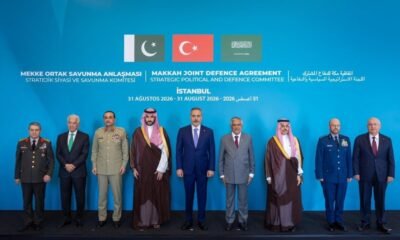
Mecca defense pact brings military chiefs together in Saudi Arabia