
Politics
Türkiye’s East Med leap leaves Tel Aviv cornered: Israeli media

Türkiye’s growing military and diplomatic clout in the Eastern Mediterranean and its landmark maritime deal with Libya are unsettling Israel, with Israeli security officials reportedly warning that Ankara’s expanding regional footprint is increasingly limiting Tel Aviv’s room for maneuver.
The Jerusalem Post reported Monday that Israel’s security establishment, including military intelligence, is closely monitoring Türkiye’s growing influence in Libya and the wider Mediterranean, viewing Ankara’s moves as increasingly constraining Israel’s regional ambitions.
The report focused on the 2019 Türkiye-Libya maritime boundaries agreement, which established a maritime corridor between the two countries and strengthened Ankara’s position in the Eastern Mediterranean.
The Israeli newspaper claimed the agreement effectively bypassed a chain of Greek islands, including Crete and Rhodes, while Türkiye’s growing military presence in the region has further shifted the strategic balance in the Mediterranean.
It also highlighted Türkiye’s military support for Libya, saying Ankara has since expanded its presence at Libyan ports, strengthened its aerial footprint and secured opportunities to explore energy resources in the country.
According to the report, Türkiye’s expanding military infrastructure and operational reach have given Ankara greater influence over strategic maritime routes extending well beyond its shores.
The newspaper also linked Israel’s concerns to planned regional energy projects, arguing that Türkiye’s maritime position could complicate a proposed natural gas pipeline connecting Israel with the Greek Cypriot administration and Greece before reaching Europe.
Ankara has maintained that projects crossing areas covered by its maritime jurisdiction require Türkiye’s consent and has repeatedly stressed that it will protect its rights and interests in the Eastern Mediterranean.
The report said the issue is particularly significant for Israel because some 98% of its imports arrive by sea, making maritime access a major economic and security concern.
Against Türkiye’s expanding regional influence, Israeli security officials cited by the newspaper described the emerging situation in stark terms: “Türkiye is cornering Israel.”

Four hundred eighty-eight years after the Battle of Preveza, Türkiye is becoming a force to reckon with in terms of naval might, thanks to its growing local defense industry. On Sunday, the country celebrated the anniversary of the Ottoman victory against the Holy League of European forces off the coast of Greece.
On the occasion, which is also celebrated as Turkish Naval Forces Day, the navy’s 15 vessels paraded across the Bosporus amid cheers. Turkish naval commanders and local authorities joined citizens in saluting the ships before a visit to the tomb of Barbaros Hayreddin Pasha, the legendary Ottoman admiral who led the victory at Preveza and was buried in Beşiktaş overlooking the Bosporus.
In a message on the occasion, the National Defense Ministry said the Turkish navy demonstrated its power 488 years ago to the world and today continues accomplishing tasks “without fear and heroically, to protect our maritime rights and interests.”
“We remember with gratitude Barbaros Hayreddin Pasha, our revered ancestors, our commander-in-chief Mustafa Kemal Atatürk, all martyrs and veterans,” the ministry said in a statement.
Alparslan Bayraktar, the minister of energy and natural resources, also issued a message on the occasion, noting that Türkiye continued “accomplishing new sagas in the Blue Homeland,” referring to Türkiye’s maritime borders concept. Bayraktar said that the victory in 1538 inspired Türkiye’s energy independence struggle in the Blue Homeland. Türkiye has developed a new energy fleet in recent years, including new seismic research vessels named after Barbaros and other respected admirals of the Ottoman navy. Bayraktar said that, with six drill ships and two seismic research ships, Türkiye now had the world’s fourth-largest energy fleet.
The Battle of Preveza was the culmination of a struggle across the Mediterranean in the 16th century between the rapidly expanding Ottoman Empire and the Holy League, formed by Pope Paul III as an alliance of the Papal States, the Republic of Venice, the Knights of Malta and Spain. It was requested by the Republic of Venice, which had lost several islands to the Ottoman navy in the Mediterranean, and convinced others to confront what they perceived as a threat to their commercial and military interests in the Mediterranean.
The Ottoman navy was led by Barbaros Hayreddin Pasha, while Genoese admiral Andrea Doria led the Holy League’s combat forces.
Doria laid siege to Preveza Castle first before retreating to Corfu, which was controlled by Venice, when the Ottoman navy arrived. Ottoman forces prompted the Holy League navy to fight in the open sea in the Gulf of Arta, in the Ionian Sea. Although outnumbered, the Ottoman forces successfully engaged with the Holy League navy, which consisted of 262 ships. Weather conditions also played a role in limiting the maneuvers of Doria’s forces, which were mostly composed of sailing ships, allowing Barbaros’ more mobile galleys to launch attacks easily. Doria eventually gave in, fleeing in the dark after many ships he commanded were sunk by the Ottomans.
Republican People’s Party (CHP) Chair Kemal Kılıçdaroğlu returned to office three years after he lost an intra-party election. Four months into his reinstatement, the leader of the opposition juggernaut, which lost most of its lawmakers to the newly established New Party (YP), told journalists he would not “stay as chair for the duration of my lifetime.”
“I never said I would seek candidacy. I respect any candidate,” he said Sunday in Bolu, a northern city where senior CHP members went for a retreat to assess a future road map.
Kılıçdaroğlu was engaged in a bitter row with former CHP Chair Özgür Özel after the latter was removed from office by a court ruling over allegations that his associates were involved in vote-buying in the intra-party election that ended Kılıçdaroğlu’s lengthy reign in the party. After returning to his former post, Kılıçdaroğlu vowed to cleanse the party of corruption, referring to the arrests and detentions of a number of CHP mayors on charges of municipal corruption.
Kılıçdaroğlu said Sunday that he was intent on returning the CHP “to a safe harbor, to the values it had when it was founded.”
“The CHP has to preserve its moral values,” he said.
He underlined that the CHP was dragged into “a dirty process” and that politics paid the price.
“Confidence in politics is shaken. The CHP is a party that founded this state and had high moral values. But it distanced itself from these values,” he said. The CHP is Türkiye’s oldest party and was founded by Mustafa Kemal Atatürk, the founder and first president of the Republic of Türkiye.
Kılıçdaroğlu said the resignation of several members, namely those supporting Özel after he founded his New Party in July, had “accomplished, to a large extent, the cleansing task.”
The CHP now aims to hold a new intra-party election, and several figures have already announced their intention to run in a possible race.
Greek media has outlined a hypothetical military scenario in which Athens could consider a “preemptive strike” against Türkiye if it determined that a Turkish attack was imminent, according to a report published by the Greek newspaper Ta Nea.
The report cited remarks by Greek Chief of Defense Gen. Dimitrios Houpis in December 2025 referring to Greece’s ability to carry out preemptive strategic strikes at long range.
Drawing on military analysts and sources, Ta Nea described a hypothetical crisis in the Aegean triggered by disputes over maritime jurisdiction or exploration activities. Under the scenario, a large-scale mobilization of Turkish forces could be interpreted by Athens as preparations for an imminent attack.
Greek intelligence would first seek to verify Turkish military movements using surveillance capabilities and satellite data provided by allied countries before the country’s national security council, KYSEA, convened to assess the situation.
The report acknowledged the risks of acting on inaccurate intelligence, noting that the side launching the first strike could face accusations of aggression and lose international diplomatic support.
In a potential second phase, the report said Greece could seek to disrupt Turkish radar and communications through electronic warfare while using Rafale and F-16 Viper fighter jets against military infrastructure. Spike NLOS and Exocet missile systems could also be deployed against Turkish amphibious forces, depending on the scenario.
Ta Nea said a possible Turkish response could involve missiles and unmanned aerial vehicles, with Greece relying on Patriot air defense systems and SeaFire radars aboard its new Kimon-class frigates.
The scenario also envisaged the United States, NATO and the European Union pushing for a cease-fire after the first 24 hours of hostilities.
In recent years, Greece has ordered four French FDI frigates and also plans to modernize its four MEKO-class frigates.
In parallel, the country is expanding its air and missile defense capabilities. Recent projects include the purchase of the multilayered “Achilles Shield” system, which is set to include Israeli systems from Rafael and Israel Aerospace Industries, as well as additional drones and reconnaissance technology. The agreement with Italy provides for the possibility of acquiring further FREMM frigates in the future, the Greek press reported.
Under the Achilles Shield deal, Israel will supply Greece with the David’s Sling and SPYDER systems, as well as the BARAK MX system along with MMR multi-mission radars for air surveillance manufactured by IAI unit ELTA Systems.
Türkiye, meanwhile, is currently building more than 50 warships simultaneously for both domestic and foreign customers, according to a statement last month by its Naval Forces commander.
The country also plans to inaugurate its locally made aircraft carrier by the end of 2027. The carrier will have the capacity to host 52 aerial vehicles and 2,500 personnel.
Under President Recep Tayyip Erdoğan’s leadership, Türkiye has pursued a rapprochement with Greece after decades of lukewarm diplomatic ties and nearly two decades after the countries came close to an all-out war over their Aegean dispute. Erdoğan and Greek Prime Minister Kyriakos Mitsotakis have met several times over the past two years, but their warm meetings have done little to change the state of relations over the maritime dispute.
Türkiye has emerged as an active player in the international security architecture while strengthening its military capabilities and pursuing diplomatic efforts to address regional conflicts, Defense Minister Yaşar Güler said Sunday.
Speaking during a series of visits in Istanbul’s Maltepe district as part of the “Türkiye Century Meetings,” Güler said shifting global security dynamics and conflicts in Türkiye’s neighborhood have highlighted the importance of strong state institutions, national unity and political stability.
“At such a challenging time, Türkiye, under the leadership of our president, has preserved its peace and security while becoming one of the active actors in the international security architecture,” Güler said.
He pointed to Türkiye’s diplomatic engagement through the United Nations and NATO, saying Ankara has sought to contribute to peace, stability and the resolution of regional crises.
Güler cited Türkiye’s efforts concerning Iraq and Syria, Libya, the Caucasus and Black Sea security, while saying Ankara continues to advocate international law and humanitarian principles in conflict zones, particularly in Palestine.
The minister also highlighted the Turkish Armed Forces’ role in supporting the country’s foreign and security policy, describing the military as one of Türkiye’s most important sources of strength.
Güler also underlined that investments in Türkiye’s domestic defense industry have reduced dependence on foreign suppliers while expanding the military’s operational capabilities and deterrence. Türkiye has developed a range of domestically produced systems, including warships, unmanned aerial vehicles, missiles, air defense systems and land, air and naval platforms, he stated.
He said Türkiye’s diplomatic influence was also underpinned by its ability to maintain an effective and deterrent military presence both domestically and beyond its borders.
Türkiye on Monday welcomed its acceptance as an associate observer to the Ibero-American Conference.
“We welcome the acceptance of Türkiye’s application to become an Associate Observer to the Ibero-American Conference at the Meeting of Ibero-American Foreign Ministers held during the High-Level Week of the 81st session of the United Nations General Assembly,” the Foreign Ministry said in a statement.
The ministry thanked all member states, particularly Spain, the current chair of the conference, as well as the Ibero-American Secretariat, for their contributions.
Türkiye will participate as an associate observer at the 30th Ibero-American Conference Summit, scheduled for Nov. 4-5 in Madrid, Spain, the statement said.
The ministry added that Türkiye would continue to deepen its cooperation with the conference’s members within the framework of its multidimensional policy toward Latin America and the Caribbean.
According to Turkish diplomatic sources, the decision is expected to be formalized during the summit of heads of state and government in November.
Türkiye formally submitted its application on July 3 through a letter from Foreign Minister Hakan Fidan to Ibero-American Secretary-General Andres Allamand.
The status is expected to help Türkiye deepen political dialogue with member countries and expand cooperation in trade, culture and development.
Angola and India also had their applications for associate observer status approved at the foreign ministers’ meeting.
Ibero-American Conference
Established through founding summits held in Guadalajara, Mexico, in 1991 and Madrid in 1992, the Ibero-American Conference brings together 22 countries from Latin America and the Iberian Peninsula. Its General Secretariat is based in Madrid.
The conference allows non-member countries to participate as associate observers and international organizations as consultative observers.
Other countries holding associate observer status include Belgium, France, Germany, Haiti, Hungary, Italy, Japan, Luxembourg, Morocco, the Netherlands, the Philippines and South Korea.
Associate observers can participate in summits of heads of state and government, sectoral ministerial meetings, and meetings of foreign ministers, national coordinators and cooperation officials.
Russian Foreign Minister Sergei Lavrov underlined that Türkiye has the option to transfer its S-400 air defense systems to another country and that Moscow would weigh any proposal.
Türkiye acquired the S-400 system from Russia in 2019, after talks for air defense deals with Western countries fell through. The purchase triggered sanctions by its NATO ally, the United States, which removed Türkiye from its F-35 program the same year. Since then, Türkiye has tried to revive the F-35 deal, but it came close to success only after Donald Trump began his second term in the White House. During last July’s NATO summit in Ankara and talks with President Recep Tayyip Erdoğan, Trump signaled that Türkiye may return to the fighter jet program, sparking a debate over the fate of the S-400 systems. Media outlets have reported that Türkiye was considering reselling the S-400 to a third country, reportedly the United Arab Emirates (UAE).
Speaking on the sidelines of the U.N. General Assembly in New York, Lavrov said he would not comment much on the matter but that there were several “possibilities.” He reiterated that Türkiye needed Russia’s approval for any resale.
“The country the systems will be transferred to should act responsibly and have friendly relations with the Russian Federation. Thus, we can ensure that those systems are not delivered somewhere else from there. This is of critical importance,” Lavrov was quoted as saying.
Russia’s top diplomat said Europeans purchased weapons from all across the world and signed agreements banning their resale, but they discovered that European countries eventually transferred those weapons to Ukraine. He said they needed assurance that such “violations” would not happen after the transfer of the S-400 systems.


-

 Sports3 days ago
Mbappe lifts France past Türkiye 1-0 in Zidane’s winning debut
-

 Sports3 days ago
Busenaz Sürmeneli wins 2nd straight European boxing gold
-
 Economy2 days ago
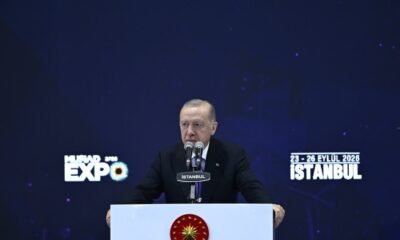
Erdoğan touts Türkiye’s export surge as MÜSİAD EXPO wraps up
-

 Sports2 days ago
Mercedes’ Russell holds off Verstappen to bag Azerbaijan GP win
-

 Sports2 days ago
Every Formula One world champion from 1950 through 2025
-

 Sports2 days ago
Man City found guilty of 114 of 115 alleged financial breaches
-

 Economy1 day ago
Europe turns to tax breaks, subsidies to tackle record-high fuel prices
-
 Politics1 day ago
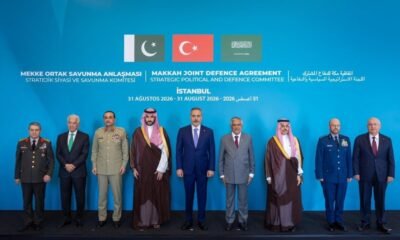
Mecca defense pact brings military chiefs together in Saudi Arabia