
Politics
Fidan meets Putin on ending war with Ukraine

MOSCOW
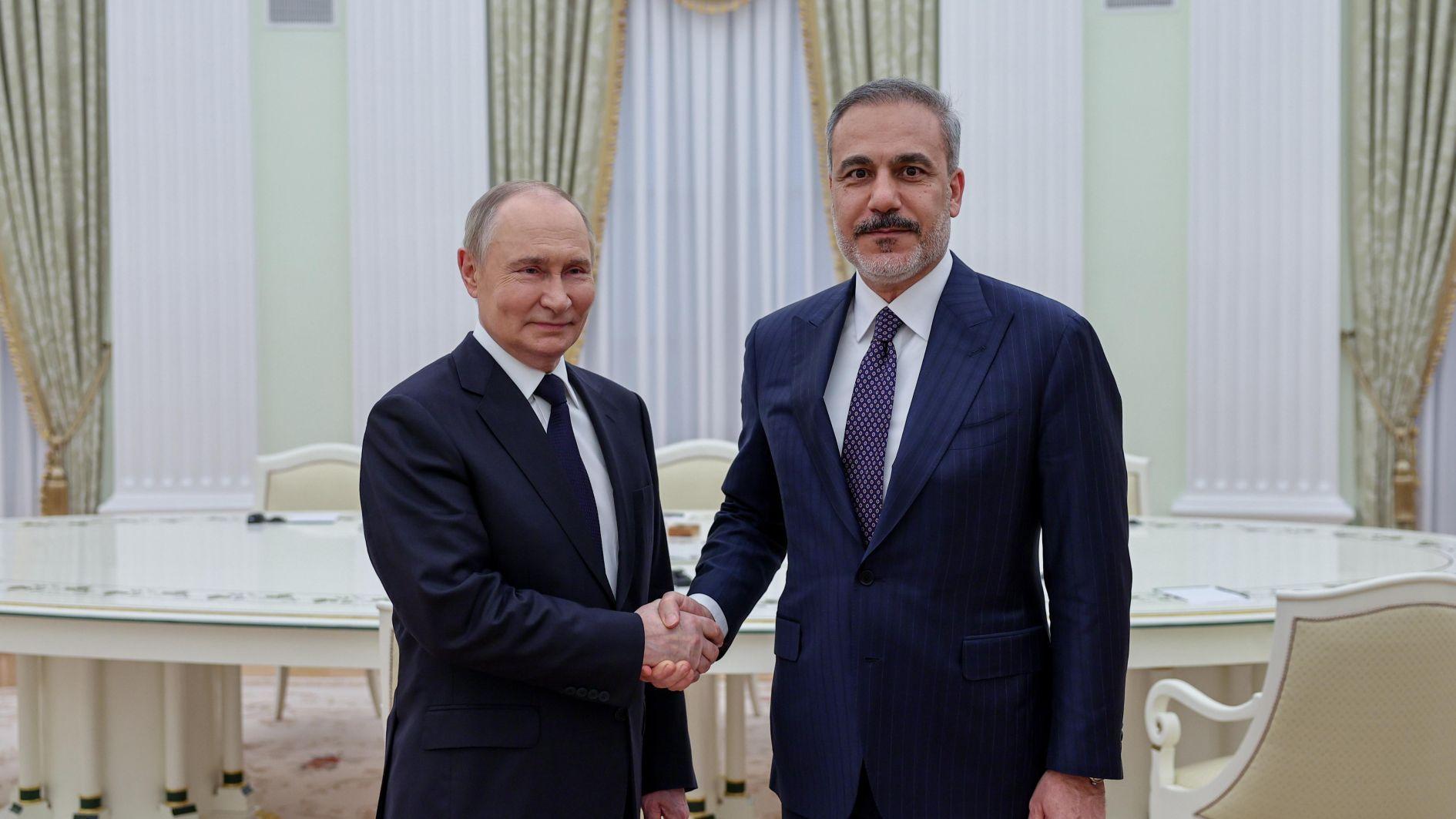
Foreign Minister Hakan Fidan held meetings with senior Russian officials in Moscow on May 26, including President Vladimir Putin, amid intensified efforts to end the war between Russia and Ukraine following historic talks between the two warring sides in Istanbul.
During the meeting with Putin, the latest developments in Syria and mediation in the Ukrainian war were discussed.
Fidan arrived in Moscow on May 26 for a two-day trip, according to a statement by the Turkish Foreign Ministry.
On his first day, he was scheduled to be received by Putin, his aide Vladimir Medinsky and Foreign Intelligence Service head Sergey Narishkin, according to the sources.
Fidan will meet his counterpart Russian Foreign Minister Sergey Lavrov on May 27.
The sources have underlined that Fidan and his interlocutors will discuss all aspects of bilateral relations, regional and global matters, particularly the ongoing war and the situation in the Middle East.
Fidan’s trip to Moscow comes after Türkiye hosted the first direct talks between the two warring parties in Istanbul after three years.
Before Fidan’s meetings, Kremlin spokesman Sergey Peskov expressed Russia’s gratitude for Türkiye over the meetings in Istanbul.
“We are grateful to Türkiye for providing ideal conditions for the negotiations in Istanbul,” Peskov stressed, informing that Ukraine will be the top issue during talks with Fidan.
Peskov also said necessary works should be done for the next round of talks with Ukraine but described the process as uncertain.
Türkiye proposes to serve as an honest broker between Russia and Ukraine.
Erdoğan, in his telephone conversations with U.S. President Donald Trump and Putin as well as with Ukraine President Volodymir Zelensky, who came to Ankara in mid-May, reiterated Ankara’s readiness to contribute to peace and stability in the region.
Türkiye condemned a drone attack on a power distribution station in the Saudi city of Medina that supplies electricity to the Prophet’s Mosque, reiterating its support for Saudi Arabia amid renewed regional tensions.
Ömer Çelik, spokesperson for Türkiye’s ruling Justice and Development Party (AK Party), condemned the attack on Friday, saying targeting infrastructure serving the Prophet’s Mosque was unacceptable.
“Attacks targeting our sacred values are illegitimate acts directed against all Muslims,” Çelik said in a social media post, adding that Türkiye strongly supported Saudi Arabia’s security and stability.
The targeted facility supplies electricity to the Prophet’s Mosque, Islam’s second-holiest site. The attack put one transformer out of service but did not affect the electricity network.
Türkiye’s Foreign Ministry also strongly condemned the attack, saying strikes targeting civilian infrastructure and threatening Saudi Arabia’s sovereignty and security should “cease immediately and unconditionally.”
The ministry reiterated Türkiye’s support for Saudi Arabia and called on parties to avoid steps that could further escalate tensions in the region.
“We reaffirm our strong support for Saudi Arabia and emphasize the need to avoid any steps that would further escalate tensions in the region,” the statement said.
Presidential Communications Director Burhanettin Duran on Friday separately condemned the strike and said Türkiye would continue to stand by Saudi Arabia.
The Saudi-led coalition said an investigation and examination of drone wreckage indicated Houthi involvement in the Sept. 29 attack.
Coalition spokesperson Maj. Gen. Turki Al Maliki said the targeted facility supplies electricity to the Prophet’s Mosque, one of Islam’s holiest sites.
Saudi Arabia said two weeks ago it had intercepted and destroyed a Houthi drone south of Mecca before it entered restricted airspace over the Muslim holy city. The coalition described that incident as the second Houthi attempt to target Mecca since 2017.
Earlier on Thursday, the Organisation of Islamic Cooperation (OIC) and several Arab countries, including the United Arab Emirates (UAE), Jordan, Kuwait and Bahrain, also condemned the attack on Medina.
The OIC described the targeting of vital infrastructure and facilities as “a dangerous escalation and a blatant violation of the sanctity of holy sites,” as well as international and humanitarian laws and norms.

Bashiqa-Zilkan, a key Turkish base in Iraq, will soon be handed over to Iraqi authorities while Turkish troops are expected to withdraw from the country. The development, which comes amid the withdrawal of U.S. forces from the country, which remained there as part of an anti-Daesh coalition, signals the start of a new era for Iraq and Türkiye. The Ministry of National Defense said in a statement on Thursday that the handover of the base did not mean an end to cooperation with Iraq and, on the contrary, Türkiye would continue supporting Iraq’s security and stability.
Türkiye and Iraq agreed earlier this month to deepen security cooperation, restore full Iraqi state authority in Sinjar and begin the gradual handover of the Bashiqa-Zilkan military base to Baghdad under an agreed timetable.
President Recep Tayyip Erdoğan and Iraqi Prime Minister Ali al-Zaidi announced the steps in a joint statement following talks in New York on the sidelines of the 81st United Nations General Assembly.
The ministry said Türkiye welcomed steps to ensure state authority in Sinjar. The base was set up in 2015 to help Iraq fight against Daesh and later maintained its presence when the terrorist group PKK sought to replace Daesh following the liberation of Sinjar.
“These steps will contribute to normalization of the region, establishing an environment of security and stability and a terror-free region,” the ministry said, using an expression referring to Ankara’s “terror-free Türkiye” initiative, which aims to disarm the PKK.
The statement also said it was decided to gradually hand over the compound to the central government in Baghdad, “based on improvement of security in Sinjar.”
“Our country, as it did in the past, stands with our neighbor Iraq in terms of maintaining an environment of security and stability. Throughout future contacts, we are planning to take steps that will further advance military and security cooperation. We will continue supporting Iraq’s armed forces in increasing military capacity, sharing know-how in counterterrorism and in the fields of military training and defense industry cooperation, based on bilateral agreements,” the ministry stated.
Ayhan Sarı, an assistant professor at the Turkish-German University and a security and foreign policy expert at the Turkish Research Foundation (TAV), noted that Türkiye’s withdrawal was linked to ending the PKK’s presence in Sinjar and the re-establishment of Baghdad’s authority there.
Sarı told Daily Sabah that Türkiye has been in Iraq as an exercise of its right to self-defense under international law, particularly Article 51 of the United Nations Charter, which recognizes the right to individual and collective self-defense against armed attacks. “Türkiye’s presence in Iraq has been due to the PKK threat in the north. (The dissolution) of the PKK will remove the need to remain in Iraq,” Sarı said.
He noted that the PKK and other terrorist groups had, for years, filled the power vacuum that emerged in Iraq’s northern region following the beginning of the Iraq War.
“Iraq’s central government claims it can find a solution to this vacuum through recent steps and establish full authority within its borders after the U.S. withdrawal,” Sarı said.
A U.S.-led coalition deployed in Iraq more than a decade ago against Daesh formally concluded its mission on Wednesday. Daesh was largely expelled from Iraq and Syria, also thanks to Türkiye’s cross-border operations in Assad-era Syria, but U.S. forces remained. Washington and Baghdad reached an agreement two years ago to wind down the mission.
Sarı said it was only natural that Türkiye was supportive of Iraq’s steps to ensure security on its own, since Ankara was committed to developing good relations with its neighbors and centered its foreign policy on peace and stability.
“As it did in Syria, Türkiye sides with central authority, stability and security in Iraq. Türkiye will support this move and will do whatever it can to ensure that this mission succeeds in maintaining stability and security, based on its neighborly relations,” he said.
Sarı added that Iraq’s efforts were compatible with Türkiye’s foreign policy and plans. “Iraq’s success will also mean the complete expulsion of the PKK from that country. This expulsion, removal of this malignant tumor between Türkiye and Iraq, will certainly add momentum to Turkish-Iraqi relations,” he also stated.
Speaking at the inauguration of the new legislative year at the Turkish Parliament on Thursday, President Recep Tayyip Erdoğan hailed a law passed by Parliament on terror-free Türkiye, which involves the disarmament of the terrorist group PKK.
“Consensus on a terror-free Türkiye has upset the country’s foes. (Terror-free Türkiye) is already having a deterrent effect on Türkiye’s foes and is empowering the country,” Erdoğan said.
The president also urged other political parties to strengthen the “home front” amid regional tensions and reach a “grand Türkiye consensus.”
The Law on Strengthening National Solidarity and Social Integration was approved by Parliament in August following months of political consultations over the government’s terror-free Türkiye initiative. The 12-article legislation received broad parliamentary backing, with 468 lawmakers voting in favor, 88 against and six abstaining. It mainly involves deferral of sentences and prosecution, as part of the initiative that paved the way for the dissolution of the PKK.
For decades, the PKK remained the main security threat for Türkiye, and its violent campaign is blamed for the deaths of thousands of people and immense economic losses, especially in southeastern Türkiye. Apart from small nationalist parties, almost all political parties openly supported the initiative, something rare in polarized Turkish politics.
“The era of opposition solely based on opposing what the government did is over. It is a grave mistake to reduce politics to antagonizing the rivals, to a war of attrition, instead of making it a race in offering the best public services. Regional and global developments require us to pursue a new style of politics,” Erdoğan told Parliament amid constant applause from lawmakers from his Justice and Development Party (AK Party). The main opposition New Party (YP) left Parliament’s general assembly hall as Erdoğan took the floor.
“We have two options now: We will either continue with the old way of politics focusing on polarization, or we will build new politics based on finding common ground, finding consensus amid competition,” he said.
“If we are meant to make Türkiye great and strong again, if we are meant to utilize historic opportunities, we have to adapt to this paradigm shift altogether and without losing more time,” he said.
The president said they did not expect all political parties to fully align or have the same opinion.
“Different views are certainly the wealth of Türkiye, Turkish democracy. But all political parties should prioritize Türkiye. Every party should draw power from its own dynamics, its grassroots, to carry out ‘Türkiye-oriented politics,'” Erdoğan said.
“Reconciliation and tolerance should replace conflict and polarization. We have to find common ground on matters essential for every member of our nation. This is what we call the ‘grand Türkiye consensus,'” Erdoğan added.
New constitution
The president also focused on drafting a new constitution. “The goal of a new and civilian constitution is a struggle for Turkish democracy to prove its maturity. Our esteemed Parliament is competent and authorized to draft a constitution under all circumstances and in every period. A new constitution that will broaden Türkiye’s horizons will be the product not of a politics of polarization, but of a new politics based on competition within consensus. Our nation’s longing for a new constitution must not be held hostage by manufactured fears. Our position regarding the first four articles of the Constitution currently in force is clear. Rolling up our sleeves for a new and civilian constitution worthy of the ‘Century of Türkiye’ is a genuine test of sincerity for everyone. I hope the current legislative year will be a year of constitutional reform that expands Türkiye’s opportunities and potential,” he said.
Since the founding of the Republic of Türkiye, constitutional design has served as the backbone of the country’s legal system. The current Constitution, adopted in 1982, has been repeatedly amended over the decades, most notably in 2017, when a national referendum paved the way for the country’s transition from a parliamentary model to an executive presidential system.
Despite numerous amendments over the decades, replacing the 1982 Constitution with a new, civilian-drafted charter remains a prominent issue in Türkiye’s political debate.
Erdoğan and Parliament Speaker Numan Kurtulmuş have repeatedly advocated for a new civilian constitution, arguing that the existing charter retains the legacy of military rule under which it was drafted despite extensive subsequent amendments.
Türkiye condemned Thursday a drone attack by Houthis on a power station in the Muslim holy city of Medina, reaffirming its support for Saudi Arabia.
The targeted facility supplies electricity to the Prophet’s Mosque, Islam’s second-holiest site. The attack put one transformer out of service but did not affect the electricity network.
The Saudi-led coalition in Yemen said on Thursday that an investigation and examination of drone wreckage confirmed Houthi involvement in planning and carrying out Tuesday’s attack.
“We strongly condemn the Houthis’ attack on civilian infrastructure serving the Prophet’s Mosque in Medina,” the Turkish Foreign Ministry said in a statement.
“These provocative attacks, which threaten Saudi Arabia’s sovereignty and security and target the sacred values of the Islamic world, must cease immediately and unconditionally,” it said.
Saudi Arabia said two weeks ago it had intercepted and destroyed a Houthi drone south of Mecca before it entered restricted airspace over the Muslim holy city. The coalition described that incident as the second Houthi attempt to target Mecca since 2017.
The Foreign Ministry emphasized the need to avoid any steps that would further escalate tensions.
“We reaffirm our strong support for Saudi Arabia and emphasize the need to avoid any steps that would further escalate tensions in the region,” the statement said.
Earlier Thursday, the Organization of Islamic Cooperation (OIC) and several Arab countries, including the United Arab Emirates, Jordan, Kuwait and Bahrain, also condemned the attack on Medina.
The OIC described the targeting of vital infrastructure and facilities as “a dangerous escalation and a blatant violation of the sanctity of holy sites,” as well as international and humanitarian laws and norms.
The organization affirmed its full solidarity with Saudi Arabia in measures taken to protect its territory, security and stability, defend Islamic holy sites and safeguard citizens and residents.
The UAE Foreign Ministry said the drone attack constituted “a flagrant violation of the sovereignty of Saudi Arabia and a threat to its security and stability.”
The Saudi-led coalition said the Medina attack was part of what it described as repeated Houthi attempts to target the Two Holy Mosques and “provoke” Muslims worldwide. It said it would continue taking measures to protect the holy sites and pilgrims.
Houthis denied the accusation.
The latest escalation is the most serious fighting between Saudi Arabia and the Iran-aligned Houthis since a U.N.-brokered truce largely halted cross-border attacks in 2022. Hostilities resumed this year after the Houthis declared a naval blockade on Saudi Arabia in July and began attacking Saudi territory and shipping, while Houthi forces also made major territorial gains along Yemen’s Red Sea coast.
Saudi Arabia has responded with airstrikes in Yemen and backed government forces fighting to push back the Houthis.
Turkish authorities detained Eyüpsultan Mayor Mithat Bülent Özmen and 27 other suspects earlier Friday as part of a corruption investigation involving the Istanbul district municipality, prosecutors said.
The Ankara Chief Public Prosecutor’s Office said detention orders were issued for 28 suspects over allegations including membership in a criminal organization, receiving and giving bribes and bid rigging.
All 28 suspects were detained in simultaneous operations carried out by financial crimes police, according to the prosecutor’s office. Authorities also conducted searches and seizures at addresses linked to the suspects and searched the Republican People’s Party (CHP)-run Eyüpsultan Municipality building.
Prosecutors said the investigation was being conducted in coordination with the Ankara Police Department’s Financial Crimes Investigation Branch.
“The investigation continues in a comprehensive and meticulous manner,” the prosecutor’s office said.
Özmen, who serves as mayor of Istanbul’s Eyüpsultan district, was among those taken into custody.
The detentions are part of an ongoing investigation, and no court has ruled on the allegations against the suspects.
Turkish Defense Minister Yaşar Güler said on Friday that security in the Caucasus could not be considered separately from the security of Türkiye, Azerbaijan and Georgia, as the three countries’ defense chiefs met in Azerbaijan to discuss regional security and military cooperation.
Güler made the remarks at the 13th Türkiye-Azerbaijan-Georgia Trilateral Defense Ministers Meeting in Shusha, attended by Azerbaijani Defense Minister Zakir Hasanov and Georgian Defense Minister Irakli Chikovani.
The ministers discussed military and defense cooperation as well as regional security developments before signing a protocol at the end of the meeting.
“The security of the Caucasus cannot be considered separately from the security of Türkiye, Azerbaijan and Georgia,” Güler stressed.
He said Türkiye remained committed to supporting the independence and territorial integrity of Azerbaijan and Georgia and was ready to deepen cooperation among the three countries in support of peace, security, stability and prosperity in the Caucasus.
Güler said the South Caucasus was undergoing a significant period of transformation and welcomed recent developments toward establishing peace between Azerbaijan and Armenia.
Türkiye believed the emerging regional environment could create new opportunities for cooperation through joint efforts by South Caucasus countries, adding that trilateral cooperation among Türkiye, Azerbaijan and Georgia had particular importance in that process, the minister noted.
Güler also pointed to energy, transportation and communications projects linking the three countries, saying they contributed not only to economic development but also to regional security and stability.
“Ensuring the security of these projects is the common responsibility of our countries,” he said.
Joint military exercises as well as training and experience-sharing activities among the three countries’ armed forces reflected that responsibility, Güler added.
Most recently, more than 3,500 military personnel from Türkiye, Azerbaijan and Uzbekistan have taken part in the joint exercises, which began Sept. 21. In addition, 130 unmanned aerial vehicles, 70 armored vehicles, 90 artillery systems and 20 aircraft are participating in the exercise, along with more than 30 electronic warfare, reconnaissance and surveillance systems.
Furthermore, Azerbaijani Defense Minister Zakir Hasanov, speaking after the meeting, described the trilateral format as an important platform for regional stability, security and development.
He said the ministers discussed prospects for expanding bilateral and trilateral cooperation, the effectiveness of existing activities and military and political developments in the region.
Hasanov stated that coordination and cooperation among the three countries had become increasingly important amid growing global political tensions, emerging challenges and economic uncertainty.
Türkiye and Azerbaijan signed several defense contracts surpassing $500 million in value, a senior official announced on Wednesday.
The deals include the supply of 14 Hürkuş-II trainer aircraft and various defense systems, said Haluk Görgün, head of the Presidency of Defense Industries (SSB).
In a statement, Görgün said the two countries, which support each other during natural disasters, wars and other times of need, were strengthening defense industry cooperation to promote regional peace and stability.
He remarked that their trust and solidarity continued to translate into concrete projects under the leadership of President Recep Tayyip Erdoğan and Azerbaijani President Ilham Aliyev.
Ahead of the trilateral talks, Güler also held bilateral meetings with Hasanov and Chikovani in Shusha. The officials discussed ways to bolster military, military-technical and military education cooperation, as well as regional security and efforts to achieve lasting peace in the region.


-
 Economy2 days ago
Türkiye’s jobless rate falls to 7.8% in August
-

 Sports2 days ago
Manchester’s streets react with shock to City’s financial scandal
-

 Economy3 days ago
UK economy Q2 growth revised slightly upward
-
 Politics2 days ago
Former mayors among arrested in major ops against corruption in Türkiye
-
 Sports2 days ago
Flydubai jet diverts after hijacking code triggers Israeli scramble
-
 Politics3 days ago
Türkiye’s top court sets deadline in New Party’s name case
-

 Economy2 days ago
US inflation rises less than expected, tempering Fed hike concerns
-
 Politics2 days ago
CHP refers 5 mayors to discipline board, seeks expulsions