
Refugees
Kurdish militants declare ceasefire in 40-year insurgency in Turkey

ISTANBUL (AP) — Kurdish militants who have waged a 40-year insurgency in Turkey declared a ceasefire on Saturday in what could mark a significant boost to President Recep Tayyip Erdogan’s government, two days after their imprisoned leader called for the group to disarm.
The announcement by the Kurdistan Workers’ Party, or PKK, comes against the backdrop of fundamental changes in the region, including the reconfiguration of power in neighboring Syria after the toppling of President Bashar Assad, the weakening of the Hezbollah militant movement in Lebanon and the Israel-Hamas war in Gaza.
People gather to watch live on a tv screen a Pro-Kurdish Peoples’ Equality and Democracy Party, or DEM, delegation members releasing an statement from the jailed leader of the rebel Kurdistan Workers’ Party, or PKK, Abdullah Ocalan, in Diyarbakir, Turkey, Thursday, Feb. 27, 2025. (AP Photo/Metin Yoksu)
While the government is yet to respond in detail to the PKK’s declaration, Erdogan warned that Turkey would “always keep our iron fist ready in case the hand we extend is left in the air or bitten.”
Speaking at a Ramadan fast-breaking dinner in Istanbul, Erdogan added: “We will continue our ongoing (military) operations, if necessary, until we eliminate the last terrorist without leaving a single stone on top of another, without leaving a single head on his shoulder.”
The conflict between Turkey and the PKK has led to tens of thousands of deaths since it began in 1984. The ceasefire is the first sign of a breakthrough since peace talks between the PKK and Ankara broke down in the summer of 2015.
The PKK declaration was published by the Firat News Agency, a media outlet close to the group, on Saturday. It referred to the insurgents’ leader, Abdullah Ocalan, who has been imprisoned by Turkey since 1999.
“We declare a ceasefire effective today to pave the way for the implementation of Leader Apo’s call for peace and democratic society. None of our forces will take armed action unless attacked,” it said, referring to Ocalan by his nickname.
Campaign of pressure on Kurds
On Thursday, a delegation of Kurdish politicians announced Ocalan’s call for the PKK to lay down its arms and disband after visiting him on his island prison.
In its statement, the PKK’s executive committee said Ocalan’s call indicated that a “new historical process has begun in Kurdistan and the Middle East.” Kurdistan refers to the parts of Turkey, Iraq, Syria and Iran inhabited by Kurds.
While stating that it would “comply with and implement the requirements of the call from our own side,” the PKK emphasized that “democratic politics and legal grounds must also be suitable for success.”
Ocalan’s call came as the main pro-Kurdish political party in Turkey has faced pressure, with several of its mayors being removed from office in recent months and replaced by government appointees.
The PKK also appealed for Ocalan to be released from Imrali prison, located in the Marmara Sea, to “personally direct and execute” a party congress that would lead to the militants laying down their arms.
‘Opportunity to take a historic step’
The peace initiative between the Turkish state and the PKK, which is considered a terrorist organization by Turkey and its Western allies, was started in October by Erdogan’s coalition partner, Devlet Bahceli, a far-right politician who suggested that Ocalan could be granted parole if his group renounces violence and disbands.
Erdogan said Ocalan’s message was a “new phase” in peace efforts in Turkey.
“There is an opportunity to take a historic step toward tearing down the wall of terror that has stood between (Turkish and Kurdish peoples’) 1,000-year-old brotherhood,” Erdogan said on Friday.
Some believe the main aim of the reconciliation effort is for Erdogan’s government to garner Kurdish support for a new constitution that would allow him to remain in power beyond 2028, when his term ends.
Bahceli has openly called for a new constitution, saying it was essential for Turkey’s future that Erdogan remain in power. Erdogan and Bahceli are reportedly seeking parliamentary support from the pro-Kurdish People’s Equality and Democracy Party, or DEM.
“There will be a series of meetings next week, including state officials and politicians, and many things will become clearer and more concrete. We hope that everything will be arranged in the next three months,” said Sirri Sureyya Onder, one of the DEM members who visited Ocalan in prison on Thursday.
Isolated attacks inside Turkey
Ocalan, 75, wields significant influence in the Kurdish movement despite his 25-year imprisonment, during which the PKK has been led by top figures who have fled and found sanctuary in the Kurdish region in northern Iraq.
In Syria, Kurdish fighters — who have ties to the PKK — have been involved in intense fighting with Turkish-backed forces on the ground there.
The leader of the U.S.-backed, Kurdish-led Syrian Democratic Forces has said Ocalan’s call for a ceasefire does not apply to his group in Syria.
The Turkish government, however, says all Kurdish groups it claims are tied to the PKK — whether in Turkey, Syria or Iraq — must disband.
In recent years, the PKK has been limited to isolated attacks inside Turkey as the Turkish military, backed by armed drones, has pushed PKK insurgents increasingly across the mountainous border into Iraq.
ANKARA, Turkey (AP) — A volunteer firefighter died on Wednesday in Turkey after helping local emergency services tackle a large wildfire in the Mediterranean coastal province of Antalya, an official said.
The fire broke out on Monday in Antalya’s Aksu district and, fanned by strong winds, quickly spread into the neighboring Kepez district, forcing hundreds of residents from their homes. The cause of the wildfire is not known.
Hasan Kahya, an Aksu resident who was helping firefighters tackle the blaze, suffered a heart attack after being affected by the smoke and later died in hospital, the district’s mayor, Isa Yildirim, said.
Two people were hospitalized with burns to their legs on Tuesday, while six others were treated for smoke inhalation. More than 100 dogs were evacuated from an animal shelter in Aksu.
Turkey’s forestry directorate said efforts to bring the blaze under control were continuing on Wednesday, adding that the fire’s intensity had been “reduced.” At least three firefighting planes, nine helicopters, 169 fire extinguishing trucks and more than 1,000 firefighters were deployed, the state-run Anadolu Agency reported.
Separately, firefighters were also tackling a wildfire in the district of Kozan, in the southern Adana province, where hundreds of residents have been evacuated, the forestry directorate said.
ANKARA, Turkey (AP) — Firefighters on Tuesday battled a wildfire in Turkey’s Mediterranean coastal province of Antalya that forced hundreds of people from their homes and injured at least two people, the state-run news agency reported.
The fire broke out Monday evening in Antalya’s Aksu district and, fueled by strong winds, quickly spread into the neighboring Kepez district, Anadolu Agency reported.
Two people were hospitalized with injuries to their legs while six others affected by smoke were treated on site, the report said.
Authorities evacuated people from at least 254 homes in Aksu and Kepez and temporarily closed a highway between Antalya and the city of Isparta, located some 130 kilometers (80 miles) north.
As flames and heavy smoke threatened the area, more than 100 dogs were evacuated from an animal shelter in Aksu and taken to safety, Antalya Municipality said. Video footage showed veterinarians treating a dog affected by the smoke.
More than 2,000 homes in the region were affected by power outages, Anadolu reported.
The agency said at least five firefighting aircraft, 10 helicopters, 110 fire extinguishing trucks and 600 personnel were deployed to battle the blaze.
Firefighters were also battling wildfires in the nearby provinces of Adana and Mersin.
BERLIN (AP) — Emma Meesseman led Belgium to the quarterfinals of women’s FIBA World Cup and Puerto Rico finished strongly to eliminate Turkey in their final group games on Monday.
Meesseman had 22 points and 10 rebounds to help Belgium top Australia 80-68 for first place in Group C.
The European champions are now off until Thursday. Australia faces a qualifying playoff on Wednesday against the loser of the Italy-China matchup that takes place later Monday.
Belgium had a five-point lead heading into the fourth quarter, before using a 11-2 run to start the period and gain a double-digit advantage. The Opals couldn’t recover.
The pro-Belgian crowd cheered on their team, waving flags in support.
Puerto Rico celebrates
Arella Guirantes led Puerto Rico with 21 points for a 75-71 win over Turkey.
Puerto Rico was trailing by seven points going into the final quarter, but Imani McGee-Stafford scored and Pamela Rosado followed with two 3-pointers to take a 59-58 lead.
Turkey power forward Elif Bayram went off early in the final quarter with what looked a left leg injury.
Turkey fans outnumbered their counterparts at Berlin’s Max-Schmeling-Halle and they tried to put off Guirantes but couldn’t stop her from securing the win with two free throws.
Puerto Rico next plays the winner between Italy-China on Wednesday.
Assist queen Allemand
Belgium’s Julie Allemand became the all-time women’s FIBA World Cup assist leader in the game. She got the record-breaking assist when Meesseman hit two free throws with 1:58 left in the first half against Australia.
FIBA gives an assist out when a player is fouled and makes the free throws. Allemand passed Laia Palau of Spain, who had 108 assists in her career.
Allemand started the tournament in eighth place all-time with 87, but had 17 assists in her first two games to get within striking distance of the record.
She finished the game with seven assists to give her 111 in World Cup play.
Decisive day
The four group winners progress directly to Thursday’s quarterfinals, while the teams that finish second and third face playoffs Tuesday or Wednesday to determine which join the group winners already through to the final eight. The bottom teams are eliminated.
Host Germany (1-1) faces Mali (1-1), and Spain (1-1) plays Japan (1-1) later with all scenarios open in Group A. Any one of the four teams can win the group and progress to the quarterfinals or finish bottom and be eliminated.
France (2-0), already through to the quarterfinals, plays already eliminated Nigeria (0-2) later, with Hungary and South Korea (both 1-1) contesting second place in Group B.
Italy (1-1), after coming close to upsetting the United States Sunday night, faces China (1-1) to decide second place in Group D. The U.S. (2-0) has already advanced to the quarterfinals before its final group game against the Czech Republic, which was eliminated after two losses.
___
See AP’s full WNBA coverage here
BERLIN (AP) — China needed overtime to edge the Czech Republic 74-70 in a thrilling game at the Women’s Basketball World Cup on Sunday.
Han Xu scored 22 points and drew China level at 53-53 in the final quarter after her team had trailed for most of the game.
Eliška Joklová put the Czechs 64-59 up with 27 seconds left only for Luo Xinyu to respond with a 3-pointer and Yang Shuyu to level at 64-64 with 3 seconds to go – after Joklová missed two free throws. There was still time for Joklová to miss another chance to clinch the win.
Yang also completed the scoring in overtime for China, which failed to get the most from 7-foot-3 Zhang Ziyu. The 19-year-old sensation could only score three points in her second game after 13 on her World Cup debut against the United States on Friday.
“She has very great talent and we need to fix how we play together,” Yang said of the teenager’s performance. “Today everybody could see that we did not play so well with her, and we have to fix it.”
China (1-1) next faces Italy on Monday in a game that will likely decide second place in Group D. The Czech Republic (0-2) faces elimination after two losses before its final group game against the United States (2-0).
The U.S. was playing Italy (0-1) later Sunday with Caitlin Clark, Angel Reese and Paige Bueckers bidding to stretch the Americans’ winning run to 32 games. The U.S. hasn’t lost a game at the World Cup since the semifinal game of the 2006 tournament.
Belgium advances
Emma Meesseman completed the scoring as European champion Belgium (2-0) booked its place in the final phase with a comfortable 76-64 win over Puerto Rico (0-2).
Imani McGee-Stafford finished with 25 points for Puerto Rico, which lost against Belgium for the third time at a World Cup.
Maxuella Lisowa Mbaka was top scorer for the Belgians with 16 points, followed by Julie Vanloo with 15. Meesseman finished with 6.
Australia makes it 2 from 2
Ezi Magbegor scored 21 points as Australia reached the final phase with a physical 87-71 win over Turkey earlier.
Turkey, led by Sevgi Uzun with 24 points, was down 8-0 at the start but fought back after a timeout to lead 15-14. That was brief, however, as the Opals rallied to end the first quarter 21-15 up and did not relinquish the lead for the rest of the game.
Turkey’s Goksen Fitik went off with what appeared to be a right-ankle injury in the third quarter but she returned in the fourth.
The Australian team features seven World Cup debutants. Team captain Sami Whitcomb of the WNBA’s Phoenix Mercury had to withdraw before the tournament with a lingering knee injury.
Australia (2-0) next faces Belgium on Monday for a showdown that will decide which team progresses directly to the quarterfinals as group winner. Australia, after two wins, is already assured of at least a playoff place in the final phase of the competition.
___
See AP’s full WNBA coverage here
ATHENS, Greece (AP) — Greece will press ahead with its strategic defense cooperation with Israel but also wants to deepen relations with other states in the Middle East, Prime Minister Kyriakos Mitsotakis said Sunday.
Greece-Israeli ties and defense, security and energy cooperation have become increasingly close over the past decade and Mitsotakis enjoys a friendly rapport with his counterpart, Benjamin Netanyahu. Shared concerns about Turkey have helped boost ties. The two countries signed a 3-billion-euro ($3.5 billion) deal on Aug. 31 for Israel to build an air defense shield in Greece.
Mitsotakis told reporters in Thessaloniki that Greece is only one of five NATO countries spending at least 3.5% of its GDP on core defense.
Greece’s traditionally high spending has been fueled by almost constant tensions with Turkey, and its questioning of Greek sovereignty over parts of the Aegean Sea and the Eastern Mediterranean. Greece recognizes only the demarcation of the two countries’ respective maritime zones as an issue to be negotiated or sent to international arbitration.
Asked about U.S. President Donald Trump’s expressed desire to sell the advanced F-35 multirole combat aircraft to Turkey, Mitsotakis replied that he will not tell the U.S. what to do, but noted that legal obstacles remain as Turkey was sanctioned for buying the S-400 air defense system from Russia.
Greece will take delivery of its first 20 F-35s in late 2028, with an option to buy 20 more.
Mitsotakis also said he planned to visit Saudi Arabia soon, and that the recently concluded Mecca Joint Defense Agreement among Pakistan, Saudi Arabia and Turkey changes nothing in Greece’s relations with Riyadh.
Greece has maintained an air defense battery in Saudi Arabia since 2021, and has used its Patriot missiles four times since July to down drones and ballistic missiles, allegedly from Yemen, aimed at the kingdom’s oil refineries.
Mitsotakis will visit Cairo on Tuesday for talks with Egyptian President Abdel-Fatah el-Sissi.
——-
Associated Press writer Costas Kantouris in Thessaloniki, Greece, contributed to this report.
WASHINGTON (AP) — The Trump administration announced Friday that it has imposed sanctions on a Turkish financial institution as part of its latest effort to sever “critical financial lifelines” for the Iranian government.
The actions against Golden Global Yatirim Bankasi Anonim Sirketi come after Treasury Secretary Scott Bessent last week launched “Operation Economic Outcast, ” Washington’s new effort to isolate already heavily sanctioned Iran from its remaining trading partners to try to get it to capitulate to U.S. demands after more than six months of war.
The Treasury Department accused the Turkish bank and its entities of being established to enable Iran’s efforts to transfer oil revenues from China to Turkey, where they could then be converted to cash and gold. It also said the institution “knowingly offered” banking services to Iranian financial entities, including those already sanctioned by the U.S. government in 2022 for funneling Tehran’s oil sales.
Bessent, who had told The Associated Press earlier this week that another bank would face economic penalties, said financial institutions with ties to Iran will “continue to find out the hard way that we are serious about Operation Economic Outcast.”
“While we hope no more banks will need to be sanctioned, that ultimately depends on how quickly the international community comes to its senses and ceases support of the murderous Iranian regime,” he said in a press release Friday. “We know who you are, we know where you are, and we will continue to take action together with our allies and partners until we have buried the head of the Iranian snake.”
But so far, the goal to force those that still do business with Iran to cut off financial ties or face U.S. retaliation has fallen flat, with promises of an “economic D-Day” for a group of countries that could include China and India quickly turning into warnings and negotiations with Iran’s trading partners.
Bessent had previously told reporters that he wanted countries to have an opportunity to shift away from Iran before it was too late in a bid to avoid upending the global financial system.
The Trump administration’s reluctance to penalize major trading partners that still do business with Iran was on display last week when the U.S. took steps to limit an Egyptian bank’s operations in the United Arab Emirates but stopped short of imposing sanctions.
The U.S. also has resumed military strikes in recent days, prompting Iranian retaliation in the region. It’s unclear what the outcome of the two-pronged strategy will be for President Donald Trump, who has struggled to end an unpopular war with an intransigent Iranian government as energy prices rise and pose problems for Republicans before November’s midterm congressional elections.
Targeted in the latest U.S. sanctions is Golden Global Investment Bank, which was founded in 2019 as Turkey’s first investment bank to offer “banking services and alternative financing methods” to foreign companies, according to its website.
The Istanbul-based bank, which is largely unfamiliar to most Turks, says it aims to increase Turkey’s foreign trade through target markets in neighboring countries.
The Treasury announcement came a day after Turkey’s state-run Halkbank declared it had reached a settlement with the U.S. Justice Department in a nine-year case focused on violating sanctions with Iran.
In that case, senior officials at Halkbank were said to have illegally moved about $20 billion worth of Iranian oil revenues. U.S. prosecutors claimed high-ranking Turkish government officials received millions of dollars in bribes to protect the scheme.
The Halkbank case caused a rift in U.S.-Turkey relations, with Turkish President Recep Tayyip Erdogan personally lobbying the White House to have the case dropped.
___
Wilks reported from Istanbul.


-

 Sports2 days ago
Mercedes’ Russell holds off Verstappen to bag Azerbaijan GP win
-

 Sports2 days ago
Every Formula One world champion from 1950 through 2025
-

 Sports3 days ago
Man City found guilty of 114 of 115 alleged financial breaches
-
 Economy3 days ago
Erdoğan touts Türkiye’s export surge as MÜSİAD EXPO wraps up
-
 Politics1 day ago
Türkiye pursues dialogue, diplomacy at UN General Assembly
-
 Economy1 day ago
Türkiye bolsters ‘agro diplomacy’ to minimize impact of geopolitical risks
-
 Economy2 days ago
US, China agree to AI dialogue, tariff cuts on $30B in goods
-
 Sports1 day ago
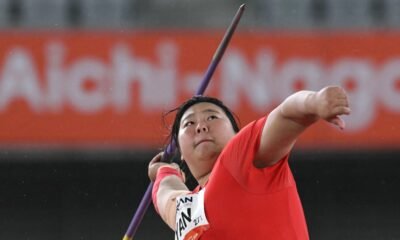
China teen takes record javelin gold to light up ‘sad’ Asian Games