
Politics
Russia, Ukraine agree to new prisoner exchange in Istanbul talks

The second round of direct peace talks between Russia and Ukraine in just over two weeks did not end negatively, according to a Turkish official.
The talks – the second such direct contacts between the sides since 2022 – had already begun nearly two hours later than scheduled, with no explanation of the delay.
State news agency TASS and the Interfax agency cited their own sources as saying the talks were over and that there were no plans to continue the talks later in the day.
The talks were intended to discuss ways out of Russia’s three-year war against Ukraine, but the two sides were apparently far apart going into the negotiations.
Kyiv had demanded an unconditional cease-fire as a first step; Moscow had a cease-fire on conditions that included Western states refraining from supplying weapons to Ukraine.
Ukrainian delegates handed over to Russian negotiators a list of children Kyiv wants Moscow to return to Ukraine, the Ukrainian president’s chief of staff, Andriy Yermak, said after the meeting.
“The eyes of the whole world are focused on the contacts here,” Turkish Foreign Minister Hakan Fidan told the Russian and Ukrainian delegations as they faced off against each other on opposite sides of the room in the sumptuous Çırağan Palace by the Bosphorus.
“We believe that you will achieve concrete results that will bring us one step closer to peace,” Fidan added.
He said the aim of the meeting was to evaluate the cease-fire, to discuss a possible meeting between the Russian and Ukrainian presidents, and to look at more prisoner exchange opportunities.
Ukraine’s President Volodymyr Zelenskyy, speaking in Lithuania, later said the two sides were preparing a new exchange of prisoners of war.
His chief of staff also said the Ukrainian delegation had handed over a list of deported children to Russia during Monday’s talks that Ukraine wants returned home.
Ukrainian officials say hundreds of children were forcibly removed from Ukrainian territory by Russian forces, and they want them returned as part of a peace deal. Moscow says the children were moved to protect them from fighting.
No other details about Monday’s talks were immediately available.
The talks were intended to discuss ways out of Russia’s three-year war against Ukraine, but the two sides were apparently far apart going into the negotiations.
Vladimir Medinsky, the head of Moscow’s delegation, said that Russia had received Ukraine’s draft memorandum for a peace accord ahead of the talks.
Russia had said it would present its draft peace accord at the talks and a cease-fire proposal. Defense Minister Rustem Umerov was heading his country’s delegation. Several members of his delegation wore combat fatigues.
The last round of Russia-Ukraine talks in Istanbul on May 16 yielded the biggest prisoner swap of the war, with each side freeing 1,000 prisoners, but no sign of peace or a cease-fire, as they merely stated their opening negotiating positions, which were far apart.
Strain on peace
Recent comments by senior officials in both countries indicate they remain far apart on the key conditions for stopping the war.
Fierce fighting has continued along the roughly 1,000-kilometer (620-mile) front line, and both sides have hit each other’s territory with deep strikes.
On Sunday, a Ukrainian drone attack destroyed more than 40 Russian planes deep inside Russia, Ukraine’s Security Service said, while Moscow pounded Ukraine with missiles and drones.
Russian air defenses downed 162 Ukrainian drones over eight Russian regions overnight, as well as over the annexed Ukrainian peninsula of Crimea, Russia’s Defense Ministry said Monday.
Ukrainian air defenses damaged 52 out of 80 drones launched by Russia overnight, the Ukrainian air force said.
Two ballistic missiles struck a residential neighborhood in the northeastern Ukrainian city of Kharkiv on Monday morning, including one that hit near a school, the city’s mayor said.
One missile landed near an apartment building, while the second struck a road near the school, Kharkiv Mayor Ihor Terekhov said in a statement, and published a photo of a wide crater.
“Standing next to the crater, you realize how different it all could have been,” Terekhov wrote. “A few more meters – and it would have hit the building. A few more minutes – and cars, buses would have been on the road.”
No casualties were reported.

President Recep Tayyip Erdoğan met with Izmir Mayor Cemil Tugay, who resigned from the main opposition Republican People’s Party (CHP) in June, at the Presidential Complex in Ankara on Wednesday.
“We informed the president about important issues on Izmir’s agenda and our projects for the city’s future,” Tugay noted in a written statement, thanking Erdoğan for the meeting and his interest in Izmir.
The meeting comes amid speculation over Tugay’s political future following his departure from the CHP.
Tugay resigned from the party on June 18 amid turmoil following a court ruling concerning the CHP leadership and said he would continue serving as Izmir mayor as an independent.
His departure left Türkiye’s third-largest city with a mayor who was not a CHP member for the first time in more than two decades.
Since his resignation, Turkish media reports have speculated that Tugay could join the ruling Justice and Development Party (AK Party).
AK Party Izmir lawmaker Mehmet Kasapoğlu, responding to the speculation, said the party would neither attempt to force political developments nor “close the door” on trends emerging naturally in politics.
Erdoğan’s meeting with Tugay follows a Sept. 9 meeting with Ankara Mayor Mansur Yavaş, who later announced his resignation from the CHP and said he would continue his political career as an independent.
Morning raids on Thursday netted Mersin Metropolitan Municipality Mayor Vahap Seçer, along with the mayors of the Yenişehir and Mezitli districts in the province.
Authorities announced that a total of 59 suspects were detained in an investigation into corruption in the municipalities.
Seçer, Yenişehir Mayor Abdullah Özyiğit and Mezitli Mayor Ahmet Serkan Tuncer are all members of the opposition Republican People’s Party (CHP), whose new chair, Kemal Kılıçdaroğlu, has pledged to cleanse the party of corruption after taking office last May.
The investigation into Mersin municipality, a city of about 2 million people, found that violations of regulations in 13 public tenders and 63 acquisitions organized by the municipality resulted in a public loss of more than TL 330 million ($6.73 million). Suspects linked to Mezitli Municipality caused a public loss of more than TL 1.1 billion, investigators discovered, again through rigged public tenders and acquisitions, while the figure was TL 105 million at Yenişehir Municipality.
A similar scheme was discovered in most municipalities that faced investigations in the past two years, and almost all of them were run by CHP mayors. In other investigations, prosecutors have accused defendants, including mayors and senior municipal bureaucrats, of running criminal organizations that thrived on bribes in exchange for zoning and building permits, awarding lucrative tenders to businesspeople in exchange for advance payments in violation of tender laws and holding companies hostage over payments for their services, releasing the payments only after the companies paid additional money to the municipalities.
Authorities said Tuncer also faced a separate investigation over allegations that he ordered armed attacks on people with whom he was involved in a feud, as well as on a local office of the New Party (YP), which was founded last July by former CHP chair Özgür Özel, and the offices of a media company.
The CHP seeks to restore its image, tarnished by the arrest of mayors on corruption charges. As promised by Kılıçdaroğlu, the “cleansing process” will now involve preemptive steps to prevent future cases, according to a recent report by Sabah newspaper. Starting next year, the party will introduce a “performance monitoring system” for its mayors, which will serve as a benchmark to assess whether they comply with the CHP’s predetermined criteria.
With this move, the mayors’ past and future performance will come under scrutiny. They will be assessed based on how many criteria they have met, and at the end of the process, they will be given a “report card.”
The mayors will undergo reviews in a number of areas, including project management, financial management, human resources management and public relations. The flow of funds in municipalities, investments and the allocation of tenders are also expected to be examined comprehensively.
Mayors whose activities are deemed suspicious, who fail to meet the established criteria or are found to have performed poorly will not be nominated in the next election. Throughout the process, the main focus will be on clean politics and financial transparency.
All of the mayors who remain under the CHP umbrella are individuals who were nominated in the last local elections during Özgür Özel’s tenure as party chairperson. The party leadership also plans to hold a meeting of mayors shortly to strengthen central authority and discuss steps to be taken for the coming year.
Defense Minister Yaşar Güler attended the Distinguished Observer Day of the Unity of Strength-2026 military exercise in Azerbaijan on Thursday, alongside senior commanders from the Turkish Armed Forces (TSK).
The exercise, hosted by Azerbaijan with the participation of Türkiye and Uzbekistan, is aimed at improving coordination and joint operational capabilities among the three countries’ armed forces.
Güler visited the exercise area in Shusha with Chief of General Staff Gen. Selçuk Bayraktaroğlu, Navy Commander Adm. Ercüment Tatlıoğlu, Land Forces Commander Gen. Metin Tokel and Air Force Commander Gen. Rafet Dalkıran.
Güler and Azerbaijani Defense Minister Zakir Hasanov also inspected weapons, ammunition and military technologies displayed and used during the exercise.
Türkiye’s Defense Ministry said Turkish and Azerbaijani air forces struck simulated ground targets on their first attempts during the drills. The ministry also said troops conducted urban warfare training as part of the exercise.
According to the ministry, participating units trained under challenging scenarios designed to improve coordination, speed and their ability to conduct joint operations.
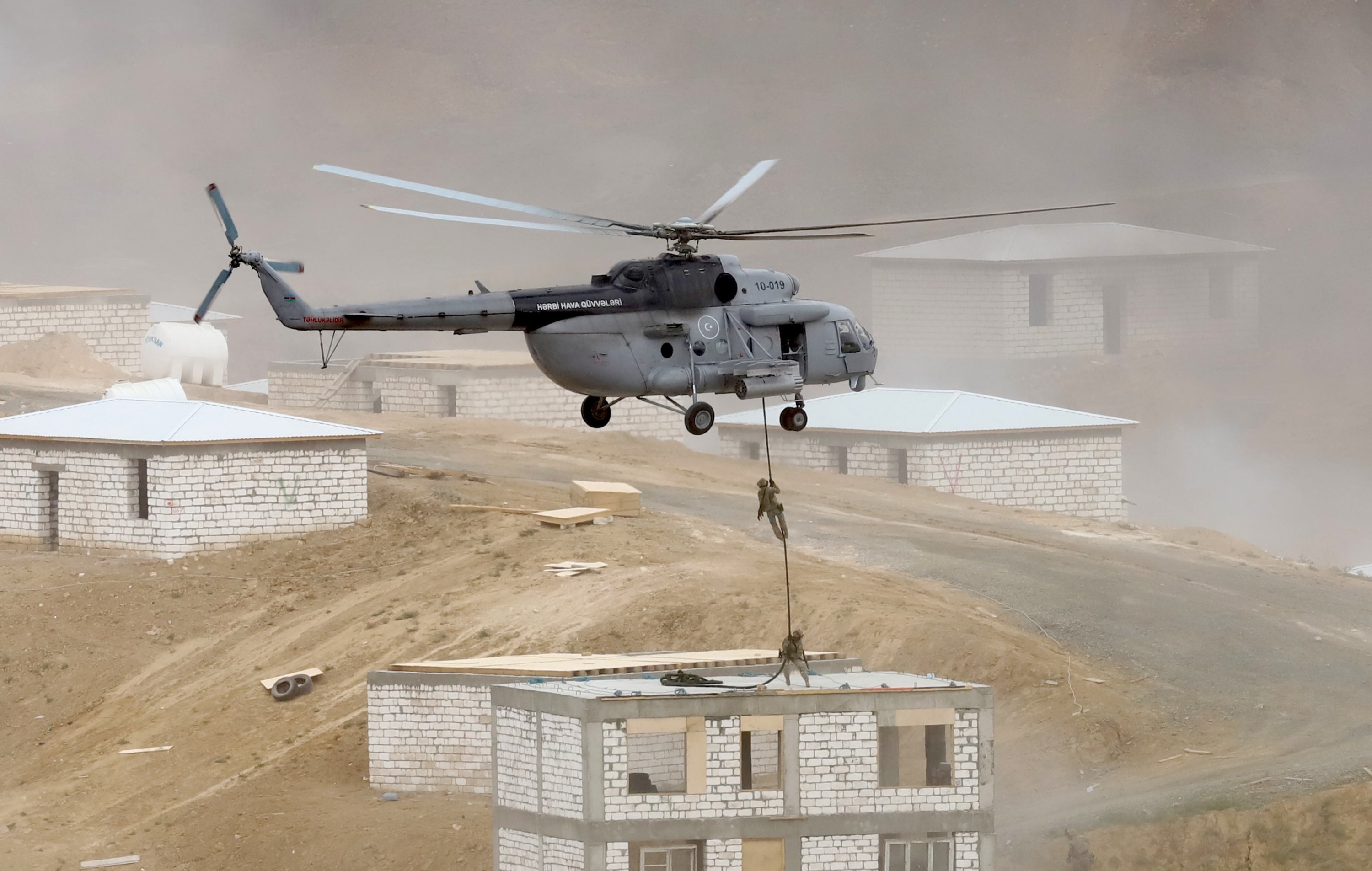
More than 3,500 military personnel from Türkiye, Azerbaijan and Uzbekistan have taken part in the joint exercises, which began Sept. 21, according to Azerbaijan’s Defense Ministry, noting the drills marked the first military exercise of this scale to include territories retaken by Azerbaijan.
More than 130 unmanned aerial vehicles, 70 armored vehicles, 90 artillery systems and 20 aircraft are participating in the exercise, along with more than 30 electronic warfare, reconnaissance and surveillance systems. The drills also involve more than 15 air defense systems, eight sets of engineering equipment and more than 20 naval vessels, the ministry said.
The Kremlin said Wednesday that work was underway on the possible transfer of Türkiye’s Russian-made S-400 air defense systems to a third country, a move that could help address a longstanding dispute between Ankara and Washington over Türkiye’s participation in the F-35 fighter jet program.
Kremlin spokesperson Dmitry Peskov said the issue was “on the agenda” and that discussions were taking place.
“Relevant work is being done, and appropriate contacts are taking place,” Peskov noted when asked about the possibility of transferring the systems.
His comments came after Russian Foreign Minister Sergei Lavrov said Moscow could consider allowing the S-400 systems to be transferred to another country.
Lavrov said any recipient would need to act responsibly and maintain friendly relations with Russia, adding that Moscow would consider such a transfer if a request were made.
Türkiye agreed to purchase the S-400 air defense system from Russia in 2017 and acquired the system in 2019.
The acquisition drew criticism from the United States and other NATO allies, which argued that operating the Russian system posed risks to NATO defense systems and the F-35 program.
Washington subsequently removed Türkiye from the F-35 program and imposed sanctions under the Countering America’s Adversaries Through Sanctions Act (CAATSA).
Ankara has long sought to resolve the dispute and return to the F-35 program. Yet, U.S. President Donald Trump said he was considering allowing Türkiye to rejoin the F-35 program at the NATO summit in Ankara in July.
Speaking alongside President Recep Tayyip Erdoğan at the Presidential Complex after arriving in Ankara for the summit, Trump said the time had come to remove sanctions that have strained relations between the two NATO allies.
“We’re going to lift the sanctions,” Trump said. “We don’t want to sanction our friends. I don’t want to choke my friend with sanctions.”
Calling Türkiye a militarily powerful country under Erdoğan’s leadership, Trump remarked that relations between Washington and Ankara were at their strongest point in years.
Yemen is seeking to expand cooperation with Türkiye to rebuild state institutions and improve essential public services as the war-torn country grapples with persistent security and humanitarian challenges, Foreign Minister Afrah al-Zouba said.
Al-Zouba made the remarks during a meeting with Türkiye’s Ambassador to Riyadh, Emrullah Işler, Yemen’s official SABA news agency reported.
The two officials discussed recent developments in Yemen and the wider region, as well as ways to strengthen bilateral relations and broaden cooperation.
Al-Zouba praised Türkiye’s support for Yemen and its internationally recognized government, including Ankara’s backing for the Presidential Leadership Council.
She stressed the importance of strengthening political and diplomatic coordination between Türkiye and Yemen amid regional and international developments, saying closer ties could support efforts to rebuild state institutions and bolster regional security and stability.
The Yemeni government is particularly interested in expanding cooperation with Türkiye in strengthening state institutions and improving basic services to help ease hardships facing the population, al-Zouba said.
The foreign minister also raised the impact of Houthi attacks on security in Yemen and the wider region, including threats to international trade and maritime traffic in the Red Sea and the Bab el-Mandeb Strait.
She warned that indiscriminate missile launches by the Houthis posed growing risks to civil aviation and international air travel, saying weapons that fail to distinguish between civilian and military targets endanger passenger aircraft and civilian lives.
Işler, for his part, reiterated Türkiye’s support for the Yemeni government and for Yemen’s security, unity, sovereignty and territorial integrity.
He also reaffirmed Ankara’s commitment to expanding bilateral cooperation and supporting the Yemeni government’s efforts to rebuild state institutions and restore security and stability.
Türkiye’s National Security Council (MGK) on Wednesday called for an end to the U.S.-Israel-Iran war and a return to negotiations, warning that continued fighting risks creating a cycle of conflict with increasingly serious global consequences.
President Recep Tayyip Erdoğan chaired the council to discuss Türkiye’s national security priorities and a series of regional and international conflicts, according to a statement released by the Communications Directorate after the meeting.
Officials briefed the council on ongoing operations at home and abroad against threats to Türkiye’s national unity and security, particularly the PKK/KCK-PYD/YPG, Gülenist Terror Group (FETÖ) and Daesh terrorist organizations, as well as recent international developments.
The MGK also reviewed progress under the Terror-Free Türkiye and Terror-Free Region initiatives, reaffirming Ankara’s determination to continue efforts aimed at strengthening the security of Türkiye and the wider region.
The council said Türkiye would continue pursuing policies aimed at contributing to the peace, security and prosperity of neighboring countries.
Syria featured prominently in the discussions, with the council reviewing what it described as positive developments in strengthening the country’s unity and territorial integrity, extending state authority nationwide and advancing the integration process.
Türkiye will continue supporting the Syrian people as they rebuild their country and strengthen relations with the international community, the statement said.
The council also underlined the importance of stability in Iraq, describing peace and security in the neighboring country as critical to the wider region.
It welcomed the Iraqi government’s efforts to strengthen state sovereignty throughout the country and reaffirmed Türkiye’s commitment to advancing strategic cooperation with Baghdad.
Turning to the conflict involving the United States, Israel and Iran, the MGK warned that continued hostilities were developing into a cycle of confrontation that was deepening existing regional vulnerabilities.
The council urged the parties to return to negotiations and end the conflict, warning that its global repercussions were becoming progressively more serious.
The MGK separately addressed developments in Gaza and Lebanon, saying Israel had continued its attacks without fulfilling its commitments and obligations toward establishing peace.
It called on the international community to take concrete action against Israeli policies that Türkiye says are obstructing regional stability, including violations of Syria’s territorial integrity and sovereignty.
The council also reviewed the latest developments in the Russia-Ukraine war, focusing particularly on attacks against civilian infrastructure and navigation routes and their regional and global repercussions.
Pointing to signs of uncontrolled escalation and the potential spread of the conflict, the MGK called on both sides to exercise restraint and pursue a cease-fire.
The meeting also addressed escalating tensions in Yemen, with the council warning that recent developments were increasing security risks across the region, particularly for neighboring countries.
It stressed that restoring calm in Yemen was also important for global stability and called for tensions to be brought under control without delay.
The MGK reiterated Türkiye’s determination to combat terrorism while pursuing regional diplomacy, stability and cooperation across neighboring countries and conflict zones.


-
 Sports2 days ago
Türkiye slip to 31st in FIFA rankings after Nations League defeats
-
 Politics2 days ago
Iraq says talks underway for withdrawal of Turkish troops
-
 Economy3 days ago
Erdoğan says Turkish capital market resilient, vows action in funds case
-
 Sports2 days ago
Turkish football refereeing rocked by probe as MHK chief detained
-

 Sports2 days ago
Manchester City stare down barrel after reported guilty verdict
-
 Economy3 days ago
Moscow seizes control of German retailer Metro’s Russian assets
-
 Politics2 days ago
Turkish diplomat Güllüoğlu appointed to senior UN posts
-
 Lifestyle2 days ago
Nature, history, heritage come together aboard Karaelmas Express