
Politics
Turkish minister eyes Germany, Italy visits to fight int’l crime

Interior Minister Mustafa Çiftçi vowed a strict crackdown on organized crime and warned criminals that they should not think they could “get away” by fleeing abroad. Çiftçi told local broadcaster KonTV on Saturday that he would soon visit Germany and Italy to reinforce Türkiye’s efforts to bring back criminals from those countries.
Since taking office in February, Çiftçi has visited neighboring countries. On Thursday, he was in Greece and had previously held talks with officials in Georgia and Bulgaria to strengthen cooperation in fighting transnational crime. Türkiye’s neighbors are often the first destinations for criminals fleeing the country. Some hide in those countries, while others travel farther west illegally.
Çiftçi is at the forefront of Türkiye’s efforts to crack down on “next-generation gangs,” which have proliferated in recent years. Unlike the Turkish mafia of the past, these gangs rely more heavily on minors and teenagers to commit crimes ranging from extortion to murder. They are also active on social media, where they glorify their crimes and seek to recruit more young people.
“As of the end of September, we had carried out 1,741 operations targeting 625 criminal organizations as part of our crackdown on next-generation criminal organizations. The number of operations reached 1,741 because we conducted multiple operations against some of these groups. As a result, we secured the arrest and imprisonment of 8,170 people.
“Next-generation criminal organizations do not operate only in Türkiye. They immediately flee abroad when they find themselves in trouble. In recent months, I visited Bulgaria in connection with this issue. I later traveled to Georgia and met with the Georgian interior minister. I was in Greece on Thursday, where I held separate meetings with Greece’s minister for citizen protection and minister for migration and asylum.
“Our discussions focused entirely on security diplomacy, next-generation criminal organizations and the places abroad where their members flee and hide. They should not think they can escape us by fleeing abroad. No matter which country in the world they flee to, where they hide or what hole they crawl into, the mighty hand of our state will find them wherever they have fled, bring them back to Türkiye and hand them over to justice. They will answer for their actions before the Turkish judiciary,” Çiftçi said.
“In the first nine months of this year, we secured the extradition of 736 people from abroad. These were individuals who had committed crimes in Türkiye, fled abroad and thought they could escape us there. Through our upcoming visits and security diplomacy efforts, we will further increase this number. We will track down every single one of them and bring them back to Türkiye,” he said.
Noting that next-generation criminal organizations commit a wide range of crimes, including drug trafficking, smuggling, offenses involving irregular migrants, fraud and public-order offenses, Çiftçi said: “One of their sources of funding is drug trafficking, which they use to sustain their operations. Their main source of income is the illicit proceeds they obtain from drug trafficking. When we took office, we identified the fight against drugs as our second major area of focus. Drugs are not just a problem for Türkiye today; they are a problem for the entire world because they directly affect our future. These groups generate income from this trade while continuing to poison our youth. We are continuing to fight them as vigorously as possible to cut off their sources of funding.”
Çiftçi noted that 35,819 people had been arrested in 42,377 operations conducted as part of the fight against drugs this year. He said there were 432,000 people in prisons across Türkiye, adding that 36% of them were either convicted of or detained on drug-related charges.
Çiftçi also reported that the operations had resulted in the seizure of 39 tons of narcotics and approximately 104 million synthetic drug pills. Authorities also seized 20.8 million cannabis plants.

After a two-week hiatus, President Recep Tayyip Erdoğan will convene the Cabinet on Monday.
The investigation into investment funds ordered to be liquidated and planned interim payments to investors will be the main items on the meeting’s agenda. The latest developments in the terror-free Türkiye initiative, ongoing contacts between the United States and Iran to resolve their conflict, the situation in Gaza, the Russia-Ukraine war and economic developments will also be discussed.
A nine-article bill regulating interim payments to investors with holdings in investment funds ordered to be liquidated, as well as the liquidation process itself, has been submitted to the Turkish Parliament. Under the proposal, investors would receive interim payments of up to TL 1 million per person, subject to specified conditions. The payments are planned to be covered by the funds’ assets.
At the Cabinet meeting, officials are expected to discuss preparations for payments to investors and ongoing work on liquidating the funds, alongside the bill’s legislative progress. The decisions made at the fourth meeting of the Fund Coordination Board and the impact of interagency coordination on the process will also be reviewed.
Another key item on the Cabinet’s agenda will be the terror-free Türkiye process. Subcommissions established under the National Solidarity and Integration Coordination Board are being organized, with their duties and areas of authority being defined, while work on interagency coordination continues.
Attention is focused on the work of the monitoring commission in Parliament, while authorities are also tracking progress in the terrorist group PKK’s timeline for laying down its arms. Based on information provided by security agencies, the Cabinet is expected to assess the current state of the process, developments on the ground and the next steps.
On foreign policy, ongoing contacts between the United States and Iran and security developments in the region will take center stage. Ankara is closely monitoring the course of talks between the two countries, efforts to end the fighting and the implications for regional stability.
Recent developments in Gaza and Israel’s attacks, as well as the Russia-Ukraine war, will also feature on the Cabinet’s foreign policy agenda. Officials are expected to assess Türkiye’s diplomatic efforts to resolve regional crises and the potential implications of international developments for the country.
The latest economic developments, efforts to combat inflation and policies aimed at ensuring price stability will also be on the meeting’s agenda.
In parallel with Greece’s defense spending frenzy, the Greek Cypriot administration on the island of Cyprus has ambitions of supremacy at sea and on the island. Located in the south of the divided island of Cyprus, where the existence of Turkish Cypriots is not recognized, the administration eyes key “defense” moves in the Eastern Mediterranean, a source of tensions with Türkiye and Turkish Cypriots.
The new plans to boost defense come amid a stern warning from Ankara, and it remains to be seen whether Greek Cypriots will heed it amid new cooperation with Türkiye’s foes and allies, including France, the U.S. and Israel.
One of the key investments of the Greek Cypriot administration is a 205-million-euro ($229.66-million) naval base project to expand its military facilities in the Eastern Mediterranean, an area where it contests the rights of Turkish Cypriots, to the chagrin of the Turkish Republic of Northern Cyprus’ (TRNC) guarantor state, Türkiye.
In a speech at the inauguration of the new academic year at the National Defense University, Turkish Minister of National Defense Yaşar Güler said that Türkiye would not stand idly by in the face of crises in the wider region. He reiterated Türkiye’s determination to safeguard the security and legitimate rights of Turkish Cypriots, noting that Türkiye is sensitive about protecting rights and interests in the Eastern Mediterranean.
Güler emphasized that all measures had been “decisively taken” as part of national security in the context of developments on the island. At the same time, he pointed out that a policy of oppression that had continued since the 1960s against Turkish Cypriots was still in place. He gave examples of the Greek Cypriot opposition to an international music festival and a football camp by the Barcelona Football Academy scheduled to be held in the TRNC as an “intransigent delusion of the Greek Cypriot side.”
Along with new bases, Greek Cypriots seek to modernize the air base in Baf (Paphos) with U.S. support and secure 1.2 billion euros in defense funding through the European Union’s Security Action for Europe (SAFE) defense financing mechanism.
The Greek Cypriot administration continues its cooperation with the U.S., France and Greece to expand military infrastructure suitable for use by foreign armed forces in the Eastern Mediterranean. The Greek Cypriot administration’s “defense ministry” signed a technical study contract on Oct. 6 with a consortium comprising Greece-based companies TRITON and MARNET to expand the Evangelos Florakis Naval Base in the Mari area.
According to the Greek Cypriot newspaper Fileleftheros, the project aims to upgrade the naval base to accommodate warships belonging to France, Greece and other European countries.
Another component of the Greek Cypriot administration’s military infrastructure projects with foreign countries is the Andreas Papandreou Air Base in Baf. Fileleftheros reported that the U.S. is undertaking the technical work to modernize the air base, and Washington is expected to provide technical and financial support for the project. Preparations involving the U.S. include plans to extend the runway, establish infrastructure suitable for a greater number of military aircraft, build large aircraft hangars and upgrade communications systems. A report by the Greek newspaper Kathimerini Cyprus said the aim is to upgrade the Baf Air Base to standards suitable for use by U.S. military aircraft.
Plans for the Mari Naval Base include increasing the harbor’s depth, expanding berthing areas for large warships and strengthening military logistics infrastructure. According to information published in Greek Cypriot media, authorities are considering increasing the harbor’s current depth of approximately 7 meters (23 feet) to more than 12 meters. The aim is to establish infrastructure suitable for frigates and submarines. France is among the countries expected to benefit from the naval base, while Greek warships may also use the facility.
Greek Cypriot leader Nikos Christodoulides identified strengthening the military capabilities of the Greek Cypriot “national guard” as a priority in the government’s 2026 program.
The Greek Cypriot administration maintains that the modernization projects will serve humanitarian aid and evacuation operations in addition to military activities. It says ownership and control of the facilities will remain with the Greek Cypriot administration.
The Greek Cypriot administration’s military infrastructure projects with foreign countries remain part of the Eastern Mediterranean’s security agenda. The signing of a technical study contract for the Mari Naval Base, the U.S. role in modernizing the Paphos Air Base and plans for France and Greece to use the naval facility highlight the administration’s efforts to expand military cooperation with foreign countries. Technical studies for the expansion of the Mari Naval Base are expected to be completed in October 2027, while the construction project has yet to enter the implementation phase.
Cemil Tugay, mayor of Türkiye’s third-largest city, Izmir, was the latest among dozens of mayors joining the ruling Justice and Development Party (AK Party). His switch was probably the most talked-about, as Izmir has been a stronghold of the opposition Republican People’s Party (CHP), with no AK Party governance for more than two decades. In a lengthy interview with the Yeni Asır newspaper, Tugay explained the story of his historic switch and how he risked being branded a traitor by the opposition.
In the interview published on Sunday, Tugay lamented that neither his former party, the CHP, nor the New Party (YP), founded by former CHP Chair Özgür Özel, stood with him during his tenure, and spoke of how AK Party chair and President Recep Tayyip Erdoğan instilled him with confidence.
“I gave (the switch) a lot of thought; I took a risk. It is not easy, but I believe I did the right thing,” he said. “The biggest gain for me was to feel the support of the president,” said Tugay, who joined the party on Oct. 7, weeks after his resignation from the CHP.
Tugay, elected mayor in 2024 as a CHP candidate, left the opposition party in June, one month after a bitter split among supporters of reinstated Chair Kemal Kılıçdaroğlu and Özgür Özel, who was ousted after a court verdict annulled his chairmanship on charges of vote-buying in a 2023 intra-party election. Despite consecutive wins in most provinces and districts over the past two decades, where it dominated the political landscape, the AK Party had found little support in the city, which is viewed as the heartland of CHP voters. Tugay defeated AK Party lawmaker Hamza Dağ in the 2024 vote, winning 48% of the vote against Dağ’s 37%. The CHP also won 28 of Izmir’s 30 district municipalities in the same election.
The mayor said he had faith in President Erdoğan, citing his background as Istanbul mayor. “He knows very well what state Izmir is in, and how public services can be carried out. I believe we can maintain healthy communication between Izmir and Ankara. Everything will be better for the city,” he said.
Tugay noted that he took over a municipality that faced many problems in 2024. “Aside from financial problems, it was a municipality where things were done in an unplanned manner and with a serious shortage of staff. For instance, IZBETON (a subsidiary of the municipality) was embattled with debt. I improved the municipal services, but the municipality still needs more. We need water treatment facilities, and we need improvements to the sewage system. I was at a crossroads. I would either try to resolve all the problems on my own or leave them to the next mayor. I decided it would be best to work with the AK Party government if it would help Izmir. I thought it was in the best interest of the residents of Izmir,” he said.
The mayor has incurred the wrath of both the CHP and YP, whose leader picked him as the mayoral candidate in the 2024 elections. Answering CHP leader Kemal Kılıçdaroğlu’s claims that he was involved in irregularities and that Kılıçdaroğlu had warned the Özel administration not to nominate him, Tugay said this was not the case. He said he had repeatedly held talks with Kılıçdaroğlu before, and Kılıçdaroğlu never mentioned those claims and openly supported him. “If I was really a bad choice, they could have removed me from the party,” he complained. He said the CHP sought to keep him even after his resignation in June. “They asked me back repeatedly,” he claimed. He complained that the CHP had not stood with him during his tenure and was never interested in the problems the municipality faced. “I lived through many things. The CHP administration did not show up for inauguration ceremonies of big projects. When workers went on strike, the administration did not side with me,” he said.
The Turkic World Youth Gathering brought together hundreds of youth in the northwestern Turkish province of Kocaeli this week. On Sunday, the last day of the event co-organized by the ruling Justice and Development Party (AK Party) and the local municipality, President Recep Tayyip Erdoğan addressed participants via a video message.
Erdoğan said that the partnership among Turkic nations extends far beyond geographical borders, emphasizing their shared history, rich culture and strong emotional bonds.
“Our partnership goes far beyond the borders drawn on maps. Our journey together is built on a deep-rooted history, a rich culture and very strong bonds of affection,” he said.
He welcomed the young people attending the event from different parts of the Turkic world and asked them to pass along his greetings to their home countries.
Erdoğan also congratulated his party’s Directorate for Relations with Turkic States and everyone involved in organizing the gathering, which brought together young people from across the Turkic world under the motto “Shared Heritage, One Heart.”
“I consider it very important that the children of Anatolia come together with you, my young brothers and sisters from different regions of the Turkic world,” he said.
“We will continue to provide the strongest possible support to you, young people who unite your energies around a common ideal toward a prosperous future,” he added.
Erdoğan noted that Türkiye would host the 13th summit of the Organization of Turkic States (OTS) at the end of this month, and they aimed to further their motto and concept “unity in language, ideas and work.”
Türkiye is expected to assume the rotating presidency of the OTS during the summit. The OTS membership now spans an area hosting more than 170 million people, and the combined gross domestic product (GDP) of the member countries exceeded $2 trillion (about TL 98.44 trillion). The rise of the Turkic world as a united force in the broader region has transformed it into a key actor in global affairs, rather than a bunch of post-Soviet states and their allies on the margins. For the U.S., for instance, it is now viewed as a hub of alternative supply chains and investment situated geographically on the periphery of Russia and China. For Türkiye, these states possess vast opportunities, both separately and as a composite entity.
Kürşad Zorlu, deputy chair of the AK Party who also heads the party’s Directorate for Relations with Turkic States, said at the event on Saturday that, as the Turkic states, they had recently been working on a common alphabet and stressed the importance of establishing a shared framework to bring their languages of communication closer together.
Zorlu said participants had come not only from Turkic states but also from Gagauzia, Iraq, Syria, Tabriz and many other places. He said they were united by the goal of expanding cooperation across all fields throughout the Turkic world.
“The foreign trade volume between Türkiye and our seven brotherly Turkic states has reached $115 billion in just five years. Last year, this figure stood at $26 billion,” Zorlu said.
“This is not yet our ultimate goal, as it accounts for approximately 4.5% of our total foreign trade. Our aim is to work toward increasing the share of trade with each of our Turkic states to 10% and to achieve that target.
“Recently, our cooperation in education, health care, tourism and many other fields has also been growing. This is bringing about a process that can stimulate and encourage areas of cooperation that directly connect our peoples.”
Zorlu said one of the issues under consideration was allowing citizens to travel between OTS member states using national identity cards.
“We currently travel using our passports. We are working to lay the groundwork and make the necessary preparations to enable us to travel using our identity cards,” he said.
Zorlu also said remarks by Kazakh President Kassym-Jomart Tokayev on the Middle Corridor had opened up new horizons for them.
“President Tokayev proposed carrying out the necessary work to connect the 44-kilometer (27-mile) route between Nakhchivan and Azerbaijan, which we know as the Zangezur Corridor and have made great efforts to open, to the Middle Corridor through railway and transportation networks.
“This proposal comes from a strategic shield on the shores of the Caspian Sea. Here in Anatolia, we are working with another country on the Caspian coast to ensure that trade corridors become integrated. “We will not allow anyone to stop this. I sincerely believe that when we stand united and together and focus on our goal, we will make the next 100 years the ‘Century of the Turkic World.’”
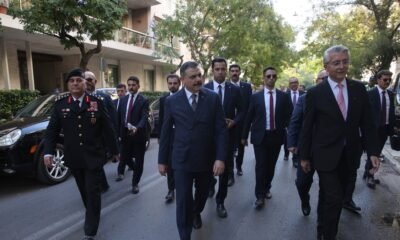
Interior Minister Mustafa Çiftçi has urged Greece to extradite members of the Gülenist Terror Group (FETÖ) and accelerate the return of wanted criminal gang leaders, calling for stronger cross-border security cooperation to combat terrorism and organized crime.
Speaking during an official visit to Athens on Friday, Çiftçi met with Greek Minister for Citizen Protection Michalis Chrysochoidis to discuss cooperation against terrorist organizations, emerging criminal networks and other forms of transnational crime.
“We expect our friends to recognize FETÖ’s true face, support our fight against the organization and extradite its members to our country,” Çiftçi said, according to a statement released after the meeting.
The talks focused on strengthening cooperation between the two countries’ security and law enforcement agencies, including the exchange of information, the prevention of cross-border crime and measures against criminal networks operating across national borders.
Çiftçi said he hoped the meeting would produce tangible results in improving bilateral security cooperation, emphasizing that criminal organizations increasingly coordinate their activities across multiple countries and exploit differences between national legal systems.
He also called on Greek authorities to prevent criminal gang leaders held in Greek prisons from continuing to communicate with their networks and coordinate criminal activities while in detention.
“Some leaders of criminal organizations who have been arrested and are being held in Greece can unfortunately continue to communicate with their organizations and carry out operations despite being in custody,” he said. “It is extremely important to prevent this. We particularly expect their extradition processes to be accelerated.”
Faster extradition demand
Extradition procedures featured prominently in Çiftçi’s discussions, with the minister raising concerns about cases in which the transfer of suspects to Türkiye has been halted shortly before completion.
He said some extradition procedures had been suspended or canceled after travel arrangements and tickets for the individuals concerned had already been finalized. In certain cases, he said, Greek authorities cited ongoing judicial proceedings in Greece, while others involved last-minute applications to the European Court of Human Rights (ECHR).
According to Çiftçi, such interruptions have become more frequent in recent months, including after Turkish officials assigned to extradition duties had already traveled to Greece or to land border crossings to receive the individuals.
“These incidents negatively affect the predictability of extradition processes,” he said.
The minister warned that repeated delays could create an incentive for wanted individuals seeking to evade extradition to travel to or remain in Greece.
To address the issue, he proposed making use of existing provisions under the bilateral readmission agreement and applying deportation procedures where the legal conditions are met.
“We can also make use of the provisions of the existing readmission agreement to prevent this situation,” Çiftçi said. “The deportation mechanism can be applied to individuals for whom the necessary conditions are met.”
The comments reflect Ankara’s push to make extradition and law enforcement cooperation more predictable as authorities seek to pursue suspects whose alleged activities extend beyond Türkiye’s borders.
The two countries’ cooperation involves a range of issues, from organized criminal networks and terrorism to human trafficking, drug smuggling and irregular migration. Effective coordination, Turkish officials argue, is particularly important when suspects, criminal proceeds and communications networks span several jurisdictions.
Action against FETÖ
Çiftçi also pressed Greece to take action against FETÖ, the group responsible for the deadly 2016 coup attempt in Türkiye.
The minister said that the organization’s activities, including the misuse of refugee status, posed a threat not only to Türkiye but also to public order and the interests of Greece and other countries where the group operates.
He called for greater recognition of the organization’s activities and urged Greek authorities to cooperate more closely with Türkiye in securing the return of its members.
The issue remains politically sensitive in bilateral relations. Following the failed coup attempt in 2016, some coup plotters fled to Greece and sought asylum, prompting a dispute between Ankara and Athens over their return. Greek judicial authorities rejected Türkiye’s extradition requests, citing concerns including the defendants’ right to a fair trial. The case became one of the most prominent legal disputes between the neighboring countries following the coup attempt.
Çiftçi said Türkiye’s security forces continued to fight organizations including the PKK, Daesh, the Revolutionary People’s Liberation Party-Front (DHKP-C) and FETÖ, adding that the direct terrorist threat facing the country had been substantially reduced through those efforts.
He also urged Greek authorities to ensure that FETÖ did not exploit the more positive atmosphere created by the “terror-free Türkiye” initiative.
Çiftçi said the group’s activities presented a broader security concern and referred to legally disguised operations reflected in Europol and intelligence reports.
He called for cooperation to prevent the organization from using political or legal circumstances in other countries to maintain its activities.
Organized crime battle
Beyond terrorism and extradition, the meeting addressed efforts to combat organized criminal groups, including networks with members or leaders operating in both countries.
Çiftçi said recent contacts between Turkish and Greek law enforcement agencies, together with improved communication channels and real-time information sharing, had contributed to an increase in operations targeting Turkish-origin organized criminal groups in Greece.
He said the cooperation had resulted in numerous suspects being brought to justice and thanked Greek authorities for their efforts.
“We are pleased with this situation and thank Greece for its efforts,” he said.
The minister’s remarks highlighted the importance of operational cooperation between neighboring countries as criminal networks increasingly operate across borders rather than within a single jurisdiction.
Authorities must be able to exchange information, identify suspects and coordinate investigations even when members of the same organization are located in different countries, Çiftçi said.
The Greek side also raised concerns about criminal groups operating in Greece whose members are of Turkish origin. According to the Greek Ministry of Citizen Protection, Chrysochoidis called for Turkish authorities to seek Interpol Red Notices for wanted suspects when domestic arrest warrants have been issued, facilitating their arrest in Greece and transfer to Turkish authorities. The Greek minister also called for stronger intelligence sharing and closer operational coordination.
Çiftçi provided figures on Türkiye’s operations against organized crime, saying security forces had conducted 1,741 operations since the beginning of the year.
Those operations had dismantled 625 criminal organizations, including 22 with international reach, while 8,170 members of organized criminal groups had been arrested and remanded in custody, he said.
The minister also said authorities had arrested 35,819 people accused of drug trafficking over the same period as part of an intensified campaign against narcotics networks.
He said operations against organized criminal groups would continue with the same determination.
The figures, presented by the minister, cover a broad range of enforcement activities and illustrate the scale of the government’s campaign against criminal networks. They also formed part of Ankara’s argument for stronger cooperation with neighboring countries, particularly where suspects can cross borders or maintain links with organizations operating abroad.
Drug trafficking and other forms of organized crime often involve networks that coordinate the movement of illicit goods, money and personnel across multiple jurisdictions. Authorities therefore increasingly rely on information sharing and coordinated investigations to identify leadership structures and disrupt operations.
Çiftçi said international cooperation was essential to prevent criminal groups from exploiting gaps between national law enforcement systems.
Çiftçi also drew attention to what Turkish authorities describe as a new generation of organized criminal groups, saying their growing reliance on social media and digital communication platforms had changed how they recruit members, coordinate activities and promote their operations.
He said these networks use online platforms to organize, spread propaganda and attract new recruits, while also using digital channels to maintain communication across national borders.
Turkish authorities monitor social media activity as part of efforts to track the actions of these organizations and follow the proceeds of their crimes, he said.
The minister argued that the transnational nature of such groups makes cooperation between governments increasingly important, as investigations conducted in a single country may not be sufficient to identify or disrupt an entire network.
“No country can achieve results in the fight against crime on its own,” Çiftçi said. “Compared with conventional criminal organizations of the past, international cooperation has become even more important in combating new-generation criminal groups.”
He called on Greece to give particular attention to Turkish requests concerning the arrest and extradition of leaders and members of emerging organized criminal networks that Ankara considers a priority security threat.
The growing use of digital platforms presents law enforcement agencies with additional challenges, particularly when suspects communicate through services accessible from multiple countries or when financial transactions and other criminal activities leave evidence across different jurisdictions.
Çiftçi’s appeal for closer cooperation was therefore not limited to the physical transfer of suspects. It also encompassed the exchange of operational intelligence and the coordination needed to track networks whose members can continue to communicate and organize activities across borders.
Migration management
The meeting also took place against the backdrop of broader cooperation between Türkiye and Greece, particularly on irregular migration and border security.
Çiftçi said relations between the two countries had developed in recent years under the leadership of their respective leaders, allowing cooperation to continue on several important issues despite longstanding differences.
He pointed to the trilateral mechanism involving Türkiye, Greece and Bulgaria as an example of cooperation in combating irregular migration, saying progress had been made through the arrangement.
The three countries have a shared interest in addressing migration routes through southeastern Europe and preventing criminal networks from exploiting people seeking to cross borders. Cooperation can involve information exchange, border management and action against smugglers and trafficking networks.
Çiftçi said Türkiye had developed a comprehensive migration management model under the leadership of President Recep Tayyip Erdoğan, which he described as an example for other countries.
According to the minister, the approach seeks to balance public security with human rights, international law and humanitarian principles.
He said Türkiye supported regular migration through appropriate mechanisms while seeking to address irregular migration by tackling its underlying causes rather than focusing solely on border enforcement.
Çiftçi described the country’s approach as a comprehensive, five-pillar strategy designed to begin and end at the source of migration movements.
The minister’s remarks placed security cooperation within a wider framework in which irregular migration, human smuggling and organized crime are treated as interconnected challenges requiring coordination among neighboring countries.
A new defense cooperation roadmap between Türkiye and France has drawn attention in Greece, with a Greek media outlet warning that closer military ties between Ankara and Paris could strengthen Türkiye’s air defense capabilities and reshape the regional balance of power.
Athens-based Pentapostagma Thursday examined the potential implications of the agreement, highlighting possible cooperation on advanced SAMP/T air defense systems and Meteor long-range air-to-air missiles.
In an article headlined “The back door has opened,” the outlet suggested that renewed defense dialogue between the two NATO allies could pave the way for broader industrial partnerships and technology transfers.
The report focused particularly on Türkiye’s efforts to establish a multilayered air defense network under its domestically developed Steel Dome project.
According to Pentapostagma, Ankara could seek advanced European systems capable of countering increasingly sophisticated missile threats while maintaining interoperability with NATO defense infrastructure.
The outlet identified the Franco-Italian SAMP/T NG system as a potential area of cooperation, emphasizing that any agreement could extend beyond conventional military procurement.
“The real question is not whether Türkiye will purchase an air defense system from Europe, but under what conditions,” the report stressed.
The assessment follows an announcement by Türkiye’s Defense Ministry outlining a roadmap to establish more structured and sustainable defense cooperation with France.
Under the framework, officials from both countries are expected to hold regular meetings alternating between Ankara and Paris to discuss joint defense projects, air defense systems and intelligence sharing.
The first meeting under the roadmap is planned for the final quarter of 2026.
It argued that Turkish industrial participation, technology transfers and integration into the Steel Dome architecture could prove more strategically significant than the number of systems acquired.
Steel Dome is Türkiye’s integrated layered air defense architecture, bringing together domestically developed radar, missile, electronic warfare and command systems to protect airspace against threats at multiple altitudes and ranges.
Meteor missiles draw attention
The report also highlighted the potential acquisition of European Meteor beyond-visual-range air-to-air missiles, warning that their integration into the Turkish Air Forces Command could significantly enhance Ankara’s aerial combat capabilities.
Pentapostagma described such a development as a potentially major setback for Greece’s defense posture, particularly amid longstanding strategic competition between the neighboring NATO members.
The outlet also pointed to possible cooperation involving French defense companies Thales, MBDA and Eurosam in radar technology, missile systems and command-and-control infrastructure.
It cited a strategic partnership reportedly signed between French aerospace company Safran and Turkish drone manufacturer Baykar in May, describing the arrangement as a joint development initiative rather than a conventional buyer-seller relationship.
Acknowledging Türkiye’s expanding defense capabilities, Pentapostagma argued that Greece could no longer overlook Ankara’s military strength.
“Türkiye does not need to pretend to be strong because it already is,” the outlet said, adding that expectations of a substantially weaker Türkiye were unrealistic.


-
 Politics3 days ago
Türkiye, France deepen military ties under new road map
-
 Economy3 days ago
European firms called to expand partnerships with Turkish contractors
-
 Politics2 days ago
Turkish Defense Ministry marks 7 years since Operation Peace Spring
-

 Economy23 hours ago
Can diesel prices fall after Trump-Russia deal?
-
 Politics23 hours ago
Türkiye-France defense cooperation spark concern in Greek media
-
 Economy1 day ago
Tehran’s once-bustling bazaar struggles as war dampens demand
-
 Politics22 hours ago
Türkiye presses Greece to hand over FETÖ members, crime bosses
-
 Sports1 day ago
Deadly Houthi strike on Riyadh airport draws int’l condemnation