
Politics
Türkiye condemns Houthi attacks on Saudi airports, urges restraint

Türkiye on Friday strongly condemned Houthi attacks on two major airports in Saudi Arabia, warning that strikes targeting civilians and critical infrastructure risk further escalating regional tensions and reaffirming its solidarity with Riyadh.
In a statement, the Foreign Ministry denounced the attacks targeting Abha International Airport in southern Saudi Arabia and King Khalid International Airport in the capital, Riyadh.
The ministry extended condolences to the families of those killed and wished a speedy recovery to the injured.
Ankara called for an immediate end to attacks targeting civilians and infrastructure, warning that continued violence could further destabilize the region.
“These attacks targeting civilians and infrastructure and leading to a further escalation of tensions in the region must cease immediately,” the ministry said.
Reaffirming Türkiye’s support for Saudi Arabia, the ministry stressed the importance of resolving regional disputes through peaceful means.
“We once again emphasize our full solidarity with Saudi Arabia and reiterate our call for existing disputes to be resolved through dialogue and diplomacy,” it said.
Separately, Presidential Communications Director Burhanettin Duran condemned the strikes, describing them as unacceptable acts that threaten regional peace and stability.
Duran said the attacks, which caused civilian deaths and injuries, risked fueling further tensions across the region.
“These attacks, which have resulted in civilian deaths and injuries, are unacceptable acts that threaten peace and stability in the region and escalate tensions,” he said.
He emphasized that Türkiye, under President Recep Tayyip Erdoğan’s leadership, remains committed to preventing new conflicts and promoting diplomatic solutions to regional disputes.
The communications director also reiterated Ankara’s solidarity with Saudi Arabia and offered condolences to the victims’ families while wishing the injured a swift recovery.

A Turkish court ordered Friday the continued detention of two brothers accused of carrying out attacks on Turkish military bases and convoys in Syria as their retrial resumed in the southern province of Adana.
Ahmet Baykara and his older brother, Yusuf Baykara, appeared via video link from prison before the Adana 2nd High Criminal Court. Several complainants and lawyers attended the hearing in person.
A Turkish Armed Forces (TSK) member, identified by the initials T.T., testified that he was injured in a vehicle bombing while serving in Syria in 2018.
“We were preparing to return to Türkiye when a vehicle passed us. Five or six minutes later, a vehicle loaded with explosives detonated,” he said, adding that a fellow soldier was killed.
Both defendants denied involvement in terrorism, claiming they had traveled to Syria to conduct humanitarian activities.
“I am not a terrorist. I did not carry out any attack,” Ahmet Baykara told the court, requesting his release and acquittal.
The prosecutor requested that both suspects remain in custody pending further proceedings. The court upheld their detention and adjourned the hearing.
Türkiye’s National Intelligence Organization (MIT) captured Ahmet Baykara in an African country on Oct. 15, 2024, following intelligence linking him to attacks on Turkish military positions in Syria’s Idlib province.
His brother was subsequently detained in Adana.
The two were convicted in October 2025 and sentenced to life imprisonment for undermining state unity and territorial integrity, along with 11 years and eight months each for attempted murder of a public official.
The brothers remain in custody as proceedings continue.
Turkish authorities have been carrying out extensive counterterrorism operations at home and abroad to capture terrorists.
President Recep Tayyip Erdoğan warned that powerful technology leaders are seeking to shape young people’s lives and values, saying Türkiye must raise a generation capable of embracing technological progress while preserving its national and spiritual identity.
Speaking Saturday at the 75th anniversary gathering of the Ilim Yayma Cemiyeti in Istanbul, Erdoğan described young people as the primary target of what he called “techno-oligarchs,” whom he accused of seeking to direct the future according to their own interests and worldview.
He said the influence of artificial intelligence and rapidly advancing technologies was transforming society, making it increasingly important to protect young people from ideologies that encourage racism, hedonism and disregard for moral boundaries.
“The Teknofest generation will be our greatest assurance against the domineering mentality of techno-oligarchs who commodify people, nature, the sky and even space,” Erdoğan said, referring to Türkiye’s technology and aerospace festival, which promotes domestic innovation and attracts young people interested in science and engineering.
He also identified the Ilim Yayma generation as central to this effort, emphasizing the need to develop technology in ways that put people first and preserve moral responsibility.
“Our common goal is to raise a generation that uses and develops technology with a human-centered approach,” he said, calling for young people who read more, think critically and produce innovative work without losing their conscience, humanity or connection to national and spiritual values.
Erdoğan pointed to recent troubling incidents in schools as evidence of the threats posed by what he described as harmful influences, arguing that young people must be protected from ideologies that promote racial hatred and excessive self-indulgence.
He urged students and educators to remain committed to their responsibilities, saying the country must prepare young people to navigate an uncertain future shaped by technological change and global cultural pressures.
Ilim Yayma’s 75-year history
Erdoğan also praised the Ilim Yayma Cemiyeti, a Turkish educational and civil society organization founded in 1951, for its contribution to the country’s education system and the development of generations of students.
He described the organization’s history as closely intertwined with Türkiye’s own, saying its founding principles reflected the country’s long-standing ambition to educate young people who are knowledgeable, ethical and committed to serving society.
“Although it was founded in 1951, the history of Ilim Yayma is also the history of Türkiye,” Erdoğan said. “Its founding philosophy is the philosophy of Türkiye’s existence, and its ultimate goal is Türkiye’s centuries-old aspiration.”
He paid tribute to the organization’s founders, including its first president, Seniyüddin Başak, who helped protect Turkish foundation properties during the Lausanne Conference; Gen. Ömer Cemal Karabekir, who supported the Turkish National Movement during the War of Independence; and retired Col. Vehbi Bilimer, a veteran of the Gallipoli campaign, the Battle of Kut and the Turkish War of Independence.
Erdoğan also recalled Hasan Hikmet Demirbağ, a writer for the Sebilürreşad magazine and associate of national poet Mehmet Akif Ersoy, among the figures who helped establish the organization.
He said the founders shared a commitment to ensuring that Turkish children would not be deprived of education, knowledge or moral guidance, particularly during periods of political and social hardship.
Their common ambition, Erdoğan said, was to entrust the country’s future to a confident, well-educated and responsible generation.
He described Ilim Yayma as a symbol of Türkiye’s struggle for independence and its future, adding that the organization’s work was closely linked to the country’s broader struggles over education and democracy.
Organization helped expand imam hatip schools
Erdoğan highlighted Ilim Yayma’s role in the reopening and expansion of imam hatip schools, which combine religious instruction with general education.
He said the organization helped establish Türkiye’s first imam hatip school on Oct. 17, 1951, just six days after its founding, and later contributed to the construction of more than 100 such high schools across the country.
The expansion helped extend educational opportunities beyond Istanbul, with new institutions opening across Anatolia, Erdoğan said.
The organization also established student dormitories in several cities and provided scholarships and accommodation for students traveling from other parts of the country to study in Istanbul. These services enabled tens of thousands of young people to continue their education in safer and more supportive environments, he added.
Erdoğan said the organization had expanded its work despite obstacles, pressure and difficulties over the decades, becoming an important presence in Türkiye’s educational and civil society landscape.
He credited the founders’ determination and faith with laying the foundations for an institution that continues to support students and educators today.
192 branches, 153 dormitories and 122 education centers
Erdoğan said Ilim Yayma Cemiyeti now operates 192 branches, 153 dormitories and 122 education centers, providing services from basic education through higher education and academic development.
He also praised the contributions of the Ilim Yayma Foundation, Istanbul Sabahattin Zaim University, volunteers, donors and alumni associations, saying their combined work had helped the wider Ilim Yayma community serve the country and society.
“What 68 dedicated individuals set in motion 75 years ago now touches the lives of millions through schools, dormitories, scholarships, education centers, academic support and international initiatives,” he said.
Erdoğan described the organization’s growth as a source of pride, saying its founders had planted a modest seed that had grown into a mighty plane tree under God’s providence.
He said generations of students had benefited from the institution’s work, with many going on to serve their country and humanity.
The president urged the organization to pass its legacy on to future generations with renewed determination, expressing confidence that its work would continue to expand.
He also called on young people to draw inspiration from history while focusing on the challenges ahead, stressing that educating people required patience, sustained effort and a long-term vision.
Erdoğan calls for investment in future generations
Erdoğan said Ilim Yayma’s achievements over the past 75 years were important, but its future contribution would depend on how effectively it responded to changing social and technological needs.
He raised questions about how the organization could reach more students, help young people discover their talents, safeguard their spiritual development and strengthen national identity amid global cultural influences.
He also stressed the need for Türkiye to produce scientific, technological, cultural and artistic works rooted in its own traditions while remaining relevant in a rapidly changing world.
The president said artificial intelligence was already bringing fundamental changes to everyday life, making it necessary for educational institutions to adapt their methods and priorities.
He warned that powerful technology executives, whom he called “techno-oligarchs,” wanted to influence not only present-day society but also the future according to their own interests.
According to Erdoğan, the challenge was to ensure that technological progress served humanity rather than treating people and the natural world as commodities.
He said the Teknofest generation represented the kind of young people Türkiye needed to meet that challenge, combining scientific ambition with ethical responsibility and a strong sense of identity.
“Do not become complacent or lose heart,” Erdoğan told the audience. “If you have faith, you are the ones who will prevail.”
He pledged that the organization would continue the work begun by its founders, saying its members would uphold their legacy without seeking worldly rewards such as status, fame or wealth.
Erdoğan concluded by expressing confidence in the country’s young people and urging them to carry forward the organization’s educational mission with determination.
President Recep Tayyip Erdoğan on Friday condemned the international community’s failure to respond effectively to Israel’s actions in Gaza, warning that global legal institutions and enforcement mechanisms were failing to uphold justice and international law.
Speaking at the International Justice Summit in Istanbul, Erdoğan accused Israel of turning Gaza into the world’s largest concentration camp, criticizing the lack of accountability for civilian deaths and widespread destruction.
“For three years, people in Gaza have been brutally killed before the eyes of the entire world,” Erdoğan underlined, adding that more than 74,000 Palestinians, mostly women and children, had been killed.
He said schools, universities, hospitals and places of worship had been destroyed, while thousands of children had suffered life-changing injuries.
Gaza on Wednesday marked three years since Israel launched a genocidal war on the Palestinian territory, which continues to reel from unlivable conditions, daily killings by the Israeli military and being cut off from the rest of the world.
Erdoğan also accused Israel of repeatedly violating a cease-fire established last year, with Türkiye’s support.
Gaza authorities and international nongovernment organizations have raised alarms that Israel has continued its atrocities in the coastal enclave, killing 1,454 Palestinians and injuring 5,090 others since the cease-fire took effect on Oct. 10, 2025.
Criticism of global justice system
Erdoğan said international judicial and sanctions mechanisms had failed to respond adequately to the situation in Gaza, describing the crisis as a test of the international community’s commitment to justice.
“This is a test of humanity for the entire world. It is a test of sincerity for all of us,” he said.
He highlighted Türkiye’s application to intervene in the genocide case against Israel at the International Court of Justice, its suspension of trade with Israel and legal measures targeting those accused of attacking the Global Sumud Flotilla.
“Türkiye may face difficulties if necessary, but it will never turn its back on those suffering injustice.”
The president also criticized the broader international system, arguing that international agreements, court rulings and fundamental legal principles were increasingly being disregarded.
Even Tuesday, at least three Palestinians were killed and several others injured by Israeli army fire.
The latest killings pushed the total Palestinian death toll in Israel’s genocide past 74,000, most of them women and children, according to the Gaza Health Ministry.
Erdoğan reiterated his longstanding call for United Nations reform, declaring that “the world is bigger than five,” a reference to the five permanent members of the U.N. Security Council.
He also pointed to the prolonged Russia-Ukraine war, disruptions in the Strait of Hormuz and ongoing conflicts in Lebanon, Yemen, Somalia and Sudan as examples of mounting global instability.
He warned that inequalities between countries were widening in education, technology, food security and access to economic opportunities.
No safe haven for criminals
Turning to international law enforcement, Erdoğan stressed that technological developments had enabled criminal organizations to operate across borders through cryptocurrencies, electronic payment systems and social media.
He called for stronger judicial cooperation to prevent suspects from evading prosecution by fleeing abroad.
“Those who believe they can escape justice by leaving the country should not feel safe wherever they hide,” Erdoğan said.
He announced that Türkiye had secured the extradition of 294 individuals during the first nine months of 2026 and brought another 736 people into the country through various international search mechanisms.
“Turkish justice will sooner or later do what is necessary,” Erdoğan said, reaffirming Ankara’s commitment to international legal cooperation and accountability.
Türkiye’s Defense Ministry on Friday commemorated the seventh anniversary of Operation Peace Spring, paying tribute to soldiers who participated in the cross-border counterterrorism operation in northern Syria.
In a statement shared on social media, the ministry honored Turkish troops who took part in the operation, launched to secure Türkiye’s borders and support regional security.
The ministry also paid tribute to soldiers killed during the operation and expressed gratitude to wounded veterans for their service and sacrifices.
Ankara launched Operation Peace Spring in northern Syria to eliminate terrorists from northern Syria east of the Euphrates River, secure Türkiye’s borders, aid in the safe return of Syrian refugees and ensure Syria’s territorial integrity.
In an effort to restore normal life in the region, Turkish security forces have cleared 600 settlements of terrorists belonging to the PKK’s Syrian wing, the YPG.
Within four days, Turkish forces cleared the town of Ras al-Ain and a day later, Tal Abyad was liberated from PKK/YPG terrorists. Overall, the operation secured more than 4,000 square kilometers.
After the operation, the Turkish Armed Forces (TSK) and the Syrian National Army focused on maintaining security and enabling displaced civilians to return home. Since the establishment of local councils, which also provide job opportunities, the region has seen significant infrastructure improvements, including the resolution of water and power shortages.
On Aug. 25, the U.S.-backed YPG terrorist group announced that its so-called autonomous administration and all its military and civilian structures have been dissolved following the agreement reached between the Syrian administration and the YPG on Jan. 29 that provided for a cease-fire and the group’s gradual integration into state institutions.
Türkiye and France have signed a road map aimed at expanding defense and security cooperation, including intelligence sharing, air defense and joint military exercises, the Turkish Defense Ministry announced Thursday.
The agreement seeks to strengthen bilateral defense relations based on mutual interests and establish a more institutionalized framework for cooperation, the ministry said following its weekly press briefing at the Gölcük Naval Shipyard Command in northwestern Kocaeli province, marking the facility’s 100th anniversary.
Under the road map, the two countries plan to hold regular security consultations, enhance cooperation against hybrid threats, expand intelligence sharing and improve interoperability between their defense systems.
The agreement also envisages coordinated training and capacity-building activities in third countries to support regional stability.
Military cooperation will include expanded joint training programs, personnel exchanges between military academies, port visits and exercises involving land, naval and air forces.
In the defense industry, Ankara and Paris aim to develop joint projects, encourage technology and information sharing and increase engagement between defense companies.
The ministry said bilateral defense meetings would alternate between Ankara and Paris, with the first scheduled for the final quarter of 2026.
Israeli actions in Syria condemned
Separately, Defense Ministry spokesperson Rear Adm. Zeki Aktürk criticized Israel’s continued military activities in southern Syria, including raids, detentions, border violations and air and artillery strikes.
Aktürk accused Israel of violating the 1974 Disengagement Agreement by resuming trench-digging and road expansion activities under the Sufa-53 Line Project.
Israeli forces restarted excavation work last week west of al-Asha village in Syria’s southern Quneitra as part of a project known as the “Sufa Line,” or “Sufa 53,” according to Syria Alikhbaria TV. Military vehicles and bulldozers were seen digging near the separation line with the occupied Syrian Golan Heights, extending a route that runs through rural communities from northern to southern Quneitra. For residents, the project has meant the loss of agricultural land, damage to grazing areas and vegetation, and changes to the natural flow of rainwater in a province where many families depend on farming and livestock.
He urged the international community to take concrete measures against Israeli actions that threaten regional peace and stability.
Aktürk also highlighted ongoing military contacts between Türkiye and Greece under their 2026 Confidence-Building Measures Implementation Plan.
A delegation from Türkiye’s National Defense University visited the Hellenic National Defense College in Athens from Oct. 7-9, while another round of confidence-building talks was scheduled for Friday in Crete.
A Greek naval delegation is also expected to visit Türkiye’s Naval Forces Command from Oct. 13-15.
Border security operations
Addressing counterterrorism operations, Aktürk said one PKK terrorist surrendered to Turkish authorities over the past week.
He added that Turkish security forces apprehended 660 people attempting illegal border crossings and prevented another 1,383 from crossing during the same period.
According to ministry figures, 13,366 people have been apprehended attempting unauthorized crossings since the beginning of 2026, while another 53,870 have been prevented from entering illegally.
Türkiye’s domestically developed Bayraktar Akıncı unmanned combat aerial vehicles (UCAVs) are strengthening the Gendarmerie General Command’s surveillance and operational capabilities, conducting long-range missions across the country, officials said.
Developed by Turkish defense manufacturer Baykar, the Akıncı drones are capable of operating at altitudes of up to 40,000 feet and remaining airborne for up to 24 hours. The aircraft can conduct missions nationwide, from Edirne in the west to Iğdır in the east.
Maj. Ergin Sarıçiçek, a drone pilot stationed in Elazığ, told Anadolu Agency (AA) that the Akıncı represents one of the most advanced technologies currently used by the gendarmerie.
Equipped with an artificial intelligence-assisted triple-redundant autopilot system and satellite communications, the aircraft can conduct reconnaissance, surveillance and operational missions across Türkiye’s airspace.
“The aircraft can remain airborne for extended periods and carry out missions over large areas,” Sarıçiçek said.
Its advanced electro-optical cameras enable day-and-night surveillance, including under challenging weather conditions, providing intelligence to support counterterrorism and border security operations.
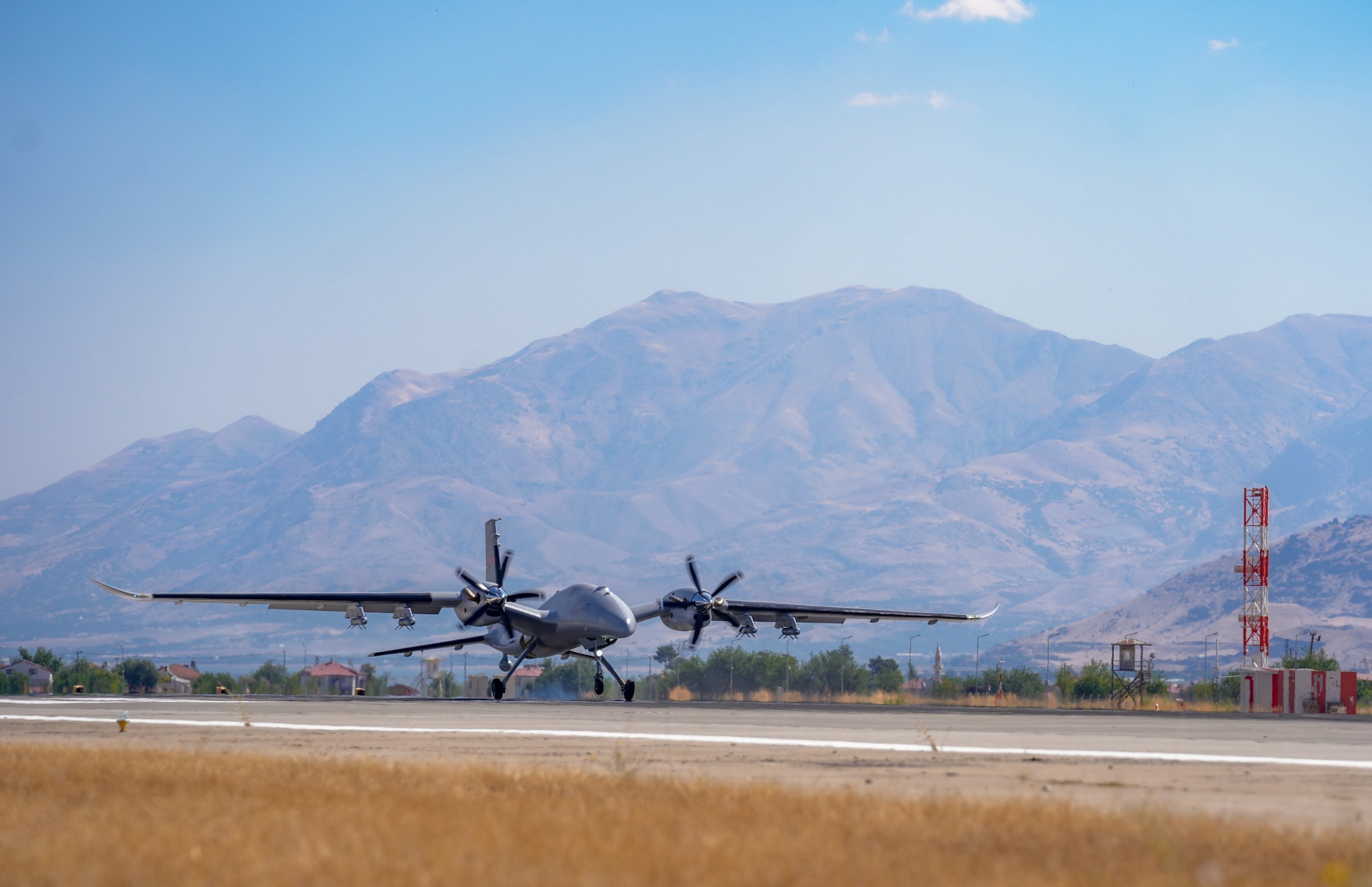
According to Sarıçiçek, the drones also contribute to combating smuggling, disaster response, crisis management and search-and-rescue operations.
He emphasized that the aircraft’s precision targeting capabilities allow security forces to respond to potential threats while reducing risks to personnel on the ground.
The Akıncı can carry up to 1,500 kilograms (3,300 pounds) of payload, including various domestically produced precision-guided munitions.
Its weapons systems include the MAM-L, MAM-C and MAM-T guided munitions, along with the Teber-82, Gözde, Tolun and İHA-230 systems developed by Turkish defense companies.
Sarıçiçek said the aircraft’s payload capacity, endurance and advanced surveillance systems distinguish it from other unmanned aerial platforms, expanding the gendarmerie’s ability to conduct complex operations across Türkiye.


-

 Economy3 days ago
Trump says anyone who doesn’t call AI ‘super intelligence’ is ‘enemy’
-
 Politics3 days ago
Turkish, Greek Cypriot leaders to hold new round of talks Oct. 13
-
 Economy2 days ago
Türkiye identifies 214 people, firms made about $3.8B from troubled funds
-
 Politics2 days ago
Türkiye rules out ops against Houthis, vows to help Saudi defense
-
 Politics2 days ago
Turkish intelligence chief discusses SDF integration with Syrian FM
-
 Economy3 days ago
Drone hits data center of Russia’s ‘Google’ in 1st for Ukraine war
-
 Economy2 days ago
Türkiye’s Kalyon PV to build solar panel factory in US
-
 Politics2 days ago
Türkiye, France deepen military ties under new road map