
Economy
US inflation rose less than feared in September, delayed data shows

Inflation in the United States remained elevated in September as gas prices jumped while the cost of rents cooled, according to official data published nine days late on Friday, painting a mixed picture of the expenses consumers are facing in a murky economy where growth appears steady but hiring slow.
Consumer prices increased 3% last month from a year earlier, the Labor Department said, the highest since January and up from 2.9% in August. Excluding the volatile food and energy categories core prices also rose 3%, down from 3.1% in the previous month.
On a monthly basis, price increases slowed: They rose 0.3% in September, down from 0.4% the previous month. Core inflation also cooled to 0.2%, from 0.3% in August.
The figures show that inflation continues to rise more slowly than many economists expected when President Donald Trump imposed sweeping tariffs in April. Some of those duties were later reduced as part of trade deals, while many companies have only passed on part of the tariff cost to consumers out of concern that doing so would reduce sales. Businesses may shift more costs to consumers in the coming months if the duties appear permanent.
The smaller increase will come as a bit of relief to Federal Reserve (Fed) officials, who have signaled that they will cut their key interest rate at their meeting next week for the second time this year. Yet inflation remains above the central bank’s 2% target, underscoring the high stakes of the Fed’s moves.
“Put simply, while inflation doesn’t appear to be accelerating, neither is it moving back toward target,” said Eric Winograd, chief U.S. economist at asset manager AllianceBernstein. “That will keep the Fed cautious rather than aggressive.”
The report on the consumer price index was issued more than a week late because of the government shutdown, now in its fourth week. The White House on Friday said the shutdown will likely prevent the publication of next month’s inflation report.
The Trump administration recalled some Labor Department employees to produce the September figures because they are used to set the annual cost-of-living adjustment for roughly 70 million Social Security recipients. On Friday, that increase was set at 2.8% for 2026, equal to about $56 per month.
Gas prices jumped 4.1% just in September from the previous month, a major driver of inflation last month. Grocery prices rose 0.3%, less than in August, and are 2.7% higher than a year ago.
Trump’s duties are pushing up the prices of many goods: Furniture costs jumped 0.9% last month and are 3.8% more expensive than a year ago. Appliance costs rose 0.8% just in September, though they are up only 1.3% from a year earlier. Clothing prices increased 0.7% last month and shoes 0.9%, though neither have risen that much from last year.
The issues of affordability and the cost of necessities are gaining in political importance.
Concerns over the costs of rent and groceries have played a key role in the mayoral race in New York City. And Trump, who has acknowledged that the spike in grocery prices under President Joe Biden helped him win the 2024 election, has been considering importing Argentine beef to reduce record-high U.S. beef prices, angering U.S. cattle ranchers.
The cost of ground beef has jumped to $6.32 a pound, a record, in part because of tariffs on imports from countries such as Brazil, which faces a 50% duty. Years of drought that have reduced cattle herds have also raised prices. Beef costs rose 1.2% in September and are up 14.7% from a year earlier, Friday’s report showed.
Even as inflation has fallen sharply from its peak of 9.1% more than three years ago, it remains a major concern for consumers. About half of all Americans say the cost of groceries is a “major” source of stress, according to an August poll by The Associated Press-NORC Center for Public Affairs Research.
And the Conference Board, a business research group, finds that consumers are still referencing prices and inflation in responses to its monthly survey on consumer confidence.
Many economists, as well as some Fed officials, expect that the tariffs will create a one-time lift to prices that will fade by early next year. At the same time, inflation excluding the tariffs is cooling, they argue: Rental price increases, for example, are declining on average nationwide.
Yet Trump is imposing tariffs in an ongoing fashion that could raise prices in a more sustained fashion.
For example, the Trump administration is investigating whether to slap 100% tariffs on imports from Nicaragua over alleged human rights violations. The prospect of such steep duties is a major headache for Dan Rattigan, the co-founder of premium chocolate maker French Broad, based in Asheville, N.C.
“We’ve been shouldering some significant additional costs,” Rattigan said. The United States barely produces any cocoa, so his company imports it from Nicaragua, the Dominican Republic, and Uganda. The imports from Nicaragua were duty-free because the country had a trade agreement with the United States, but now faces an 18% import tax.
Cocoa prices have more than doubled over the past two years because of poor weather and blights in West Africa, which produces more than 70% of the world’s cocoa. The tariffs are an additional hit on top of that. Rattigan is also paying more for almonds, hazelnuts, and chocolate-making equipment from Italy, which has also been hit with tariffs.
French Broad raised its prices slightly earlier this year and doesn’t have any plans to do so again. But after the winter holidays, “all bets are off… in what is a very unpredictable business climate,” Rattigan said.

American-born economists Robert E. Hall and Michael Woodford won the Nobel memorial prize in economics on Monday for their work on models that have helped governments and central banks manage economic shocks, such as energy crises and inflation.
The Royal Swedish Academy of Sciences announced the winners in Stockholm, saying the two were being honored for work that has helped policymakers deal with economic fluctuations.
“The laureates have helped us smooth out the economy’s peaks and troughs,” the academy said in a statement.
Hall is affiliated with Stanford University in California, and Woodford with Columbia University in New York.
Woodford spoke to the committee by phone Monday from New York, saying: “It’s a tremendous honor, it’s a surprise.”
“The laureates’ work has provided us with a stable theoretical foundation for the models that are now used by central banks and governments around the world,” John Hassler, chair of the Committee for the Prize in Economic Sciences, said in a news release.
“With them, we are better equipped to deal with shocks in the economy, such as energy crises or sudden changes in how much households consume.”
For decades, governments responded to economic shocks by following the Depression-era prescriptions of the British economist John Maynard Keynes: intervene in the economy by lowering taxes and hiking government spending, thereby encouraging consumers and businesses to spend and invest themselves and help growth get restarted.
“This is the Keynesian recipe and it worked well – until it didn’t,” said Timo Boppart of the Nobel economics prize committee. Policymakers had thought economic management involved simple trade-offs – unemployment, for instance, would stay low at a time of high inflation and rise when inflation fell. But the “stagflation” of the 1970s – when the world economy experienced simultaneous high inflation and high unemployment – proved the formula was simplistic.
Some economists argued that government attempts to intervene in the economy were doomed to fail. But Hall and Woodford, in separate contributions, set about improving the Keynesian model to take into account how consumers and businesses actually make decisions about whether to invest and spend.
“Economic outcomes are the result of millions of decisions made at the microlevel by households and businesses,” the Nobel committee wrote. “Using models based upon this approach, rather than simply studying the economy from a macro perspective, like a bird’s eye view, Hall’s and Woodford’s research has generated a paradigm shift in the theory of stabilization policy.”
During the phone call broadcast during the live conference, Woodford said his work has stressed “the understanding of the people who are in the markets and making decisions about spending.”
“And so, creating a framework that allows governments to talk to the public about what they’re doing, I think is also important. And that was one of the key goals of trying to develop an analytical framework was not simply to use it on people, but to also talk to people about why the things that are being done are being done.”
Last year, three researchers who study business innovation won for explaining how new products and inventions promote economic growth and human welfare, even as they leave older companies in the dust.
The economics prize is formally known as the Bank of Sweden Prize in Economic Sciences in Memory of Alfred Nobel. The central bank established it in 1968 as a memorial to Nobel, the 19th-century Swedish businessman and chemist who invented dynamite and established the five Nobel Prizes.
Nobel purists stress that the economics prize is technically not a Nobel Prize, but it is always presented together with the others on Dec. 10, the anniversary of Nobel’s death in 1896.
Nobel honors were announced last week in medicine, physics, chemistry, literature and peace.
The prize money this year is 12 million Swedish kronor (about $1.2 million), whether for an individual, a small group of laureates, or an organization.
Vice President Cevdet Yılmaz on Monday said 17 of the investment funds ordered liquidated after last month’s crisis were settled last week, and that talks on an ordinary liquidation of Atlas Pörtfoy should be finalized this week.
The scandal erupted in mid-September after several investment funds said they could not meet investor redemption requests during a market sell-off. That prompted authorities to launch a sweeping investigation into suspected price manipulation in a number of thinly traded stocks.
The Capital Markets Board (SPK) suspended trading in 131 investment funds run by seven asset management companies on the TEFAS electronic platform and placed them into liquidation. Nearly half a million investors were affected.
Three of the companies, A1 Capital, Bulls and Pardus, accepted ordinary liquidation terms, and payments to nearly 44,000 investors in their 17 funds were made last Thursday, Yılmaz told Anadolu Agency (AA).
Including a few thousand investors in closed funds at the same three companies, about 46,000 people have entered the ordinary process, he said. “No one has been left a victim” in the three companies, he noted.
The ruling Justice and Development Party (AK Party) submitted draft legislation governing the liquidation of the funds to Parliament on Friday. Yılmaz said if the bill passes, fewer than 100,000 investors would be awaiting payment.
The largest company in the crisis is Tera, he said, followed by Pusula, Hedef and Atlas.
Talks with Atlas’s owners are continuing, and Yılmaz said they could conclude this week. If they do, about 58,000 Atlas investors would be paid under the ordinary liquidation method.
Payouts could be completed this month
The bill before Parliament setting out the rules for extraordinary liquidation was shared Friday after being discussed by the newly created Fund Coordination Board and AK Party’s parliamentary group.
Under the draft, Yılmaz said investors would get back principal of up to TL 1 million (about $20,000), calculated using the “net investment amount.” In broad terms, this reflects the money an investor put into a fund, as opposed to profits, he added.
Anyone paid up to TL 1 million would later have their final rights and obligations calculated and offset against what they received, and the general rule still applies that whatever resources are collected will be shared out in the end.
The bill gives priority to money market funds and small investors, who make up the large majority of those affected, Yılmaz said. If it passes, he said, the number of investors still waiting would fall below 100,000.
Yılmaz said payments could be made within this month once the law is in force, and that all institutions had completed their technical preparations.
No state guarantee, no public money
Officials have repeatedly said no public resources would be used for the liquidations.
Yılmaz said funds, unlike bank deposits, have no state guarantee, and that the Savings Deposit Insurance Fund (TMSF) insurance structure covers banks only.
Investors in hedge funds sign a professional or qualified investor agreement that accepts both gains and losses, he said, and the three largest funds would be liquidated with their own resources.
The SPK has opened 131 accounts at the TMSF, one for each fund, plus a general account for people who traded in shares rather than funds.
Yılmaz said money would come from people who voluntarily return excessive gains and from the sale of assets belonging to companies or individuals who acted unlawfully. He said each fund’s legal situation differs and must be examined one by one.
Returning money does not close the investigations, the vice president said. Legal responsibility remains for unlawful transactions, disruptive market activity and excessive profit-taking.
Judicial, administrative action
Yılmaz said the courts were taking effective action against those who harmed investors.
Many people, he said, were in custody, detained or under investigation, and the owners of the companies were being prosecuted.
He said he did not recall any main suspect having fled abroad. He said significant investigations were underway into people who made excessive profits.
On the administrative side, he said the SPK and the banking regulator BDDK had issued various decisions, and that new rules had increased transparency.
He said the funds with problems had been exposed by the new rules and then placed in “a kind of quarantine” through quick liquidation decisions so that the damage would not spread.
The State Supervisory Council (DDK) has also begun fieldwork with about 15 auditors and inspectors, he said, and will draw on experts from other institutions. The inquiry will reveal both institutional shortcomings and individuals’ responsibility, Yılmaz noted.
Several top energy executives have been dropped from the schedule of a major summit in Riyadh, as Saudi authorities pressed ahead with the event Monday despite deadly attacks on the capital claimed by Yemen’s Iran-aligned Houthis.
The chief executives of ExxonMobil, TotalEnergies, Shell, Chevron and BP had all been expected at the WPC Energy Congress, which began on Sunday, but were no longer on the agenda that conference organizers released early Monday.
“To everyone who traveled to Riyadh, thank you,” said Saudi Energy Minister Prince Abdulaziz bin Salman, who opened Monday’s session of the gathering for energy policy and industry.
“You know this country is safe and that we hold your protection at whole heart…Our gathering here does not mean the risk is gone.”
Prince Abdulaziz said the events of recent weeks were serious and that the kingdom’s response must be “equally serious.”
The strikes are a blow to Vision 2030, Saudi Arabia’s multi-billion-dollar program to diversify the economy away from oil, modernize society and position the kingdom as an investment and tourism hub.
Hosting international events is a priority of the program, which was already facing delays and recalibrations. Prince Abdulaziz said the kingdom must remain focused on the decades ahead and Vision 2030 must continue.
The WPC Energy Congress was originally scheduled for April of this year, but was postponed after the U.S. and Israeli war on Iran began in late February. Saudi Arabia was named host in October 2022, the first time the event, first held in Britain in 1933, has been held in the kingdom.
Chief executives of major energy companies are a regular fixture at WPC Energy events and had been scheduled to speak on stage this week about global oil and gas markets, energy security and the energy transition.
A BP spokesperson said the company had “made every effort to participate” in the conference. “Unfortunately, due to travel disruption, we are unable to be there in person. We greatly value our long-standing partnerships across the region.”
The WPC Energy Congress is taking place this week at a conference center some 10 kilometers (6 miles) from Riyadh’s international airport, which has been attacked four times in the last week.
One person was killed and nearly a dozen hurt in a new attack on the airport on Sunday evening, Saudi authorities reported, a day after a strike claimed by Houthis killed 13 people and wounded more than 300, the deadliest attack in the kingdom in more than a decade.
Upcoming midterm elections in the U.S. stand as a main reason behind the Trump administration’s sudden announcement that Russian diesel would be released immediately to American and global markets, analysts and critics say.
On Friday, U.S. President Donald Trump said he concluded a “highly successful discussion” with Russian President Vladimir Putin and noted it was agreed that Russia would “immediately” supply over 300,000 tons of diesel fuel to the American and global marketplace.
“Another 500,000 Tons during the month of November, and 1,000,000 Tons immediately therafter,” he wrote in a post shared on his Truth Social.
Separately, the U.S. Treasury Department has shared a notice and issued a temporary exemption from sanctions against Russia, permitting the sale, supply, unloading and import of Russian diesel until April 7, 2027.
Russian Deputy Prime Minister Alexander Novak also announced the immediate lifting of Russia’s ban on diesel exports, according to the state news agency Tass.
Record diesel prices
The prices of diesel reached record highs in the U.S., and many advanced economies, including the U.K., France and Germany, in recent weeks amid the ongoing war between the U.S. and Iran in the Middle East and Ukraine’s attacks on Russian energy infrastructure.
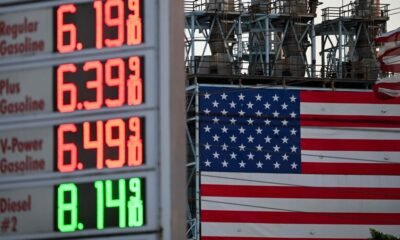
U.S. national average diesel prices reached $6.27 per gallon as of October, according to AAA Fuel Prices.
However, with the midterm elections next month, critics argue that the amount of supply volume shared by Trump is insufficient, also suggesting that Russia is likely unable to produce as much at its refineries impacted by Ukrainian attacks.
Before the reported lift on the ban, Russian authorities had recently extended the ban on exports of diesel untill end of October amid the domestic crunch in supplies – a rare case for the country, which before the invasion of Ukraine was one of the top global energy suppliers.
Can deal ease pressure on prices?
The U.S.-Russia deal, which has led to a rebuke by Ukraine and its European allies, such as Germany, raised a question: could it actually help alleviate the recent cost pressures the customers across Europe and the U.S. have been facing?
Following Trump’s announcement, diesel futures in fact dropped, trading about 4.5% lower at $4.67 per gallon. Data from the NY Harbor chart, displaying costs of futures on Oct. 9, showed that the November price dropped by 4.1% to $4.68.
Still, it is unclear how it would reflect on crude oil prices, with tensions in the Middle East and lately between Saudi Arabia and Houthi rebels also weighing on the outlook.
Diesel is a refined product, and additional shipments do not automatically increase crude production.
WTI price settled Friday at $91.85 per barrel, up 0.39%, while Brent crude closed at $104.72, gaining 0.42%. Both benchmarks finished higher despite the initial reaction to Trump’s announcement.
But since diesel is used in logistics and agriculture and coupled with the recent G-7 decision to release additional emergency stockpiles, any drop in prices would be welcomed by farmers and companies, which have voiced dissatisfaction with the current level of prices.
The U.S.-Russia deal was also criticized by Ukrainian President Volodymyr Zelenskyy, after which Trump said the war-torn country needed a new president.
“Allowing Russia to sell petroleum products is an investment in the war, which must be ended, not prolonged,” Zelenskyy wrote on Telegram on Friday evening.
German Education Minister Karin Prien on Sunday also criticized Trump over his call for a new Ukrainian president amid the recent U.S.-Russia diesel agreement.
“For a few liters of diesel. What a moral bankruptcy,” Prien said on X in response to Trump’s remarks.
Trump on Saturday called for Ukraine to “get a new president,” accusing Zelenskyy of repeatedly failing to reach a deal to end the war with Russia.
“I suggest they get a new leader who can make a deal, because he could have made many deals that, for some reason, he never does,” Trump said.
Meanwhile, Germany reaffirmed its commitment to sanctions against Russia on Saturday following the Trump-Putin agreement, according to German media.
The bank accounts of 214 individuals and companies have been frozen as part of the ongoing investigation into funds and asset management companies following the liquidation order by Turkish authorities, with TL 187 billion (about $3.8 billion) in earnings under scrutiny, according to a Sunday report by Sabah newspaper.
As part of an ongoing investigation into investment funds in Istanbul, authorities identified 141 individuals and 73 companies, 214 in total, who reportedly earned more than TL 100 million from three funds, the report suggested.
The Istanbul Chief Public Prosecutor’s Office is said to have sent the list of these individuals and companies to the Savings Deposit Insurance Fund (TMSF), which has begun formally notifying them about the return of their earnings, it added.
Court orders have also imposed travel bans preventing the relevant individuals and company executives from leaving Türkiye.
Moreover, investigators are reportedly tracing where the money went after it was withdrawn from the investment funds.
On Friday, another report said that Turkish prosecutors have identified 214 individuals and companies they say made a combined TL 187.65 billion from three of the investment funds at the center of the country’s fund turmoil.
The Sunday report names Melis Sütşurup Sandal, the wife of Turkish singer Mustafa Sandal.
According to the investigation documents cited in the report, she reportedly earned TL 2.355 billion from Tera’s TLY investment fund, placing her first among the individuals listed.
Her total withdrawals from fund accounts during 2026 reportedly amounted to nearly TL 15.8 billion. As of Sept. 16, 2026, her fund account reportedly held approximately TL 250 million.
The Financial Crimes Investigation Board, known as MASAK, has also begun examining the bank accounts of people who transferred money from their fund investments into their personal bank accounts. Investigators are said to be preparing detailed reports to determine where the approximately TL 187.65 billion ended up.
Authorities launched a sweeping investigation and market intervention last month after suspected price manipulation in a number of thinly traded stocks triggered heavy losses and redemption pressures at investment funds.
The Capital Markets Board (SPK) halted trading in more than 130 funds on Sept. 17. Nearly half a million investors have been affected.
India targets increasing its steel capacity to 604 million metric tons by 2047 from around 220 million tons at present, according a draft steel policy for public consultation released late on Saturday.
Reuters reported last week, citing the draft document, that the policy lays out plans to cut sector emissions and shore up access to iron ore and coking coal, key raw materials, to meet anticipated demand.
The policy aims to cut the sector’s average carbon-emission intensity to around 1.54 tons of carbon dioxide per ton of crude steel by 2047 from the current 2.54 tons, in line with India’s net zero emission goal for 2070, according to the draft document.
The steel ministry expects iron ore demand at 772 million tons and plans to secure access to high-grade reserves by pursuing foreign assets and joint ventures, the document said.
The ministry also expects coking coal demand to reach 236 million tons, the document said, with the government planning to diversify its sourcing via “strategic global outreach” and acquire overseas assets.


-

 Economy3 days ago
Türkiye identifies 214 people, firms made about $3.8B from troubled funds
-
 Politics3 days ago
Türkiye, France deepen military ties under new road map
-

 Economy3 days ago
Türkiye extends high-speed rail network to EU border
-

 Politics3 days ago
Türkiye’s Akıncı drones extend gendarmerie’s reach across country
-
 Economy3 days ago
European firms called to expand partnerships with Turkish contractors
-

 Politics3 days ago
Türkiye cooperates with EU for foreign nationals in need
-

 Politics2 days ago
Turkish Defense Ministry marks 7 years since Operation Peace Spring
-
 Economy20 hours ago
Can diesel prices fall after Trump-Russia deal?