
Politics
What does NATO membership mean for Türkiye?

Türkiye this year marks the 74th anniversary of its accession to NATO and has the second-largest army in the alliance. It is the only country in NATO’s “southern flank” with a sizable military power and a gateway to the Middle East and wider Asia. Security of the Black Sea also largely depends on Türkiye, especially amid the Russia-Ukraine conflict, which threatens maritime security.
Founded on April 4, 1949, under the collective self-defense principle set out in Article 51 of the United Nations Charter, the North Atlantic Treaty Organization (NATO) was established as a defense alliance against the Soviet threat.
Following the end of the Cold War and the bipolar world order in 1989, NATO launched its Partnership for Peace program with former socialist countries in 1994, with the aim of facilitating their eventual accession to the alliance. In this context, the Czech Republic, Hungary and Poland joined NATO in 1999, bringing the number of member states to 19.
The fall of the Berlin Wall on Nov. 9, 1989, marked a turning point in NATO’s history and heralded the end of the Cold War.
Following the collapse of the Soviet Union, NATO established partnerships with its former adversaries as the alliance adapted to the post-Cold War security environment.
NATO later conducted its first major crisis-management operation in Bosnia and Herzegovina.
The Sept. 11 terrorist attacks in New York and Washington prompted NATO to invoke Article 5 of the North Atlantic Treaty for the first time in its history and led the alliance to adopt a broader approach to security.
Article 5 of the North Atlantic Treaty forms the basis of NATO’s collective defense principle, under which an armed attack against one or more allies is considered an attack against all members.
The article states that if such an attack occurs in North America or Europe, each member will assist the attacked ally by taking “such action as it deems necessary,” including the possible use of armed force, in line with the right to individual or collective self-defense recognized by Article 51 of the United Nations Charter.
NATO subsequently took command of the International Security Assistance Force (ISAF) in Afghanistan.
At NATO’s Prague Summit in November 2002, the alliance entered its second round of post-Cold War enlargement, holding accession and alliance-related talks with Balkan and Baltic countries.
Greece also withdrew from NATO’s military command structure in 1974 in response to Türkiye’s second Cyprus Peace Operation in August that year, but returned to the structure in 1980.
NATO marked its 77th anniversary on April 4, 2026, celebrating the signing of the North Atlantic Treaty in Washington, D.C., on April 4, 1949.
The main aim of the alliance is to maintain the security and sovereignty of member states while developing cooperation among partners.
For Türkiye, the key factor behind accession was the need to balance Soviet pressure, particularly Moscow’s claims over the Turkish straits and eastern provinces. Since joining NATO in 1952, however, Türkiye has emerged as a key member of the alliance due to its support for NATO missions, participation in exercises, steadily growing military capabilities and geopolitical importance.
Türkiye enters alliance
Following World War II, the Soviet Union expanded its influence by establishing communist governments across Eastern Europe, laying the foundations of the Cold War.
NATO emerged as a source of hope for Türkiye under these circumstances. From the alliance’s establishment, the Turkish government showed a strong willingness to join. However, some of NATO’s smaller members, as well as the United States, initially opposed Türkiye’s membership over concerns that it could heighten the Soviet threat.
Yet, Türkiye’s geopolitical importance and the performance of Turkish troops deployed during the Korean War in 1950 demonstrated the potential strategic value of bringing the country into NATO. After two previous applications, in May and September 1950, had been rejected, Türkiye was invited to join NATO alongside Greece on Sept. 21, 1951. The U.S. Senate approved the accession of the two countries on Jan. 29, 1952, and the Turkish Grand National Assembly approved Türkiye’s accession to NATO on Feb. 18, 1952.
Contributions to deterrence
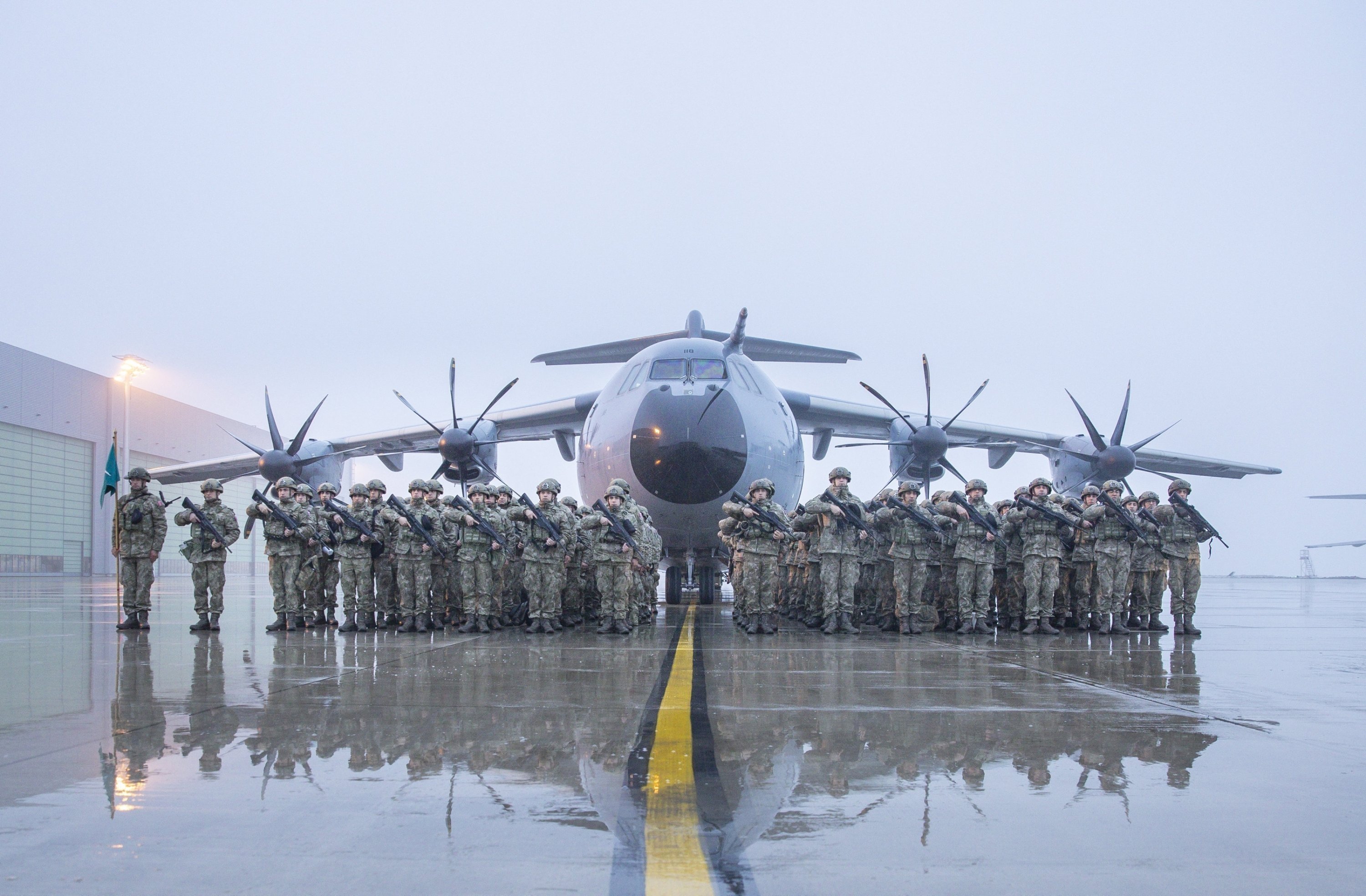
Türkiye’s contributions extend from the Baltic region to the Black Sea and include NATO missions, operations and exercises, as well as responsibilities in maritime security, crisis management, training and deterrence.
The country currently contributes nearly 3,000 personnel, along with various weapons, vehicles and military platforms, to ongoing NATO missions, operations and initiatives.
Türkiye also hosts critical NATO facilities, including the Allied Land Command, located in the western city of Izmir, and the Rapid Deployable Corps, based in Istanbul.
The capital, Ankara, hosts the Center of Excellence for Defense Against Terrorism (COE-DAT) and the Partnership for Peace Training Center. Istanbul hosts the NATO Maritime Security Center of Excellence (MARSEC COE).
Furthermore, the Turkish Armed Forces (TSK) this year joined NATO’s Steadfast Dart exercise in Germany from Feb. 12-24, held to improve the operational readiness of the Allied Reaction Force. The army contributed naval, land and air elements, including the Anadolu Task Group, and deployed a joint force of more than 2,000 personnel to Germany.
Starting in 2028, Türkiye will assume leadership of NATO’s Allied Reaction Force (ARF), one of the Alliance’s most critical military capabilities, further strengthening its key role in European security.
With its capabilities in artificial intelligence, cyber defense and space, Türkiye stands out as one of the NATO members adapting most rapidly to the Alliance’s evolving threat landscape.
In this context, Türkiye stands out as one of NATO’s key members strengthening not only its own defense capabilities but also the Alliance’s technological edge through major projects such as the Steel Dome integrated air defense system, the KAAN fighter jet and the Altay main battle tank.
Türkiye allocated 2.33% of its gross domestic product (GDP) to defense in 2025, placing it among the NATO members assuming a high level of financial and military responsibility within the Alliance.
Türkiye also remains one of NATO’s key members in counterterrorism, maintaining an active operational role in combating terrorism, one of the threats facing the Alliance.
Significant missions
Since joining NATO, Türkiye has steadily expanded its contributions to the alliance’s missions and operations, including in Afghanistan, Kosovo, Bosnia-Herzegovina, Libya and Iraq. Turkish officials say the country has preserved and developed Cold War-era military capabilities while also fighting terrorism and responding to regional instability.
Türkiye supported NATO’s Afghanistan mission between 2002 and 2014 under the International Security Assistance Force and later contributed to the Resolute Support Mission from 2015. Turkish forces also assumed framework nation responsibility for the secure operation of Kabul Hamid Karzai International Airport until NATO’s mission ended in August 2021.
The Turkish military also contributed to the NATO Mission Iraq, launched to help build the capacity of the Iraqi army, from 2018 until a withdrawal process began in March amid worsening security conditions.
Following NATO’s decision to continue the mission with a core staff at the Allied Joint Force Command Naples, Türkiye assigned three personnel to the new structure.
July’s NATO summit
Moreover, Ankara this year, hosted the 36th NATO Heads of State and Government Summit on July 7-8, with leaders issuing a final declaration reaffirming their “unwavering commitment” to Article 5, the alliance’s collective defense clause, and to the transatlantic bond.
The summit brought together leaders of the 32-member alliance as well as key partners to discuss Europe’s defense capacity.
The final declaration of the summit in the end underscored collective defense, procurement agreements and continued support for Ukraine.
Member states had gathered in Ankara to reaffirm their “unwavering commitment” to Article 5, NATO’s collective defense clause, and to the transatlantic bond, it noted.
The declaration said the investments would deliver required capabilities while also strengthening the defense industry and resilience. adding that European allies and Canada increased investment in core defense requirements by more than $139 billion in 2025.
NATO allies further stressed that the support for Ukraine should remain fair, predictable and sustainable over the long term, pledging 70 billion euros ($81.5 billion) in military equipment, assistance and training for Ukraine in 2026 and committing to maintain at least the same level of support in 2027.
Moreover, the declaration also emphasized that the Alliance continued to respond and adapt to strategic competition, widespread instability, hybrid threats and recurring crises shaping the broader security environment.
Türkiye has no plans to engage Yemen’s Houthi rebels in combat under its trilateral defense agreement with Saudi Arabia and Pakistan, Defense Minister Yaşar Güler said Friday, stressing that any Turkish military support for Riyadh would focus on strengthening deterrence and preventing further regional escalation.
Güler outlined Ankara’s position on the Mecca Joint Defense Agreement, signed by Türkiye, Saudi Arabia and Pakistan in August and submitted to the Turkish Parliament for ratification this week.
“We absolutely do not envisage entering into any clashes with the Houthis,” Güler told Star TV, emphasizing that Türkiye’s priority was to prevent new tensions and contribute to regional security and stability.
He said potential Turkish military assistance to Saudi Arabia would follow a model similar to Ankara’s existing military cooperation with Qatar, focusing primarily on deterrence rather than direct involvement in hostilities.
“In this context, as in Qatar, the primary objective of our potential military support for Saudi Arabia would be to strengthen deterrence,” Güler said.
The agreement, which commits the three countries to regard an armed attack against one member as an attack against all, has raised questions about the extent of Türkiye’s potential military involvement amid continued Houthi attacks targeting Saudi Arabia.
Güler clarified that the scope of any Turkish assistance would be determined only after the Turkish Parliament ratifies the agreement and the necessary legal procedures are completed.
He said Ankara would then evaluate Saudi Arabia’s requests within the framework of parliamentary authorization before deciding on the nature and extent of its support.
The minister reiterated that Türkiye’s approach was aimed at strengthening collective security while avoiding actions that could trigger further military confrontation in the region.
Türkiye offers Egypt maritime deal
Turning to developments in the Eastern Mediterranean, Güler said Türkiye was prepared to negotiate a maritime boundary delimitation agreement with Egypt, highlighting the potential benefits for Cairo.
Following Ankara’s maritime jurisdiction agreement with Libya, the minister said Türkiye remained open to similar cooperation with Egypt.
“Our proposal to Egypt is clear,” Güler said, explaining that Cairo could secure approximately 15,000 square kilometers (5,800 square miles) of additional maritime jurisdiction by reaching an agreement with Türkiye rather than pursuing a potential arrangement with Greece.
“We are ready to sign an agreement with Egypt on the delimitation of maritime jurisdiction areas,” he said.
The proposal reflects Ankara’s efforts to strengthen regional cooperation in the Eastern Mediterranean, where competing maritime claims and energy interests have long fueled diplomatic tensions.
Defense cooperation with Qatar, Indonesia, Pakistan
Güler also highlighted the Badr Memorandum of Understanding signed by Türkiye, Qatar, Indonesia and Pakistan, describing it as an important step toward expanding multilateral military cooperation.
He said the memorandum was designed to bring together the defense capabilities and resources of the participating countries while strengthening their strategic partnerships.
The agreement, built on mutual trust and shared objectives, aims to advance defense relations through closer coordination and cooperation, according to the minister.
Güler emphasized that Türkiye would continue developing defense partnerships that contribute to regional stability, enhance collective deterrence and strengthen security cooperation with its international partners.

Türkiye on Saturday accused Greece of undermining the religious freedoms of the Turkish minority in Western Thrace by appointing state-selected muftis in Komotini and Xanthi, renewing a decades-long dispute over the community’s right to choose its religious leaders.
In a statement issued Oct. 24, the Turkish Foreign Ministry said the appointments disregarded rights and freedoms protected under the 1923 Treaty of Lausanne and other international agreements.
“The institution of the Mufti is an integral part of the religious, social, and cultural identity of the Turkish Minority in Western Thrace,” the ministry said.
It accused Athens of ignoring the community’s wishes by refusing to recognize its elected muftis and instead imposing religious officials selected through state procedures.
“By refusing to recognize the Muftis elected by the Turkish Minority in Western Thrace, an official minority in the country, Greece is ignoring the Minority’s will and religious freedom, thereby once again revealing its distorted perspective on fundamental human rights,” the ministry said.
Ankara called on Greek authorities to recognize the community-elected religious leaders and end the appointment of state-selected muftis.
The statement followed the formal appointment of two religious officials for five-year terms. Bilal Kara Halil, a former deputy mufti in Xanthi, was appointed mufti of Komotini, known as Gümülcine in Turkish, while Şükrü Şerif Damatoğlu, who previously served as a religious official on the island of Kos, was appointed mufti of Xanthi, known as İskeçe in Turkish.
The appointments have reinforced a system in which state-appointed muftis operate alongside religious leaders chosen by members of the minority community.
The community recognizes İbrahim Şerif as its elected mufti in Komotini and Mustafa Trampa as its elected mufti in Xanthi. Greek authorities do not officially recognize either leader as the mufti of their respective cities.
The disagreement has persisted for decades, with Türkiye and minority representatives arguing that the community should have the right to elect its religious leadership, while Greece maintains that mufti appointments must follow national law.
The dispute intensified in 1985 following the death of Hüseyin Mustafa Efendi, then mufti of Komotini, when Greek authorities began appointing successors. Legislative changes in 1991 removed earlier provisions concerning elections and consolidated the appointment-based system.
Further reforms, including Law 4964/2022, placed mufti offices more explicitly under state oversight, with appointment procedures involving committees that include minority members. Greece has also appointed a mufti for Didymoteicho under the framework.
Türkiye and minority representatives base their position on the Treaty of Lausanne, the 1913 Treaty of Athens and Greece’s Law No. 2345 of 1920, which they argue supports the community’s right to elect its muftis.
They maintain that muftis serve as more than religious officials, playing a central role in the community’s social and cultural life. From this perspective, state appointments undermine the minority’s religious autonomy and its right to determine its own leadership.
Greece rejects that interpretation. Athens describes the community as a Muslim religious minority rather than an ethnic Turkish minority, citing the terminology used in the Treaty of Lausanne. Greek authorities also argue that the treaty does not require muftis to be elected.
The Greek government maintains that muftis exercise judicial and administrative responsibilities in addition to their religious duties, making their selection subject to the country’s legal framework. It has repeatedly said that it protects religious freedom and guarantees equal citizenship while rejecting efforts to redefine the minority’s official status.
Western Thrace, which includes the Greek regions of Rhodope, Xanthi and Evros, is home to a Muslim minority whose population is commonly estimated at tens of thousands to as many as 100,000 to 150,000 people, particularly in Rhodope and Xanthi.
The community maintains mosques, religious foundations and educational institutions. The management of foundations and communal property has also been a longstanding source of disagreement, including disputes over state-appointed administrators.
Türkiye has repeatedly raised minority rights and religious autonomy under the Treaty of Lausanne and related agreements, including in previous statements concerning mufti appointments in Didymoteicho and other parts of the region.
Turkish Foreign Minister Hakan Fidan is scheduled to meet Yemen’s top diplomat, Afrah Abdulaziz Al-Zuba, in Istanbul on Saturday to discuss bilateral relations, efforts to end Yemen’s conflict and growing threats to international shipping routes.
The Oct. 24 meeting comes as renewed fighting in Yemen raises concerns over security in the Red Sea and the Bab el-Mandeb Strait, a strategic maritime chokepoint connecting the Red Sea to the Gulf of Aden. The talks are also expected to address regional instability and the need to restore safe passage through the Strait of Hormuz.
According to Turkish Foreign Ministry sources, Fidan will reaffirm Türkiye’s support for Yemen’s territorial integrity, national unity and internationally recognized government. He is also expected to stress the need for a lasting political settlement and condemn Houthi attacks targeting civilians and civilian infrastructure.
Particular attention is expected to focus on maritime security, with both the Bab el-Mandeb and Strait of Hormuz central to concerns over the safety and freedom of international navigation.
Al-Zuba’s visit marks her first bilateral foreign trip since becoming Yemen’s foreign minister in July. She also arrived in Istanbul carrying a written message from Presidential Leadership Council Chairman Rashad Muhammad Al-Alimi for Turkish President Recep Tayyip Erdoğan.
Her appointment was part of a limited cabinet reshuffle in the internationally recognized government led by Prime Minister Shaya Mohsen Al-Zindani. She became the first woman to serve as Yemen’s foreign minister and one of the most senior female officials in the country’s government. She was sworn in before Al-Alimi in Riyadh on July 29.
Al-Zuba previously served as minister of planning and international cooperation, taking up the position in February 2026. She brings more than 25 years of experience in development, public administration, institutional governance and peacebuilding.
Originally from Al-Bayda in central Yemen, she trained as a pharmacist at Sana’a University before earning a master’s degree in community health and health economics in Malaysia and an MBA in Yemen. She also headed the Executive Bureau for the Acceleration of Donor Pledges Absorption and the Execution of Reform Policies, coordinating with international partners, including the World Bank, International Monetary Fund and Saudi Development and Reconstruction Program for Yemen.
Her experience also includes participation in Yemen’s National Dialogue Conference following the 2011 uprising, which sought to establish a framework for political reform and address longstanding divisions in the country.
Since her appointment, Al-Zuba has visited Gulf countries as part of her diplomatic engagements. Her trip to Türkiye comes as Yemeni officials seek stronger cooperation with Ankara on rebuilding state institutions, improving public services and coordinating diplomatic efforts in support of the internationally recognized government.
The discussions in Istanbul are expected to underscore Türkiye’s longstanding position in support of Yemen’s sovereignty and internationally recognized authorities, alongside its call for a negotiated settlement to the conflict that escalated into a full-scale war in 2014-2015.
The meeting comes amid renewed fighting along Yemen’s Red Sea coast. According to reports cited in the background to the talks, Houthi forces advanced in September, capturing the port of Mocha, also known as Mokha, and positions around the Bab el-Mandeb Strait, including Mayyun Island, also called Perim Island.
The reported advances heightened concerns over the security of one of the world’s most strategically important shipping corridors. The Bab el-Mandeb serves as a gateway between the Red Sea and the Gulf of Aden, linking maritime traffic to the Suez Canal route, a major passage for international trade and energy shipments. Commercial shipping through the strait had already declined sharply from pre-crisis levels.
In early October, Yemeni government forces, backed by the Saudi-led coalition, launched a counteroffensive known as Operation Dawn of Yemen. Government-aligned forces reported advances in the Dhubab district and movements toward Mocha and positions overlooking the strait, supported by Saudi airstrikes.
Fighting has also intensified around Taiz, where Houthi forces have sought to increase pressure on areas held by the government. Attacks on Saudi targets and threats against commercial shipping have added to regional tensions, while security concerns around the Strait of Hormuz have further complicated the maritime picture.
The Istanbul talks will bring these interconnected challenges to the forefront of Türkiye-Yemen relations. Ankara has consistently advocated dialogue as the route to a sustainable settlement while backing Yemen’s sovereignty and internationally recognized institutions.
Türkiye’s Hakan Fidan is set to meet Yemen’s first female foreign minister, Afrah Abdulaziz Al-Zuba, in Istanbul as renewed fighting, Houthi advances and threats to shipping in the Bab el-Mandeb Strait heighten regional tensions, putting Yemen’s political future and the security of vital global trade routes at the center of diplomatic talks.
Türkiye strongly condemned a deadly attack on a Greek Orthodox church in Jordan that killed eight people and wounded about 40 others, expressing solidarity with the Jordanian people and leadership as authorities pursued the suspected gunmen.
In a statement released Saturday, the Turkish Foreign Ministry said it “strongly condemn (s) the armed attack carried out against a church in Jordan’s Karak province.”
The ministry extended its condolences to the victims’ families and the Jordanian people, while wishing the injured a speedy recovery.
“We once again emphasize our solidarity with Jordan in the face of this heinous attack targeting the country’s unity and peace,” the statement added.
The attack occurred Friday afternoon at St. George’s Greek Orthodox Church in the village of Hammoud in Karak Governorate, south of the capital, Amman. Three unidentified gunmen reportedly arrived by vehicle during a funeral service and opened fire on mourners.
Surveillance footage reviewed by multiple media outlets showed the attackers approaching the church compound and firing from outside before advancing toward the entrance. Witnesses reported several minutes of sustained gunfire.
Between 150 and 200 people were reportedly in and around the church when the shooting began, with many of the victims said to be between 50 and 70 years old.
Jordanian authorities initially reported seven deaths, but the toll rose to eight Saturday after one of the critically injured victims died, according to Health Minister Ibrahim al-Bdour.
About 40 people were wounded, with approximately 26 to 27 still hospitalized Saturday. Some patients were transferred to medical facilities in Amman, including Al-Hussein Medical City, while others received treatment at hospitals in Karak.
Jordanian authorities described the shooting as a terrorist attack linked to extremist ideology. No group had claimed responsibility as of Saturday, and a manhunt for the perpetrators remained underway.
King Abdullah II visited the area and injured victims, vowing a forceful response against those responsible. He stressed that attempts to divide the country would fail in the face of national unity and pledged that Jordan would respond with an “iron fist.”
Prime Minister Jafar Hassan and Interior Minister Mazen al-Faraya also condemned the attack and vowed to bring those responsible to justice. The government declared three days of national mourning.
The shooting sent shock waves through Jordan, where Christians make up an estimated 2% to 3% of the population and have long coexisted with the Muslim majority. Karak is home to a historically significant Christian community, making the attack on the church particularly sensitive.
Jordanian religious leaders, the country’s Grand Mufti and the Greek Orthodox Patriarchate of Jerusalem condemned the violence. The United Nations, the European Union and foreign diplomatic missions also expressed solidarity with Jordan and denounced the targeting of civilians and places of worship.
Foreign ministers from eight countries called for diplomatic solutions to escalating Middle East conflicts, warning that military confrontations and threats to key shipping routes could deepen humanitarian suffering and disrupt global trade.
The ministers met in Istanbul on Oct. 23 for the first session of the expanded R4+E3 format, bringing together Türkiye, Egypt, Pakistan and Saudi Arabia with France, Germany, Italy and the United Kingdom. Hosted by Turkish Foreign Minister Hakan Fidan, the talks focused on the conflict involving the United States, Israel and Iran, the Israeli-Palestinian conflict, Houthi attacks in Yemen and threats to maritime security.
The meeting marked the sixth foreign ministers’ gathering of the R4 Group, established in 2026 to promote regional ownership of Middle East security challenges. It was the first to include France, Germany and the U.K., collectively known as the E3, alongside Italy.
Egyptian Foreign Minister Badr Abdelatty, Pakistani Deputy Prime Minister and Foreign Minister Mohammad Ishaq Dar, and Saudi Foreign Minister Prince Faisal bin Farhan Al Saud represented the R4 Group. European participants included French Foreign Minister Jean-Noël Barrot, German Foreign Minister Johann Wadephul, British Foreign Secretary Ed Miliband and Italian Foreign Minister Antonio Tajani.
The expanded meeting followed separate consultations among the four R4 members. The ministers also held bilateral discussions and later met with Turkish President Recep Tayyip Erdoğan.
In a joint statement, the eight countries said they had discussed regional and international security challenges and pledged to support diplomatic efforts to promote peace and stability. They also highlighted the economic and trade consequences of the conflicts, particularly the risks to critical maritime routes.
Diplomacy over military escalation
Fidan said after the meeting that military intervention in Iran would not resolve the crisis, adding that none of the participating countries currently supported such action.
The ministers called for dialogue and diplomacy to prevent further escalation in the conflict involving Washington, Israel and Tehran. They stressed the need to protect civilians, civilian infrastructure and commercial vessels, while backing efforts to reach a lasting negotiated settlement.
The R4 Group’s separate statement welcomed the Islamabad Memorandum of Understanding and ongoing diplomatic initiatives aimed at containing tensions.
The ministers also underscored the importance of freedom of navigation, particularly through the Strait of Hormuz, a strategic passage for global energy shipments. They warned that disruptions to maritime traffic could threaten international supply chains and the movement of energy, food and fertilizer, with disproportionate consequences for vulnerable populations.
They rejected restrictions on lawful navigation and called for the swift restoration of safe and uninterrupted passage through the Strait of Hormuz.
The Bab al-Mandeb Strait, another vital shipping corridor connecting the Red Sea to the Gulf of Aden, also featured in discussions over maritime security and attacks on commercial vessels.
Strong condemnation of Houthi attacks
The R4 ministers condemned what they described as an unacceptable escalation by Yemen’s Houthi militia, citing attacks against Saudi Arabia, civilian infrastructure and commercial shipping in the Red Sea and Bab al-Mandeb Strait.
They expressed solidarity with the internationally recognized Yemeni government and Saudi Arabia, calling on the Houthis to immediately end military operations, threats and attacks.
The ministers also urged the group to return to the political process in good faith, warning that continued hostilities were worsening an already severe humanitarian crisis.
The issue carries broader regional implications, as insecurity around the Red Sea and surrounding waterways threatens commercial shipping and international trade.
Call for Palestinian statehood and end to Israeli violence
The R4 Group’s statement identified Israel’s occupation of Palestinian territories as a fundamental source of instability in the region and beyond, arguing that Israeli policies had reinforced perceptions of injustice internationally.
The ministers called for the implementation of a two-state solution in accordance with relevant U.N. resolutions, reaffirming the Palestinian people’s right to self-determination and the establishment of an independent, sovereign, viable and contiguous Palestinian state based on the June 4, 1967, lines, with East Jerusalem as its capital.
They demanded an end to Israeli violence, settlement expansion in the West Bank and East Jerusalem, settler attacks and efforts to change Jerusalem’s legal and historical status.
The statement also called for an end to the destruction and humanitarian suffering in Palestine, emphasizing the need for uninterrupted aid deliveries and reconstruction in Gaza.
The eight-nation gathering placed the Israeli-Palestinian conflict alongside the Iran crisis and maritime security as interconnected challenges requiring sustained diplomatic engagement.
Türkiye seeks wider diplomatic coordination
The meeting came amid mounting concerns over regional instability, including the humanitarian crisis in Gaza and the West Bank, Houthi attacks and tensions involving Iran. Potential disruptions to the Strait of Hormuz and Bab al-Mandeb have raised wider concerns about energy security, food supplies and international commerce.
By bringing together four regional powers and four major European countries, Türkiye sought to strengthen coordination between Middle Eastern governments and European partners.
The participants agreed to maintain consultations in the expanded format, signaling their intention to continue working together beyond the Istanbul meeting.
The Greek government has appointed new muftis in Komotini (Gümülcine) and Xanthi (Iskeçe), proceeding with the appointments despite calls from the Turkish minority in Western Thrace to elect its own religious leaders.
A controversial presidential decree formalizing the appointments was published in Greece’s Official Gazette on Friday.
Under the decree, Bilal Kara Halil, a former deputy mufti in Xanthi, was appointed mufti of Komotini, while Şükrü Şerif Damatoğlu, who worked as a religious official on the island of Kos, was appointed mufti of Xanthi.
Both appointments are for five-year terms.
The dispute over mufti appointments in Western Thrace dates back to 1985, when Greek authorities began appointing muftis following the death of Hüseyin Mustafa Efendi, then mufti of Komotini.
In 1991, Greece amended its legislation, removing provisions concerning the election of muftis and cementing the appointment-based system.
The changes led to a dual structure in the region, with state-appointed muftis operating alongside religious leaders elected by the Turkish minority in Western Thrace.
Greek authorities do not officially recognize the muftis elected by the minority, whose representatives continue to regard their own elected religious leaders as legitimate.
Ibrahim Şerif in Komotini and Mustafa Trampa in Xanthi are recognized by the minority as its elected muftis.
Representatives of the Turkish minority cite the 1923 Treaty of Lausanne, the 1913 Treaty of Athens and Law No. 2345, enacted in 1920, as legal grounds for their right to elect muftis. They call on the Greek government to end the appointment system and officially recognize the religious leaders chosen by the minority.
The Greek government, meanwhile, maintains the controversial appointment system, treating muftis as public officials.


-
 Economy3 days ago
Türkiye says waiting for Qatar sale contract for Eurofighter jets
-

 Sports2 days ago
Beşiktaş hold Palace with 10 men, Trabzonspor beat Hearts
-
 Economy3 days ago
Türkiye in advantageous position regarding global debt: Şimşek
-
 Economy3 days ago
Türkiye, Canada launch strategic partnership, eye $10B trade target
-
 Politics3 days ago
Erdoğan discusses regional security with Azerbaijan, Bulgaria leaders
-

 Economy3 days ago
French debt risk premium reaches eurozone sovereign crisis levels
-
 Economy2 days ago
Canada eyes Türkiye’s defense agency as model for domestic arms sector
-

 Sports3 days ago
Türkiye rolls national team dice on Sergen Yalçın with 4-year deal