
Politics
Erdoğan backs Teknofest youth against tech oligarchs’ influence

President Recep Tayyip Erdoğan warned that powerful technology leaders are seeking to shape young people’s lives and values, saying Türkiye must raise a generation capable of embracing technological progress while preserving its national and spiritual identity.
Speaking Saturday at the 75th anniversary gathering of the Ilim Yayma Cemiyeti in Istanbul, Erdoğan described young people as the primary target of what he called “techno-oligarchs,” whom he accused of seeking to direct the future according to their own interests and worldview.
He said the influence of artificial intelligence and rapidly advancing technologies was transforming society, making it increasingly important to protect young people from ideologies that encourage racism, hedonism and disregard for moral boundaries.
“The Teknofest generation will be our greatest assurance against the domineering mentality of techno-oligarchs who commodify people, nature, the sky and even space,” Erdoğan said, referring to Türkiye’s technology and aerospace festival, which promotes domestic innovation and attracts young people interested in science and engineering.
He also identified the Ilim Yayma generation as central to this effort, emphasizing the need to develop technology in ways that put people first and preserve moral responsibility.
“Our common goal is to raise a generation that uses and develops technology with a human-centered approach,” he said, calling for young people who read more, think critically and produce innovative work without losing their conscience, humanity or connection to national and spiritual values.
Erdoğan pointed to recent troubling incidents in schools as evidence of the threats posed by what he described as harmful influences, arguing that young people must be protected from ideologies that promote racial hatred and excessive self-indulgence.
He urged students and educators to remain committed to their responsibilities, saying the country must prepare young people to navigate an uncertain future shaped by technological change and global cultural pressures.
Ilim Yayma’s 75-year history
Erdoğan also praised the Ilim Yayma Cemiyeti, a Turkish educational and civil society organization founded in 1951, for its contribution to the country’s education system and the development of generations of students.
He described the organization’s history as closely intertwined with Türkiye’s own, saying its founding principles reflected the country’s long-standing ambition to educate young people who are knowledgeable, ethical and committed to serving society.
“Although it was founded in 1951, the history of Ilim Yayma is also the history of Türkiye,” Erdoğan said. “Its founding philosophy is the philosophy of Türkiye’s existence, and its ultimate goal is Türkiye’s centuries-old aspiration.”
He paid tribute to the organization’s founders, including its first president, Seniyüddin Başak, who helped protect Turkish foundation properties during the Lausanne Conference; Gen. Ömer Cemal Karabekir, who supported the Turkish National Movement during the War of Independence; and retired Col. Vehbi Bilimer, a veteran of the Gallipoli campaign, the Battle of Kut and the Turkish War of Independence.
Erdoğan also recalled Hasan Hikmet Demirbağ, a writer for the Sebilürreşad magazine and associate of national poet Mehmet Akif Ersoy, among the figures who helped establish the organization.
He said the founders shared a commitment to ensuring that Turkish children would not be deprived of education, knowledge or moral guidance, particularly during periods of political and social hardship.
Their common ambition, Erdoğan said, was to entrust the country’s future to a confident, well-educated and responsible generation.
He described Ilim Yayma as a symbol of Türkiye’s struggle for independence and its future, adding that the organization’s work was closely linked to the country’s broader struggles over education and democracy.
Organization helped expand imam hatip schools
Erdoğan highlighted Ilim Yayma’s role in the reopening and expansion of imam hatip schools, which combine religious instruction with general education.
He said the organization helped establish Türkiye’s first imam hatip school on Oct. 17, 1951, just six days after its founding, and later contributed to the construction of more than 100 such high schools across the country.
The expansion helped extend educational opportunities beyond Istanbul, with new institutions opening across Anatolia, Erdoğan said.
The organization also established student dormitories in several cities and provided scholarships and accommodation for students traveling from other parts of the country to study in Istanbul. These services enabled tens of thousands of young people to continue their education in safer and more supportive environments, he added.
Erdoğan said the organization had expanded its work despite obstacles, pressure and difficulties over the decades, becoming an important presence in Türkiye’s educational and civil society landscape.
He credited the founders’ determination and faith with laying the foundations for an institution that continues to support students and educators today.
192 branches, 153 dormitories and 122 education centers
Erdoğan said Ilim Yayma Cemiyeti now operates 192 branches, 153 dormitories and 122 education centers, providing services from basic education through higher education and academic development.
He also praised the contributions of the Ilim Yayma Foundation, Istanbul Sabahattin Zaim University, volunteers, donors and alumni associations, saying their combined work had helped the wider Ilim Yayma community serve the country and society.
“What 68 dedicated individuals set in motion 75 years ago now touches the lives of millions through schools, dormitories, scholarships, education centers, academic support and international initiatives,” he said.
Erdoğan described the organization’s growth as a source of pride, saying its founders had planted a modest seed that had grown into a mighty plane tree under God’s providence.
He said generations of students had benefited from the institution’s work, with many going on to serve their country and humanity.
The president urged the organization to pass its legacy on to future generations with renewed determination, expressing confidence that its work would continue to expand.
He also called on young people to draw inspiration from history while focusing on the challenges ahead, stressing that educating people required patience, sustained effort and a long-term vision.
Erdoğan calls for investment in future generations
Erdoğan said Ilim Yayma’s achievements over the past 75 years were important, but its future contribution would depend on how effectively it responded to changing social and technological needs.
He raised questions about how the organization could reach more students, help young people discover their talents, safeguard their spiritual development and strengthen national identity amid global cultural influences.
He also stressed the need for Türkiye to produce scientific, technological, cultural and artistic works rooted in its own traditions while remaining relevant in a rapidly changing world.
The president said artificial intelligence was already bringing fundamental changes to everyday life, making it necessary for educational institutions to adapt their methods and priorities.
He warned that powerful technology executives, whom he called “techno-oligarchs,” wanted to influence not only present-day society but also the future according to their own interests.
According to Erdoğan, the challenge was to ensure that technological progress served humanity rather than treating people and the natural world as commodities.
He said the Teknofest generation represented the kind of young people Türkiye needed to meet that challenge, combining scientific ambition with ethical responsibility and a strong sense of identity.
“Do not become complacent or lose heart,” Erdoğan told the audience. “If you have faith, you are the ones who will prevail.”
He pledged that the organization would continue the work begun by its founders, saying its members would uphold their legacy without seeking worldly rewards such as status, fame or wealth.
Erdoğan concluded by expressing confidence in the country’s young people and urging them to carry forward the organization’s educational mission with determination.
Authorities apprehended 17 suspects on Oct. 7 in yet another operation targeting corruption allegations engulfing municipalities. The deputy mayor of Esenyurt, Istanbul’s most populous district, was among them. New details from the investigation indicate that Yusuf Ulutaş, a lawyer who previously served as deputy mayor of Istanbul’s Beyoğlu district, enriched himself through bribes.
A report by the Sabah newspaper says Halil Yılmaz, a businessman, told authorities that Ulutaş demanded TL 9 million in exchange for settling the municipality’s outstanding debts to Yılmaz. The businessman said he paid the money in two separate installments at Ulutaş’ municipal office.
Ulutaş and nine other suspects were remanded in custody last week, while the remaining suspects were released under judicial control. The investigation concerns allegations of corruption and bribery at the municipality, which is currently run by a district governor appointed as a trustee following the 2024 arrest of former Mayor Ahmet Özer on charges of links to a terrorist group.
According to the Sabah report, the investigation uncovered a scheme involving kickbacks from public tenders, millions of dollars handed over in cash and secret financial transactions among suspects. Investigators examined witness and suspect statements and uncovered how certain companies were favored in municipal tenders and how municipal officials allegedly demanded 20% of the amount owed to companies in exchange for releasing payments for work they had completed.
Another suspect, Orhan Yıldırım, admitted to paying Ulutaş around $400,000 in exchange for the release of outstanding payments, the report said. An investigation by the Financial Crimes Investigation Board (MASAK) found that 20% of payments made to companies for work carried out for the municipality were transferred to municipal suspects on the same day the payments were made.
Authorities identified another suspect, Anıl Alioğlu, as an alleged intermediary who delivered bribes from companies to municipal officials. The investigation also found that bribes were not always paid in cash and were sometimes delivered in the form of gift cards redeemable at supermarkets and laptop computers.
An examination of Ulutaş’ bank accounts showed that the transaction volume surged to TL 231 million in 2025 from just TL 601,000 in 2017. Investigators also found a transaction volume of TL 212 million in the accounts of Ulutaş’ sister, who works for Turkish Airlines (THY).

The Turkish Armed Forces (TSK) will wrap up a multiweek exercise in the capital, Ankara, on Oct. 22, with a distinguished visitors’ day scheduled for this week. The exercise is in the spotlight as an opportunity to demonstrate the capabilities of locally produced weapons.
Held in Ankara’s Polatlı district, which has long been home to an artillery school, the exercise involves units from all branches of the military, including the Air Force and the Naval Forces.
In the region where Mustafa Kemal Atatürk led an outnumbered army against invading Greek forces 105 years ago, the TSK has had the opportunity to test new weapons and hone its shooting skills. Weapons and defense systems tested during the exercise include the Boran howitzer, the Karaok anti-tank weapon system, electronic warfare equipment, and armed and unarmed drones. A total of 95 weapons and weapons systems are being used in the exercise, while 104 different types of weapons and defense systems are on display in an exhibition area. The Turkish Stars, the military’s aerobatic team, will also perform on Oct. 15 as part of the exercise.
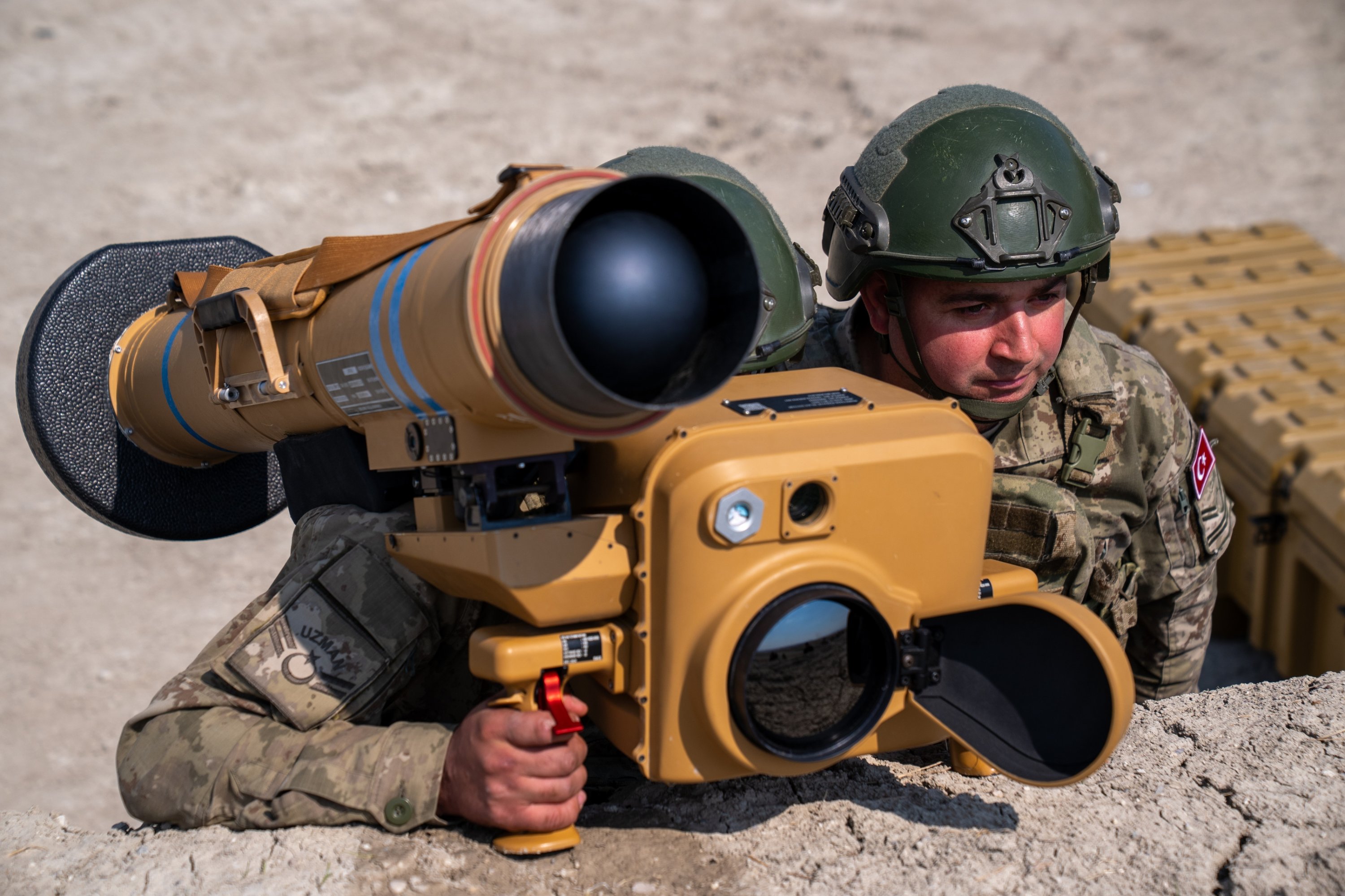
During the exercise, targets at various ranges were hit using sniper rifles of different calibers and specifications. The firing drills employed the domestically developed KNT 76 and Bora 12 rifles chambered in 7.62 mm, the KN12 in 8.59 mm and the KALE-KSR 50 in 12.7 mm.
The 105 mm Boran lightweight towed howitzer, designed for airborne transport and used in counterterrorism operations and challenging terrain, was another highlight of the exercise. It began entering service in 2022 and is equipped with modern artillery systems that enable it to determine its own position and orientation. Capable of firing in 360 degrees, deploying in as little as one minute and firing six to eight rounds per minute, Boran can also conduct direct-fire missions at night and provide close protection thanks to its direct-fire sighting system.
The exercise featured a wounded personnel evacuation and firing drill demonstrating cooperation between an unmanned ground vehicle and a tank. According to the scenario, after the tank reached the wounded person and deployed a smoke screen, the unmanned, modular Palem ground vehicle transported the casualty to a safe area.
Targets were also hit using Panter howitzers during the exercise. Developed using domestic resources and capabilities, the Panter howitzer was integrated into 88 tactical wheeled vehicles in 2025, contributing to the TSK’s firepower and mobility.
The 155 mm Panter howitzer can engage targets at distances of up to 40 kilometers (24.85 miles) with a five-person crew. Its ability to change positions in as little as two minutes enhances its mobility and survivability on the battlefield.
The Karaok anti-tank weapon system was also showcased during the exercise. Developed entirely by Türkiye’s Roketsan using domestic resources and capabilities, Karaok is a third-generation, short-range guided anti-tank weapon featuring a fire-and-forget capability.
Interior Minister Mustafa Çiftçi vowed a strict crackdown on organized crime and warned criminals that they should not think they could “get away” by fleeing abroad. Çiftçi told local broadcaster KonTV on Saturday that he would soon visit Germany and Italy to reinforce Türkiye’s efforts to bring back criminals from those countries.
Since taking office in February, Çiftçi has visited neighboring countries. On Thursday, he was in Greece and had previously held talks with officials in Georgia and Bulgaria to strengthen cooperation in fighting transnational crime. Türkiye’s neighbors are often the first destinations for criminals fleeing the country. Some hide in those countries, while others travel farther west illegally.
Çiftçi is at the forefront of Türkiye’s efforts to crack down on “next-generation gangs,” which have proliferated in recent years. Unlike the Turkish mafia of the past, these gangs rely more heavily on minors and teenagers to commit crimes ranging from extortion to murder. They are also active on social media, where they glorify their crimes and seek to recruit more young people.
“As of the end of September, we had carried out 1,741 operations targeting 625 criminal organizations as part of our crackdown on next-generation criminal organizations. The number of operations reached 1,741 because we conducted multiple operations against some of these groups. As a result, we secured the arrest and imprisonment of 8,170 people.
“Next-generation criminal organizations do not operate only in Türkiye. They immediately flee abroad when they find themselves in trouble. In recent months, I visited Bulgaria in connection with this issue. I later traveled to Georgia and met with the Georgian interior minister. I was in Greece on Thursday, where I held separate meetings with Greece’s minister for citizen protection and minister for migration and asylum.
“Our discussions focused entirely on security diplomacy, next-generation criminal organizations and the places abroad where their members flee and hide. They should not think they can escape us by fleeing abroad. No matter which country in the world they flee to, where they hide or what hole they crawl into, the mighty hand of our state will find them wherever they have fled, bring them back to Türkiye and hand them over to justice. They will answer for their actions before the Turkish judiciary,” Çiftçi said.
“In the first nine months of this year, we secured the extradition of 736 people from abroad. These were individuals who had committed crimes in Türkiye, fled abroad and thought they could escape us there. Through our upcoming visits and security diplomacy efforts, we will further increase this number. We will track down every single one of them and bring them back to Türkiye,” he said.
Noting that next-generation criminal organizations commit a wide range of crimes, including drug trafficking, smuggling, offenses involving irregular migrants, fraud and public-order offenses, Çiftçi said: “One of their sources of funding is drug trafficking, which they use to sustain their operations. Their main source of income is the illicit proceeds they obtain from drug trafficking. When we took office, we identified the fight against drugs as our second major area of focus. Drugs are not just a problem for Türkiye today; they are a problem for the entire world because they directly affect our future. These groups generate income from this trade while continuing to poison our youth. We are continuing to fight them as vigorously as possible to cut off their sources of funding.”
Çiftçi noted that 35,819 people had been arrested in 42,377 operations conducted as part of the fight against drugs this year. He said there were 432,000 people in prisons across Türkiye, adding that 36% of them were either convicted of or detained on drug-related charges.
Çiftçi also reported that the operations had resulted in the seizure of 39 tons of narcotics and approximately 104 million synthetic drug pills. Authorities also seized 20.8 million cannabis plants.
After a two-week hiatus, President Recep Tayyip Erdoğan will convene the Cabinet on Monday.
The investigation into investment funds ordered to be liquidated and planned interim payments to investors will be the main items on the meeting’s agenda. The latest developments in the terror-free Türkiye initiative, ongoing contacts between the United States and Iran to resolve their conflict, the situation in Gaza, the Russia-Ukraine war and economic developments will also be discussed.
A nine-article bill regulating interim payments to investors with holdings in investment funds ordered to be liquidated, as well as the liquidation process itself, has been submitted to the Turkish Parliament. Under the proposal, investors would receive interim payments of up to TL 1 million per person, subject to specified conditions. The payments are planned to be covered by the funds’ assets.
At the Cabinet meeting, officials are expected to discuss preparations for payments to investors and ongoing work on liquidating the funds, alongside the bill’s legislative progress. The decisions made at the fourth meeting of the Fund Coordination Board and the impact of interagency coordination on the process will also be reviewed.
Another key item on the Cabinet’s agenda will be the terror-free Türkiye process. Subcommissions established under the National Solidarity and Integration Coordination Board are being organized, with their duties and areas of authority being defined, while work on interagency coordination continues.
Attention is focused on the work of the monitoring commission in Parliament, while authorities are also tracking progress in the terrorist group PKK’s timeline for laying down its arms. Based on information provided by security agencies, the Cabinet is expected to assess the current state of the process, developments on the ground and the next steps.
On foreign policy, ongoing contacts between the United States and Iran and security developments in the region will take center stage. Ankara is closely monitoring the course of talks between the two countries, efforts to end the fighting and the implications for regional stability.
Recent developments in Gaza and Israel’s attacks, as well as the Russia-Ukraine war, will also feature on the Cabinet’s foreign policy agenda. Officials are expected to assess Türkiye’s diplomatic efforts to resolve regional crises and the potential implications of international developments for the country.
The latest economic developments, efforts to combat inflation and policies aimed at ensuring price stability will also be on the meeting’s agenda.
In parallel with Greece’s defense spending frenzy, the Greek Cypriot administration on the island of Cyprus has ambitions of supremacy at sea and on the island. Located in the south of the divided island of Cyprus, where the existence of Turkish Cypriots is not recognized, the administration eyes key “defense” moves in the Eastern Mediterranean, a source of tensions with Türkiye and Turkish Cypriots.
The new plans to boost defense come amid a stern warning from Ankara, and it remains to be seen whether Greek Cypriots will heed it amid new cooperation with Türkiye’s foes and allies, including France, the U.S. and Israel.
One of the key investments of the Greek Cypriot administration is a 205-million-euro ($229.66-million) naval base project to expand its military facilities in the Eastern Mediterranean, an area where it contests the rights of Turkish Cypriots, to the chagrin of the Turkish Republic of Northern Cyprus’ (TRNC) guarantor state, Türkiye.
In a speech at the inauguration of the new academic year at the National Defense University, Turkish Minister of National Defense Yaşar Güler said that Türkiye would not stand idly by in the face of crises in the wider region. He reiterated Türkiye’s determination to safeguard the security and legitimate rights of Turkish Cypriots, noting that Türkiye is sensitive about protecting rights and interests in the Eastern Mediterranean.
Güler emphasized that all measures had been “decisively taken” as part of national security in the context of developments on the island. At the same time, he pointed out that a policy of oppression that had continued since the 1960s against Turkish Cypriots was still in place. He gave examples of the Greek Cypriot opposition to an international music festival and a football camp by the Barcelona Football Academy scheduled to be held in the TRNC as an “intransigent delusion of the Greek Cypriot side.”
Along with new bases, Greek Cypriots seek to modernize the air base in Baf (Paphos) with U.S. support and secure 1.2 billion euros in defense funding through the European Union’s Security Action for Europe (SAFE) defense financing mechanism.
The Greek Cypriot administration continues its cooperation with the U.S., France and Greece to expand military infrastructure suitable for use by foreign armed forces in the Eastern Mediterranean. The Greek Cypriot administration’s “defense ministry” signed a technical study contract on Oct. 6 with a consortium comprising Greece-based companies TRITON and MARNET to expand the Evangelos Florakis Naval Base in the Mari area.
According to the Greek Cypriot newspaper Fileleftheros, the project aims to upgrade the naval base to accommodate warships belonging to France, Greece and other European countries.
Another component of the Greek Cypriot administration’s military infrastructure projects with foreign countries is the Andreas Papandreou Air Base in Baf. Fileleftheros reported that the U.S. is undertaking the technical work to modernize the air base, and Washington is expected to provide technical and financial support for the project. Preparations involving the U.S. include plans to extend the runway, establish infrastructure suitable for a greater number of military aircraft, build large aircraft hangars and upgrade communications systems. A report by the Greek newspaper Kathimerini Cyprus said the aim is to upgrade the Baf Air Base to standards suitable for use by U.S. military aircraft.
Plans for the Mari Naval Base include increasing the harbor’s depth, expanding berthing areas for large warships and strengthening military logistics infrastructure. According to information published in Greek Cypriot media, authorities are considering increasing the harbor’s current depth of approximately 7 meters (23 feet) to more than 12 meters. The aim is to establish infrastructure suitable for frigates and submarines. France is among the countries expected to benefit from the naval base, while Greek warships may also use the facility.
Greek Cypriot leader Nikos Christodoulides identified strengthening the military capabilities of the Greek Cypriot “national guard” as a priority in the government’s 2026 program.
The Greek Cypriot administration maintains that the modernization projects will serve humanitarian aid and evacuation operations in addition to military activities. It says ownership and control of the facilities will remain with the Greek Cypriot administration.
The Greek Cypriot administration’s military infrastructure projects with foreign countries remain part of the Eastern Mediterranean’s security agenda. The signing of a technical study contract for the Mari Naval Base, the U.S. role in modernizing the Paphos Air Base and plans for France and Greece to use the naval facility highlight the administration’s efforts to expand military cooperation with foreign countries. Technical studies for the expansion of the Mari Naval Base are expected to be completed in October 2027, while the construction project has yet to enter the implementation phase.
Cemil Tugay, mayor of Türkiye’s third-largest city, Izmir, was the latest among dozens of mayors joining the ruling Justice and Development Party (AK Party). His switch was probably the most talked-about, as Izmir has been a stronghold of the opposition Republican People’s Party (CHP), with no AK Party governance for more than two decades. In a lengthy interview with the Yeni Asır newspaper, Tugay explained the story of his historic switch and how he risked being branded a traitor by the opposition.
In the interview published on Sunday, Tugay lamented that neither his former party, the CHP, nor the New Party (YP), founded by former CHP Chair Özgür Özel, stood with him during his tenure, and spoke of how AK Party chair and President Recep Tayyip Erdoğan instilled him with confidence.
“I gave (the switch) a lot of thought; I took a risk. It is not easy, but I believe I did the right thing,” he said. “The biggest gain for me was to feel the support of the president,” said Tugay, who joined the party on Oct. 7, weeks after his resignation from the CHP.
Tugay, elected mayor in 2024 as a CHP candidate, left the opposition party in June, one month after a bitter split among supporters of reinstated Chair Kemal Kılıçdaroğlu and Özgür Özel, who was ousted after a court verdict annulled his chairmanship on charges of vote-buying in a 2023 intra-party election. Despite consecutive wins in most provinces and districts over the past two decades, where it dominated the political landscape, the AK Party had found little support in the city, which is viewed as the heartland of CHP voters. Tugay defeated AK Party lawmaker Hamza Dağ in the 2024 vote, winning 48% of the vote against Dağ’s 37%. The CHP also won 28 of Izmir’s 30 district municipalities in the same election.
The mayor said he had faith in President Erdoğan, citing his background as Istanbul mayor. “He knows very well what state Izmir is in, and how public services can be carried out. I believe we can maintain healthy communication between Izmir and Ankara. Everything will be better for the city,” he said.
Tugay noted that he took over a municipality that faced many problems in 2024. “Aside from financial problems, it was a municipality where things were done in an unplanned manner and with a serious shortage of staff. For instance, IZBETON (a subsidiary of the municipality) was embattled with debt. I improved the municipal services, but the municipality still needs more. We need water treatment facilities, and we need improvements to the sewage system. I was at a crossroads. I would either try to resolve all the problems on my own or leave them to the next mayor. I decided it would be best to work with the AK Party government if it would help Izmir. I thought it was in the best interest of the residents of Izmir,” he said.
The mayor has incurred the wrath of both the CHP and YP, whose leader picked him as the mayoral candidate in the 2024 elections. Answering CHP leader Kemal Kılıçdaroğlu’s claims that he was involved in irregularities and that Kılıçdaroğlu had warned the Özel administration not to nominate him, Tugay said this was not the case. He said he had repeatedly held talks with Kılıçdaroğlu before, and Kılıçdaroğlu never mentioned those claims and openly supported him. “If I was really a bad choice, they could have removed me from the party,” he complained. He said the CHP sought to keep him even after his resignation in June. “They asked me back repeatedly,” he claimed. He complained that the CHP had not stood with him during his tenure and was never interested in the problems the municipality faced. “I lived through many things. The CHP administration did not show up for inauguration ceremonies of big projects. When workers went on strike, the administration did not side with me,” he said.


-
 Politics2 days ago
Turkish Defense Ministry marks 7 years since Operation Peace Spring
-

 Economy1 day ago
Can diesel prices fall after Trump-Russia deal?
-
 Politics1 day ago
Türkiye-France defense cooperation spark concern in Greek media
-
 Politics1 day ago
Türkiye presses Greece to hand over FETÖ members, crime bosses
-
 Economy1 day ago
Tehran’s once-bustling bazaar struggles as war dampens demand
-

 Sports2 days ago
Arsenal rally past Leeds to draw level with Man City atop PL
-
 Sports1 day ago
Deadly Houthi strike on Riyadh airport draws int’l condemnation
-

 Sports2 days ago
Ronaldo provisionally suspended after Portugal walkout