
Politics
Ex-Finnish defense minister sees room for stronger Türkiye ties

Finland and Türkiye are well positioned to deepen defense cooperation as NATO allies, former Finnish Defense Minister Antti Kaikkonen said, highlighting Türkiye’s military capabilities, defense industry and strategic location.
Speaking to Anadolu Agency (AA), Kaikkonen said Finland’s accession to NATO had opened new opportunities for bilateral defense ties between Helsinki and Ankara.
“As NATO allies, Finland and Türkiye are very well positioned to further deepen their defense cooperation,” Kaikkonen noted.
He described Türkiye as an important ally with strong military capabilities and a significant defense industry, noting its strategic position between Europe, the Black Sea and the Middle East.
Kaikkonen noted that a memorandum of understanding on defense industry cooperation signed by the two countries could help further strengthen bilateral relations.
Addressing security in the Baltic Sea, Kaikkonen said Finland was prepared for different scenarios amid heightened regional tensions. NATO membership has strengthened Finland’s deterrence, he said, adding that the country would rely on its national defense forces and allied support in the event of military aggression.
Kaikkonen also pointed to NATO’s Baltic Sentry initiative, which was launched to strengthen surveillance and protect critical infrastructure in the Baltic Sea.
Turning to European defense, he said the continent’s defense industry production remained below required levels, with the war in Ukraine exposing shortages in ammunition, air defense systems, drones, missiles and broader industrial capacity.
Kaikkonen also warned that Russia could reinforce forces operating under its Leningrad Military District over the next two to four years, depending on developments in Ukraine.
Russian forces stationed near Finland could eventually increase from around 30,000 to approximately 80,000 troops, he said, though a major buildup was unlikely while the war in Ukraine continued.
Kaikkonen said future relations between Russia, Northern Europe and NATO would depend on Moscow’s adherence to international law and agreements, adding that political dialogue between Europe and Russia would eventually be necessary.

Türkiye and Greece have engaged in a moderate war of words in recent months. The two sides have occasionally taken steps that could translate into a greater conflict in the future, but they have generally favored maintaining good relations. Greek Prime Minister Kyriakos Mitsotakis, however, appears to be reversing his earlier, warmer rhetoric. Mitsotakis emphasized Greece’s “inalienable right” to extend its territorial waters in the Aegean on Saturday, days after his country signed a historic defense deal with Türkiye’s archfoe, Israel. Experts say this newfound confidence could upset the relative calm.
Professor Ozan Örmeci, a political scientist and general coordinator of the International Political Academy (UPA), says Mitsotakis has, for some time, engaged in strategic moves to stir up a rift between Türkiye and the West. “He has been successful to some extent,” he told Daily Sabah on Monday. He said Greece had established a trilateral partnership with the Greek Cypriot administration and Israel and, at one point, sought closer ties with France. “Under Mitsotakis, Greece pursued an extensive armament program, whether it was Rafale jets from France, F-35 fighter jets from the United States or Eurofighter Typhoon jets from European countries,” Örmeci said. He said this newfound military strength, coupled with backing from Israel and the Israeli lobby, had led Mitsotakis to make the remarks about the islands.
At a press conference in Thessaloniki, Mitsotakis stated that Greece would extend its territorial waters to 12 nautical miles “whenever and however it deems fit,” according to Greek media reports. He boasted about how Greece in recent years “had the courage to implement maritime spatial planning, marine parks and strengthen its deterrent capability in the Aegean Sea.” He added that Greece would not “ask anyone’s permission on how it would arm itself.”
“In recent years, Greek foreign policy has undertaken initiatives that no government has had the courage to implement: maritime spatial planning, the initiative for marine parks, surveying, and the strengthening of our deterrent capability,” he added.
Responding to questions about Greece’s rearmament program, Mitsotakis said that while the government promotes dialogue on bilateral issues, the country will not “ask anyone’s permission on how we will arm ourselves.”
Türkiye and Greece are at odds over several issues, including competing claims to jurisdiction in the Eastern Mediterranean, overlapping claims over their continental shelves, maritime boundaries, airspace, energy, the ethnically divided island of Cyprus, and the status of the islands in the Aegean Sea. The 12-mile dispute is linked to differing interpretations of international law regarding countries’ rights to claim territorial waters extending up to 12 nautical miles. Türkiye argues that this principle does not apply to the semi-enclosed Aegean Sea, where any declaration extending territorial waters to 12 nautical miles would severely restrict Turkish access to the sea.
Örmeci pointed out that the Turkish Parliament in 1995 designated any Greek move to extend its territorial waters as casus belli, or an act that could be considered grounds for war. “So, officials should exercise greater caution in their remarks,” he said. Örmeci said it was meaningless for Mitsotakis to adopt this rhetoric as it was not “election time” in Greece and Ankara had not provoked Athens in any way. “Certainly, there have been small frictions, but we are not in an era of high tensions. Even during Mr. Mitsotakis’ visit to the NATO summit in Ankara and in his talks with the president, we did not see any friction,” Örmeci noted.
“I assume he is taking an approach that holds Türkiye responsible, perhaps partly to support the government in Israel, especially since politicians in Türkiye can also occasionally make individual statements about Israel and Greece,” he said. Israeli Prime Minister Benjamin Netanyahu often turns to anti-Turkish rhetoric as he prepares for general elections.
Under President Recep Tayyip Erdoğan’s leadership, Türkiye has pursued a rapprochement with Greece after decades of lukewarm diplomatic ties and nearly two decades after the two countries came close to an all-out war over their Aegean dispute. Erdoğan and Greek Prime Minister Kyriakos Mitsotakis have met several times over the past two years, but their warm meetings have done little to change the state of relations over the maritime dispute.
Last week, Erdoğan warned Greece not to arm the Aegean islands in violation of past treaties.
Türkiye opposes any Greek military deployment on the eastern Aegean islands, arguing that they should remain demilitarized under the 1923 Treaty of Lausanne and the 1947 Paris Peace Treaty. Greece, however, cites a “threat” from Türkiye and says it has the right under international law to defend its sovereignty. The two countries have recently been at odds over the declaration of marine parks to preserve marine biodiversity, with both accusing each other of attempting to violate their maritime borders.
“Greece should know that Türkiye has no intention of grabbing the territory of any other country, but Türkiye also has no intention of allowing anyone to violate its rights. Ignoring international treaties will not benefit anyone. Anyone who interprets Türkiye’s level-headed approach based on common sense as weakness is making a grave mistake. Greece should reverse course and stop arming demilitarized islands. History is a good guide for those who can learn from the past,” Erdoğan told journalists as he was returning from the Shanghai Cooperation Organization (SCO) summit in Kyrgyzstan.
Professor Nurşin Ateşoğlu Güney of the National Intelligence Academy (MIA) says Greece’s latest moves may be linked to its reaction to the Mecca Defense Alliance between Türkiye, Saudi Arabia and Pakistan. The alliance aims to boost Türkiye’s deterrence capabilities in the region, particularly as Israel pursues a policy of expansionism and seeks renewed alliances to curb Türkiye’s clout.
“There used to be a policy against Türkiye in the Eastern Mediterranean to encircle and contain its sphere of influence, and this involved Greece among other countries. Türkiye overcame this attempt through the so-called Seville Map, by clarifying its position under international law and through hard power,” Güney said, referring to a contentious academic map drawn up at the University of Seville in the early 2000s to support Greek claims to Aegean waters.
“In the current context, it is actually impossible to completely separate the Middle East from the other regions, namely the Mediterranean and the Aegean. I interpret Greece’s recent statements as a reaction to the Mecca pact. In other words, there is really no possibility of even the 12-mile issue being implemented. Türkiye’s response to this is already very clear, and it is not a new response either. Greece, in response to the alliances Türkiye has recently developed, is making these rather disconnected statements, backed by its Achilles Agreement with Israel,” she said.
Achilles Shield
Under the Achilles Shield deal signed earlier this month, Israel will supply Greece with the David’s Sling and SPYDER systems, as well as the BARAK MX system made by Israel Aerospace Industries, along with MMR multimission radars for air surveillance manufactured by IAI unit ELTA Systems. David’s Sling was used by Israel to intercept Iranian missiles during the war with Iran this year. Greece becomes the second customer for the system after Finland. Athens plans to spend about 28 billion euros ($32.52 billion) by 2036 to build the Achilles Shield multilayered anti-ballistic, anti-aircraft and anti-drone system, and to buy up to 40 F-35 fighter jets from the U.S. and frigates from France and Italy.
Güney said Türkiye’s efforts to diversify its relations and establish alliances with important middle powers in the Middle East had made both Greece and Israel “extremely uncomfortable.”
“Faced with the image of a Türkiye whose power is growing by the day, we are seeing and, I believe, will continue to see for some time, these kinds of outbursts and statements,” Güney said.
Emete Gözügüzelli, an associate professor at the Social Sciences University of Ankara, says Mitsotakis’ remarks about the nautical-mile dispute are not in compliance with international law.
“The fundamental criterion under the Law of the Sea for delimiting or determining territorial waters is equity. They cannot act contrary to the nature of the international convention. If states around the world had sought to delimit their maritime boundaries or determine maritime jurisdiction solely on the basis of a position such as, ‘This is my sovereign right, and the convention grants me this right,’ particularly in a semi-enclosed or enclosed geographical area, there would be major wars taking place around the world today,” she said.
Gözügüzelli also linked Mitsotakis’ statements to a “politics of tension” following the backing he received from Israel.
“This is a very dangerous game and a very dangerous undertaking. Türkiye’s power should not be underestimated. Otherwise, those who underestimate Türkiye’s power will disappear from this region,” she told Daily Sabah.
“Israel, Greece and the Greek Cypriots are carrying out highly strategic efforts, including deepened military and defense agreements, cybersecurity agreements, and the integration of air defense and/or airstrike systems. Software based on artificial intelligence is being developed. Planning is also being carried out on islands in coordination with Israel, including strengthening airports and air defense radar systems. At the rhetorical level, we see them attempting to bring disputes over maritime jurisdiction to the forefront of the agenda, highlighting an extremely important issue such as territorial waters, and attempting to act on this dispute through a unilateral decision and unilateral action, as though Türkiye did not exist. Not only do they have no legal right to pursue such an effort, but it would also be in everyone’s interest if all sides remembered the reality of the casus belli,” she said.
Örmeci said Mitsotakis’ “overconfidence” is “not a good thing” and that he should recognize how seriously Türkiye takes the preservation of its interests. He pointed to the Turkish Parliament’s casus belli decision. “It transcends politics,” he warned, adding that both Greece and Türkiye should refrain from altering the balance in the region.
“It is worth remembering that both countries are NATO members and that, in situations such as the Kardak crisis in the past, the United States intervened. At the time, the Clinton administration, with President Clinton himself, stepped in. If you ask whether today’s U.S. administration would care as much, perhaps not. The current president is more inward-looking and less interested in global issues and European security. But the United States will certainly not accept two of its allies coming into conflict in the Aegean. Particularly if something gets out of control, Washington will take action to stop it. The same applies to the European Union,” he said, referring to a 1996 island dispute that led to Turkish troops landing on uninhabited islets between the two countries after a tense standoff.
“The side that undermines the status quo and changes the balance should be held responsible here. And that side is clearly Greece, based on its statements,” Örmeci added.
He stated that if Mitsotakis’ remarks genuinely indicate an intention to extend the territorial waters, it would be “extremely serious.”
“It could lead to major crises in Turkish-Greek relations and in Türkiye’s relations with Western Europe. Naturally, we hope that this is not the case, because Türkiye would immediately go on high alert and enter into a war footing. That would obviously be in the interests of neither Türkiye nor Greece, nor the world,” he said. He noted that the deal with Israel demonstrated that Greece was preparing for a conflict. “This is not a good sign,” he warned.
President Recep Tayyip Erdoğan on Monday reaffirmed Türkiye’s determination to safeguard its national interests at home and abroad, warning that Ankara would not remain a bystander to hostile moves in the region, as he also announced new housing measures for Istanbul and highlighted the country’s economic and diplomatic agenda.
Speaking after a Cabinet meeting, Erdoğan said officials had discussed a wide range of issues and taken decisions aimed at improving the welfare of Turkish citizens.
“We see the Republic of Türkiye, the latest state we established on these lands, as the most precious link in our journey spanning thousands of years,” Erdoğan said.
Turning to regional developments, Erdoğan struck a firm tone, saying Türkiye’s measured approach should not be mistaken for weakness.
“Let me state this openly and clearly: Our calm and composed stance should not lead anyone to false expectations,” he said. “We will not allow anyone to conduct operations on these lands, nor will we simply watch hostile steps in our region from the sidelines.”
Erdoğan stressed that Türkiye is not opposed to any religion or community but would stand against aggression regardless of its source.
“We harbor no categorical hostility toward anyone,” he said, adding that those unsettled by Türkiye’s growing strength would not be able to divert the country from its course.
“Türkiye will once again unite with its brothers and sisters. Those who are friends of Türkiye will win, and those who choose hostility will lose,” he said.
The president also addressed ongoing search-and-rescue operations following maritime accidents in the Turkish Republic of Northern Cyprus (TRNC) and Istanbul’s Silivri district.
Erdoğan said 14 people were killed and another 14 remained missing after a passenger vessel capsized off Girne. Türkiye is supporting operations conducted in coordination with the TRNC with nine vessels and 11 aircraft, while Turkish authorities are closely following the judicial investigation.
Search-and-rescue efforts are also continuing for 10 crew members following a separate shipwreck off Silivri, he said.
On foreign policy, Erdoğan said Türkiye’s historical ties, cultural heritage and growing capabilities have strengthened its position on the international stage.
Ankara, he said, would continue pursuing cooperation with countries across the world through a foreign policy centered on Türkiye’s national interests.
Erdoğan highlighted the potential of the Shanghai Cooperation Organization and said Türkiye reaffirmed its commitment to engagement with the bloc by attending its Sept. 1 summit in Bishkek.
He said he held talks with several heads of state and government on the sidelines of the summit, including Russian President Vladimir Putin.
On the economy, Erdoğan pointed to recently released trade figures, saying Türkiye’s exports reached $185 billion in the first eight months of 2026, leaving the country $1.7 billion short of its year-end target.
He congratulated Turkish exporters for their contribution to the performance and reiterated the government’s commitment to keeping the economy on a path of investment, production and growth.
Erdoğan also pointed to soaring oil prices in several countries, including the United States, arguing that the economic repercussions of the war triggered by what he described as Israeli “provocations” were being felt far beyond Iran.
“As long as this radical mentality does not change, the storm of crises will not subside,” he said.
Despite global and regional pressures, Erdoğan said Ankara would not abandon policies prioritizing production and investment, while maintaining its determined fight against inflation.
The president also said preparations were continuing for the COP31 climate summit, which Türkiye is set to host in Antalya.
Infrastructure and transportation projects are being accelerated ahead of the gathering, Erdoğan said, including the completion of 38 kilometers (24 miles) of road works designed to ease traffic in Antalya.
More than 100,000 visitors from over 190 countries are expected to attend the summit, according to Erdoğan.
Erdoğan also announced fresh details of the government’s housing drive, with applications for a new rental housing project in Istanbul set to begin Sept. 14.
Türkiye previously held lotteries for 500,000 social housing units across all 81 provinces, with the first keys expected to be delivered beginning in March 2027.
In Istanbul, the government plans to build 15,000 rental housing units in addition to 100,000 social housing units. The first lottery for the rental project is scheduled for October.
Erdoğan said the broader housing and urban transformation drive would ultimately provide safer homes for around 2 million people in Istanbul.
Concluding his remarks, Erdoğan congratulated Türkiye’s national women’s volleyball team, the “Sultans of the Net,” for defeating Italy and claiming the European championship for a second consecutive time.
Turkish police detained nine suspects in Istanbul on Tuesday as part of an investigation into alleged financial links to the Daesh terrorist group, authorities said.
Counterterrorism teams from the Istanbul Police Department launched the investigation to identify the terrorist group’s financial networks and individuals suspected of providing or facilitating funding.
Investigators identified the suspects after examining financial transactions flagged by Türkiye’s Financial Crimes Investigation Board (MASAK), according to authorities.
The suspects were found to have links to conflict zones and financial transactions with numerous individuals who had previously faced legal proceedings over alleged connections to Daesh and other religiously motivated terrorist groups.
Police carried out simultaneous raids at several addresses across Istanbul, detaining nine suspects.
The suspects were taken to police headquarters for further questioning and processing.
Turkish security forces have stepped up operations against Daesh networks in recent years, targeting suspected members as well as recruitment, logistics and financing networks linked to the terrorist group.
Earlier this month, a suspected member of Daesh who was allegedly planning an attack in Türkiye was killed after opening fire on police during an operation in Istanbul.
According to a statement from the Istanbul Governor’s Office, the 21-year-old suspect was targeted in a joint operation coordinated by Türkiye’s National Intelligence Organization (MIT) and the Istanbul Police Department.
During another search previously conducted at multiple locations also led to the seizure of assets valued at approximately TL 1.82 million ($42,000), along with a hunting rifle, digital materials and documents affiliated with the group.
Authorities on Monday detained 10 people who worked at an Istanbul prison where a former top intelligence official was incarcerated in 2011. The death of Kaşif Kozinoğlu, who worked for the National Intelligence Organization (MIT), is being treated as suspicious. At the same time, media outlets reported that investigators are looking into the suspects’ alleged links to the Gülenist Terror Group (FETÖ).
Kozinoğlu, a former major who worked as the MIT’s chief adviser for Central Asia before his arrest in 2011, was detained as part of the far-reaching Ergenekon investigations. Ergenekon was the name given to an alleged “deep state” network by prosecutors, but subsequent investigations and trials found that FETÖ infiltrators had orchestrated the probe within the judiciary and law enforcement. Kozinoğlu’s death at the time was attributed to a heart attack after he reportedly exercised excessively at the prison in Istanbul’s Silivri district.
Most of the suspects detained on Monday were prison guards who worked at Silivri prison while Kozinoğlu was held there. Another suspect remains at large. The Sabah newspaper identified the fugitive suspect as Ferhat Veysi Gül. A report published by Sabah on Monday said Gül was the sole guard in charge of Kozinoğlu’s ward and deliberately ignored an emergency call from the ward on the day Kozinoğlu died.
Security camera footage from the prison reportedly showed Gül turning up the volume of music at the venue to muffle the emergency alarm, ignoring it for several minutes. When other guards arrived about 15 minutes later, he joined them in checking on Kozinoğlu. Kozinoğlu was transferred to a hospital but was pronounced dead. Gül fled to France in August 2016 as Türkiye stepped up its crackdown on suspected FETÖ members following the terrorist group’s coup attempt in July 2016.
Justice Minister Akın Gürlek, who has led efforts to reopen unsolved cases since taking office in February, said in a social media post on Monday that authorities were determined not to leave any suspicious deaths in the dark.
“We are revisiting cases that have raised questions in the public conscience, regardless of how much time has passed, and pursuing every piece of evidence that can be uncovered,” Gürlek said.
“Camera footage and medical records were examined, and statements were taken from prison officials, gendarmerie and medical personnel, his cellmates and the deceased’s wife. On April 10, 2012, a decision of non-prosecution was issued. Our Department for Investigating Unsolved Crimes subsequently re-examined the case. In light of assessments by the Silivri Chief Public Prosecutor’s Office, the investigation was reopened on Aug. 26, 2026,” Gürlek stated.
Kozinoğlu was scheduled to testify in a hearing and said in a statement shortly before his death that he feared he could be killed. Prosecutors had accused him of being a member of a terrorist group and leaking confidential documents, and he was questioned by Zekeriya Öz, a prosecutor who is now on the run after an arrest warrant was issued for him on charges of FETÖ membership.
The Ergenekon case began in 2007 after weapons were discovered in Istanbul’s Ümraniye district and eventually led to the prosecution of hundreds of military officers, journalists, academics and other public figures accused of belonging to an alleged clandestine network plotting to overthrow the government.
Following the failed coup attempt in 2016, Turkish authorities reassessed many of the investigations and trials carried out by members of FETÖ’s network within the judiciary. Officials have since argued that the Ergenekon proceedings were part of a broader effort by the terrorist group to remove senior military personnel and expand its influence within state institutions.
Türkiye this year marks the 74th anniversary of its accession to NATO and has the second-largest army in the alliance. It is the only country in NATO’s “southern flank” with a sizable military power and a gateway to the Middle East and wider Asia. Security of the Black Sea also largely depends on Türkiye, especially amid the Russia-Ukraine conflict, which threatens maritime security.
Founded on April 4, 1949, under the collective self-defense principle set out in Article 51 of the United Nations Charter, the North Atlantic Treaty Organization (NATO) was established as a defense alliance against the Soviet threat.
Following the end of the Cold War and the bipolar world order in 1989, NATO launched its Partnership for Peace program with former socialist countries in 1994, with the aim of facilitating their eventual accession to the alliance. In this context, the Czech Republic, Hungary and Poland joined NATO in 1999, bringing the number of member states to 19.
The fall of the Berlin Wall on Nov. 9, 1989, marked a turning point in NATO’s history and heralded the end of the Cold War.
Following the collapse of the Soviet Union, NATO established partnerships with its former adversaries as the alliance adapted to the post-Cold War security environment.
NATO later conducted its first major crisis-management operation in Bosnia and Herzegovina.
The Sept. 11 terrorist attacks in New York and Washington prompted NATO to invoke Article 5 of the North Atlantic Treaty for the first time in its history and led the alliance to adopt a broader approach to security.
Article 5 of the North Atlantic Treaty forms the basis of NATO’s collective defense principle, under which an armed attack against one or more allies is considered an attack against all members.
The article states that if such an attack occurs in North America or Europe, each member will assist the attacked ally by taking “such action as it deems necessary,” including the possible use of armed force, in line with the right to individual or collective self-defense recognized by Article 51 of the United Nations Charter.
NATO subsequently took command of the International Security Assistance Force (ISAF) in Afghanistan.
At NATO’s Prague Summit in November 2002, the alliance entered its second round of post-Cold War enlargement, holding accession and alliance-related talks with Balkan and Baltic countries.
Greece also withdrew from NATO’s military command structure in 1974 in response to Türkiye’s second Cyprus Peace Operation in August that year, but returned to the structure in 1980.
NATO marked its 77th anniversary on April 4, 2026, celebrating the signing of the North Atlantic Treaty in Washington, D.C., on April 4, 1949.
The main aim of the alliance is to maintain the security and sovereignty of member states while developing cooperation among partners.
For Türkiye, the key factor behind accession was the need to balance Soviet pressure, particularly Moscow’s claims over the Turkish straits and eastern provinces. Since joining NATO in 1952, however, Türkiye has emerged as a key member of the alliance due to its support for NATO missions, participation in exercises, steadily growing military capabilities and geopolitical importance.
Türkiye enters alliance
Following World War II, the Soviet Union expanded its influence by establishing communist governments across Eastern Europe, laying the foundations of the Cold War.
NATO emerged as a source of hope for Türkiye under these circumstances. From the alliance’s establishment, the Turkish government showed a strong willingness to join. However, some of NATO’s smaller members, as well as the United States, initially opposed Türkiye’s membership over concerns that it could heighten the Soviet threat.
Yet, Türkiye’s geopolitical importance and the performance of Turkish troops deployed during the Korean War in 1950 demonstrated the potential strategic value of bringing the country into NATO. After two previous applications, in May and September 1950, had been rejected, Türkiye was invited to join NATO alongside Greece on Sept. 21, 1951. The U.S. Senate approved the accession of the two countries on Jan. 29, 1952, and the Turkish Grand National Assembly approved Türkiye’s accession to NATO on Feb. 18, 1952.
Contributions to deterrence
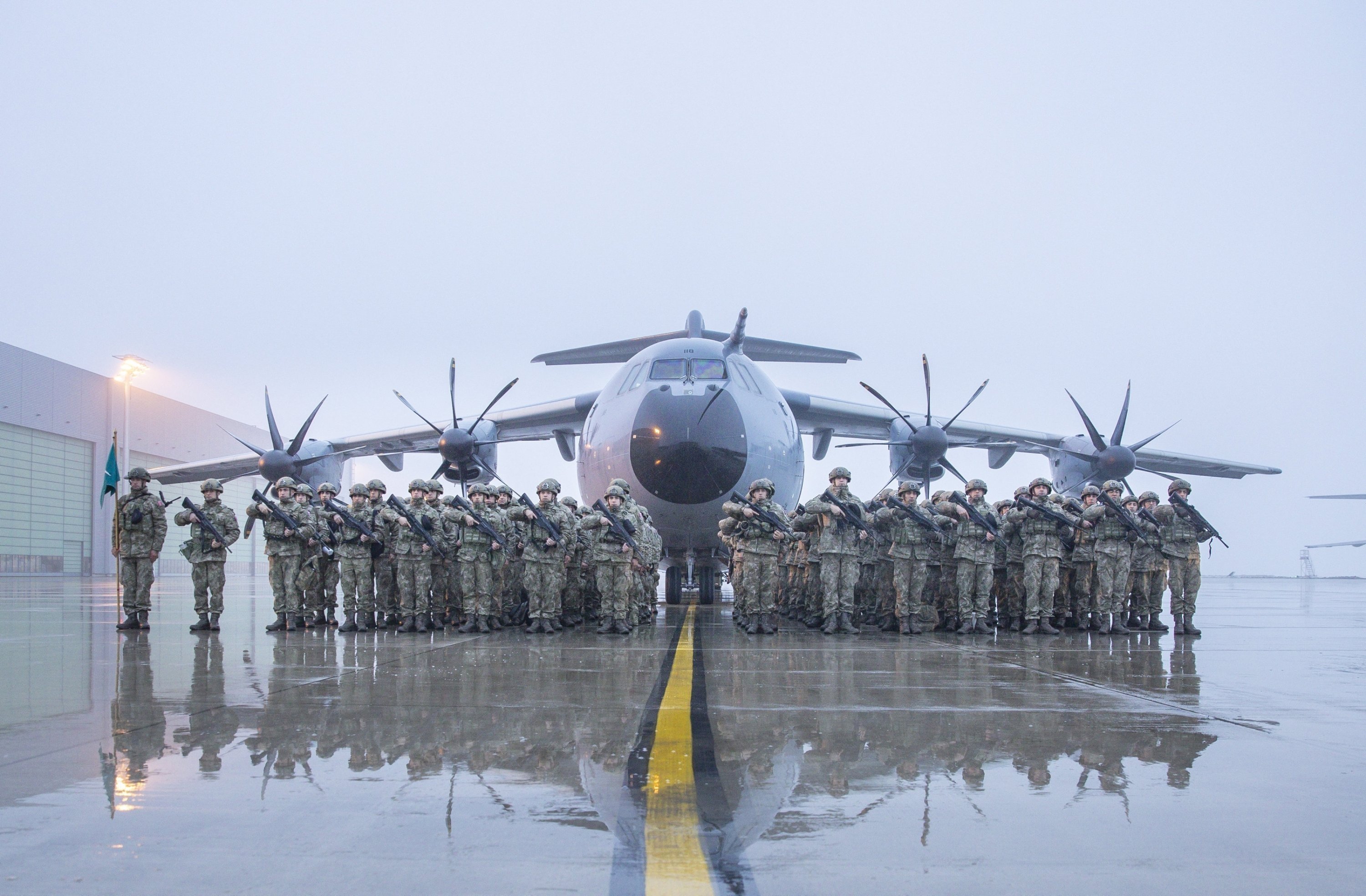
Türkiye’s contributions extend from the Baltic region to the Black Sea and include NATO missions, operations and exercises, as well as responsibilities in maritime security, crisis management, training and deterrence.
The country currently contributes nearly 3,000 personnel, along with various weapons, vehicles and military platforms, to ongoing NATO missions, operations and initiatives.
Türkiye also hosts critical NATO facilities, including the Allied Land Command, located in the western city of Izmir, and the Rapid Deployable Corps, based in Istanbul.
The capital, Ankara, hosts the Center of Excellence for Defense Against Terrorism (COE-DAT) and the Partnership for Peace Training Center. Istanbul hosts the NATO Maritime Security Center of Excellence (MARSEC COE).
Furthermore, the Turkish Armed Forces (TSK) this year joined NATO’s Steadfast Dart exercise in Germany from Feb. 12-24, held to improve the operational readiness of the Allied Reaction Force. The army contributed naval, land and air elements, including the Anadolu Task Group, and deployed a joint force of more than 2,000 personnel to Germany.
Starting in 2028, Türkiye will assume leadership of NATO’s Allied Reaction Force (ARF), one of the Alliance’s most critical military capabilities, further strengthening its key role in European security.
With its capabilities in artificial intelligence, cyber defense and space, Türkiye stands out as one of the NATO members adapting most rapidly to the Alliance’s evolving threat landscape.
In this context, Türkiye stands out as one of NATO’s key members strengthening not only its own defense capabilities but also the Alliance’s technological edge through major projects such as the Steel Dome integrated air defense system, the KAAN fighter jet and the Altay main battle tank.
Türkiye allocated 2.33% of its gross domestic product (GDP) to defense in 2025, placing it among the NATO members assuming a high level of financial and military responsibility within the Alliance.
Türkiye also remains one of NATO’s key members in counterterrorism, maintaining an active operational role in combating terrorism, one of the threats facing the Alliance.
Significant missions
Since joining NATO, Türkiye has steadily expanded its contributions to the alliance’s missions and operations, including in Afghanistan, Kosovo, Bosnia-Herzegovina, Libya and Iraq. Turkish officials say the country has preserved and developed Cold War-era military capabilities while also fighting terrorism and responding to regional instability.
Türkiye supported NATO’s Afghanistan mission between 2002 and 2014 under the International Security Assistance Force and later contributed to the Resolute Support Mission from 2015. Turkish forces also assumed framework nation responsibility for the secure operation of Kabul Hamid Karzai International Airport until NATO’s mission ended in August 2021.
The Turkish military also contributed to the NATO Mission Iraq, launched to help build the capacity of the Iraqi army, from 2018 until a withdrawal process began in March amid worsening security conditions.
Following NATO’s decision to continue the mission with a core staff at the Allied Joint Force Command Naples, Türkiye assigned three personnel to the new structure.
July’s NATO summit
Moreover, Ankara this year, hosted the 36th NATO Heads of State and Government Summit on July 7-8, with leaders issuing a final declaration reaffirming their “unwavering commitment” to Article 5, the alliance’s collective defense clause, and to the transatlantic bond.
The summit brought together leaders of the 32-member alliance as well as key partners to discuss Europe’s defense capacity.
The final declaration of the summit in the end underscored collective defense, procurement agreements and continued support for Ukraine.
Member states had gathered in Ankara to reaffirm their “unwavering commitment” to Article 5, NATO’s collective defense clause, and to the transatlantic bond, it noted.
The declaration said the investments would deliver required capabilities while also strengthening the defense industry and resilience. adding that European allies and Canada increased investment in core defense requirements by more than $139 billion in 2025.
NATO allies further stressed that the support for Ukraine should remain fair, predictable and sustainable over the long term, pledging 70 billion euros ($81.5 billion) in military equipment, assistance and training for Ukraine in 2026 and committing to maintain at least the same level of support in 2027.
Moreover, the declaration also emphasized that the Alliance continued to respond and adapt to strategic competition, widespread instability, hybrid threats and recurring crises shaping the broader security environment.
Turkish security forces detained nine suspects linked to the Gülenist Terror Group (FETÖ) as they allegedly attempted to flee the country by boat off the coast of southwestern Türkiye, authorities said Monday.
A total of 12 people, including the nine suspects, two children and the boat’s captain, were intercepted off the Datça district of Muğla province.
The Muğla Chief Public Prosecutor’s Office said the suspects had previously faced proceedings over alleged membership in FETÖ and that their cases were pending appeal. Authorities determined they were preparing to leave Türkiye illegally.
Coast guard teams intercepted the Russian-flagged vessel “Peter Pan” near international waters after receiving information about the group’s location.
Separate legal proceedings were launched against the nine suspects for allegedly attempting to leave the country illegally.
The captain was detained and is being investigated on suspicion of aiding a terrorist group and migrant smuggling. The two children were handed over to relatives.
FETÖ has faced increased scrutiny following the coup attempt that killed 251 people and injured nearly 2,200 others. Tens of thousands of people were detained, arrested or dismissed from public sector jobs following the attempt under a state of emergency.
The terrorist group faces operations almost daily as investigators still try to unravel their massive network of infiltrators everywhere, but an unknown number of FETÖ members, mostly high-ranking figures, fled Türkiye when the coup attempt was thwarted.


-
 Economy2 days ago
Türkiye outlines new 2027-2029 Medium-Term Program
-
 Economy2 days ago
Disinflation remains top priority as Türkiye unveils 2027-2029 road map
-
 Politics2 days ago
Türkiye prepares to lead OTS with focus on deeper integration
-

 Politics2 days ago
Emergency call records deepen probe into former Turkish minister’s death
-
 Economy2 days ago
THY aims to be 1st Turkish firm among top 100 global brands
-

 Sports3 days ago
Mbappe fumbles late penalty as Real Madrid lose to Betis
-
 Politics2 days ago
President Erdoğan congratulates Meloni on record tenure as Italian PM
-
 Politics2 days ago
CHP loses 4 council members to AK Party in İstanbul’s Üsküdar