
Economy
France urges EU ban on social media for under-15s

French President Emmanuel Macron urged the European Commission to back a European Union-wide ban on social media for children under 15 after Paris failed to enact its own legislation, his office said Tuesday.
In a letter to European Commission President Ursula von der Leyen dated Aug. 29, Macron said it had become urgent to introduce a bloc-wide ban through new EU legislation after France’s Constitutional Council struck down a national bill this summer before it was due to take effect in September.
“I believe it has now become essential to go further and, through a new European legislative text, harmonize a ban on access to social media platforms for children under the age of 15, in order to protect all children across the Union,” Macron wrote.
Following Australia’s landmark social media ban for children adopted last year, several European countries are considering their own curbs amid growing concern over the impact of social media on young people’s mental health and safety. But some countries, especially in Scandinavia, believe it is best left for parents to decide.
Macron, now in his final year as president, has taken up the cause as a priority before the next French presidential election in 2027, and has been lobbying other EU governments to back restrictions.
He said France would separately rework the legislation struck down by the Constitutional Council, though political fragmentation in parliament and difficult budget negotiations could complicate efforts to pass a new law.
Von der Leyen said in July that the European Union would move to limit young children’s access to social media across the 27-member bloc, citing proposals from two experts recommending a tiered system.
Under that approach, children under 13 would only be allowed limited, supervised access, with restrictions eased gradually as they get older.
Macron is seeking a tougher approach, pushing for a blanket ban on social media access until the age of 15, ahead of von der Leyen’s flagship State of the Union speech to the EU Parliament later this month.

Togg, Türkiye’s domestically developed electric vehicle brand, unveiled on Friday a new special edition of its T10F electric fastback, featuring amber-inspired design details and seven exterior color options.
The T10F 4More Kehribar edition takes its name from kehribar, the Turkish word for amber, a natural resin that fossilizes over millions of years. The series draws on amber’s warm tones and changing reflections to highlight the car’s sporty design, the company said.
The seven exterior colors are Ayder, Seyhan, Urla, Kula, Oltu, Gemlik and Mardin, names associated with locations across Türkiye. The colors are designed to create different visual effects depending on the lighting and viewing angle.
Amber-colored accents appear on several exterior elements, including the wheels, front grille, logo, side mirrors and window surrounds. Inside, seats made with Artisyn fabric, embossed patterns and specially designed decorative surfaces carry the color and material theme into the cabin.
The new edition joins Togg’s special-series lineup following the Obsidian edition, which drew inspiration from the deep black tones of obsidian, a naturally occurring volcanic glass.
The 4More goes for a high-performance, dual-motor, all-wheel-drive (AWD) product line for the carmaker’s models.
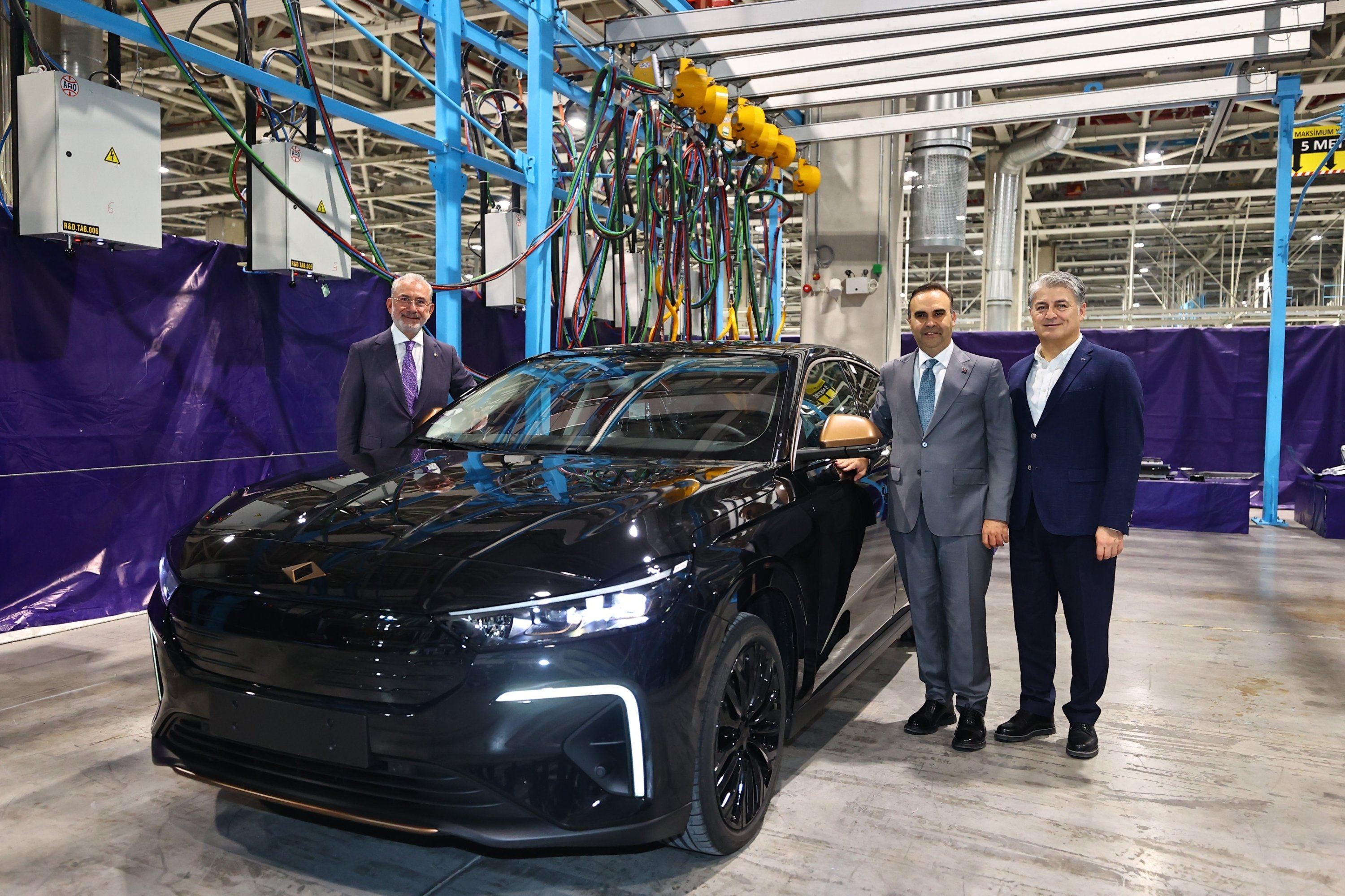
Industry and Technology Minister Mehmet Fatih Kacır on Friday visited Togg’s campus in the northwestern Bursa province to review work on the new model and the T6X, a low-cost B-SUV scheduled to go on sale in 2027.
In a post on the Turkish social media platform NSosyal, Kacır described Togg’s facility as the country’s most digitally advanced automotive production plant, with an average of one industrial robot for every 10 employees.
He also said the plant had a production rate of 375 vehicles per day, highlighting the company’s manufacturing capacity as it continues to develop its model lineup.
Togg was founded eight years ago after President Recep Tayyip Erdoğan called for the production of a fully locally funded passenger car.
The company is currently manufacturing the T10X SUV and the T10F fastback, launched last year.
Togg sold 39,020 vehicles domestically last year, and its sales in the first nine months of this year rose over 60% year-over-year to 37,426 units, data from the Automotive Distributors and Mobility Association (ODMD) shows.
U.S. President Donald Trump is expected to lift 50% tariffs on select Canadian agricultural and forestry products in a move intended to bolster Republican Sen. Susan Collins’ reelection bid in Maine ahead of November’s midterm elections, The Wall Street Journal reported Friday.
Citing people familiar with the planned action, the report said the tariff changes could be announced as early as Friday, although the scope and timing remain subject to change.
The potential move comes after Collins, a moderate Republican facing a competitive reelection race, sought relief from tariffs that have affected Maine industries and consumers. Maine has extensive economic ties with Canada, making cross-border trade a significant issue in the state’s Senate contest.
Collins’ Democratic challenger, Troy Jackson, has made Trump’s trade policies toward Canada a central theme of his campaign. The two candidates are neck-and-neck in polls ahead of Election Day.
A White House official cautioned against treating preliminary reports as confirmation of an impending policy change. “Any tariff announcements would come directly from the administration and any preliminary reporting is speculation,” the official said, according to the Journal.
Canada imposed retaliatory tariffs on the U.S. after Trump’s announcement last month, following the breakdown of trade talks between Washington and Ottawa.
Canada plans to use a government agency in Türkiye that manages the country’s defense industry and the supply of military technology as a model as it works to build up its own domestic arms sector, a report said Friday.
The Presidency of Defense Industries (SSB) serves as the primary defense procurement authority to fulfill the technological needs of Turkish security forces utilizing domestic resources.
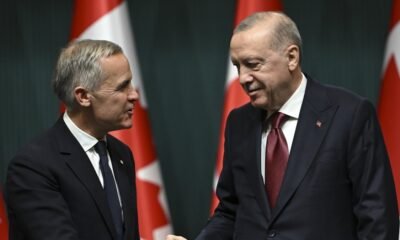
The report comes amid Prime Minister Mark Carney’s visit to Türkiye, the first bilateral visit by a Canadian leader, as Ottawa seeks new global trade partners to reduce reliance on the United States.
NATO allies upgraded their relations to a “strategic partnership” on Thursday following talks between Carney and President Recep Tayyip Erdoğan in Ankara, focusing on trade and investment, defense, security and energy.
In Istanbul on Friday, Carney said Ottawa is “in need of Turkish expertise” to strengthen its defenses and reduce reliance on foreign military systems. He said Canada was interested in both Turkish military technology and joint industrial partnerships.
Türkiye has agreed to join Canada’s Defense Security and Resilience Bank as one of 10 founding member nations of Carney’s multilateral “middle powers” bank.
The bank’s purpose is to bolster the defense of like-minded allied nations by raising up to 100 billion pounds ($134 billion) in cheap financing.
‘Lot to learn’
Carney’s government wants to bring about strategic cooperation between Canadian and Turkish companies in production, innovation and technology transfer, Anadolu Agency (AA) said on Friday, citing defense industry sources. They said he drew particular attention to Türkiye’s expertise in space and aviation.
During the visit, Carney stressed Türkiye produces around 80% of its own defense needs domestically, which he said is not the case in Canada. “We have a lot to learn,” he noted.
He added that Canada is in a position where it needs Türkiye’s defense industry expertise more and described reaching a local-content rate above 80% as a desirable policy goal for his government, the report said.
In an earlier interview, Carney said Canada intends both to run joint defense projects with Türkiye and to buy Turkish products. He pointed to Türkiye’s innovation and technology base, especially in unmanned systems.
What SSB does
The SSB organizes nearly all areas of Türkiye’s defense industry, including localization, production, innovation, procurement, regulation, public-private cooperation and corporate financing.
It centralizes coordination between the armed forces and public and private companies, which allows quick decisions and rapid delivery of requirements. It is said to be a structure with no equal in the world.
The agency supports national design and domestic production, introduces rules to raise firms’ export earnings, and aims to phase out dependence on foreign suppliers for critical systems. It oversees an ecosystem of more than 4,500 companies, guided by technology-acquisition obligations and capability-building policies.
Poland’s deputy prime minister and defense minister, Wladyslaw Kosiniak-Kamysz, has also praised the agency. He said earlier that Poland wanted to adopt a similar model, because the SSB not only buys and produces for its own needs but also exports and promotes exports.
Part of push to cut reliance on Washington
Canada’s interest fits Carney’s strategy of reducing dependence on the United States for security and supplies.
Canada’s government set up a Defense Investment Agency last year to cut bureaucratic delays in defense procurement. It also announced a goal of raising the domestic industry’s share of defense spending to 70% over the next 10 years.
The two countries signed a Defense Sector Partnerships memorandum of understanding on Thursday. SSB head Haluk Görgün said it reflects a commitment to expand cooperation between two NATO allies.
On Friday, Carney met senior executives of Aselsan, known for electro-optical, radar and avionics systems, and Baykar, known for unmanned aerial systems and autonomous software.
Türkiye aims to see 100,000 startups founded by 2030 and to raise the combined valuation of its “Turcorns,” the country’s billion-dollar startups, to $100 billion, Industry and Technology Minister Mehmet Fatih Kacır said on Friday.
“We aim to have 100,000 startups established in Türkiye by 2030 and to raise the total valuation of our Turcorns to $100 billion,” Kacır told the GO! GLOBAL Türkiye Summit 2026.
The event was organized by the Türkiye-U.S. Business Council’s Digital Working Group at the Foreign Economic Relations Board (DEIK) with Endeavor Türkiye. It focused on Türkiye’s technology entrepreneurship ecosystem, global investment opportunities and goals in advanced technology.
Kacır said Türkiye is working to become a global center for technology, entrepreneurship and investment. He said annual research and development spending has risen over the past 20 years from $1.2 billion to about $20 billion, and R&D’s share of national income from 0.5% to 1.46%.
He said advances in artificial intelligence, biotechnology, semiconductors and quantum technologies are reshaping global competition, value chains and traditional sources of competitive advantage.
Kacır said more than 13,000 technology companies operate in Türkiye’s 115 technology parks, and thousands of researchers and engineers work in more than 1,700 R&D and design centers. He added that Türkiye is the world’s 11th-largest defense exporter.
Startup support, data centers
Kacır pointed to Togg, Türkiye’s national electric carmaker, as a concrete example of this vision. He said more than 120,000 Togg vehicles have been put on the road so far.
He said the BiGG program is Türkiye’s largest public support mechanism for pre-seed and seed-stage technology startups, and has helped set up about 2,700 technology ventures.
Kacır said artificial intelligence is among the government’s highest priorities, and that Türkiye wants to be a country that develops AI technologies and exports them to global markets.
The Türkiye AI Action Plan has 16 priority actions, he said. Within two years, the government aims to train 10,000 advanced AI specialists and 100,000 AI application professionals, and to give AI literacy training to 5 million citizens.
On data centers, he said the goal is to raise installed capacity to at least 1 gigawatt by 2030, which would require mobilising at least $10 billion of investment.
He said $3 billion in public support has been set aside for data center and AI investments under HIT-30, the government’s high-technology investment program.
Kacır said Türkiye offers global investors its strategic location, growth, large domestic market and skilled workforce. The economy has grown by more than 5% a year on average over the past 20 years, he said, and the country has more than 86 million people and about 23 million primary, secondary and university students.
He said Türkiye added about 8 gigawatts of electricity generation capacity last year, and aims to add 8 to 10 gigawatts of renewable capacity each year for the next decade.
Canadian engineering company AtkinsRealis is in the running to help build Türkiye’s third nuclear power plant, Prime Minister Mark Carney said Friday.
NATO allies Canada and Türkiye upgraded their relations to a “strategic partnership” during the first bilateral visit by a Canadian prime minister on Thursday, as Carney seeks new global trade partners to reduce reliance on the U.S.
The new partnership signed in Ankara following talks between Carney and President Recep Tayyip Erdoğan focuses on trade and investment, defense, security and energy. It aims to create jobs and opportunities for Canadian and Turkish companies to do more business together.
Carney arrived in Istanbul on Friday to meet with Turkish business leaders in strategic sectors such as energy, aerospace and critical minerals.
Canada and Türkiye announced a partnership agreement in the defense industry and have also identified potential for cooperation in nuclear energy.
Asked about talks on Canadian involvement in Türkiye’s planned third nuclear power plant, over which Ankara has also held talks with South Korea, Russia, China and Japan, Carney said the decision would ultimately be made by the Turkish government, but he believed Canada had better odds now.
“If you would have asked us a year ago how we would have pegged the chances, they would have been very low. Now there are good chances. There’s real competition, of course,” Carney told reporters in Istanbul, adding that there may be a decision on the issue before the end of the year.
He said the strength of Canada’s CANDU technology, partnership with some Turkish businesses, including on the construction side, and the ability to build out elements of the supply chain make it “quite a compelling proposition.”
Rosatom, Russia’s state nuclear energy company, is building Türkiye’s first nuclear power station at Akkuyu in the Mediterranean province of Mersin under a $20 billion accord from 2010. It said last week that it expected a year-end nuclear startup at the site.
Türkiye plans to build a second nuclear power plant in the Black Sea region of Sinop, with the third planned in the northwestern region of Thrace.
Reports before Carney’s visit said allies would discuss potential purchases by Türkiye of liquefied natural gas (LNG) from Canada, as well as critical minerals.
On Thursday, they said they had agreed to significantly increase collaboration across the energy sector, including in LNG, civil nuclear energy and renewable energy.
Turkish expertise in defense
Carney meanwhile also said Friday that Ottawa is “in need of Turkish expertise” to strengthen its defenses and reduce reliance on foreign military systems.
He said Canada was interested in both Turkish military technology and joint industrial partnerships, with an emphasis on developing capabilities together.
“I would lean toward the partnership end of the spectrum, where we’re providing complementary technology and we’re building up together,” Carney said.
He was more direct when asked whether Canadian companies could benefit from closer ties with Türkiye’s established defense industry, particularly its expertise in drones and autonomous systems.
“Candidly, we’re in a position where we’re more in need of Turkish expertise in terms of reinforcing what we need to do to protect Canadians and to serve as a full NATO ally at this stage,” he said.
Deal to strengthen export credit cooperation
Separately, Türkiye and Canada signed a memorandum of understanding to strengthen export credit cooperation and support joint projects in third-country markets, Trade Minister Ömer Bolat said Friday.
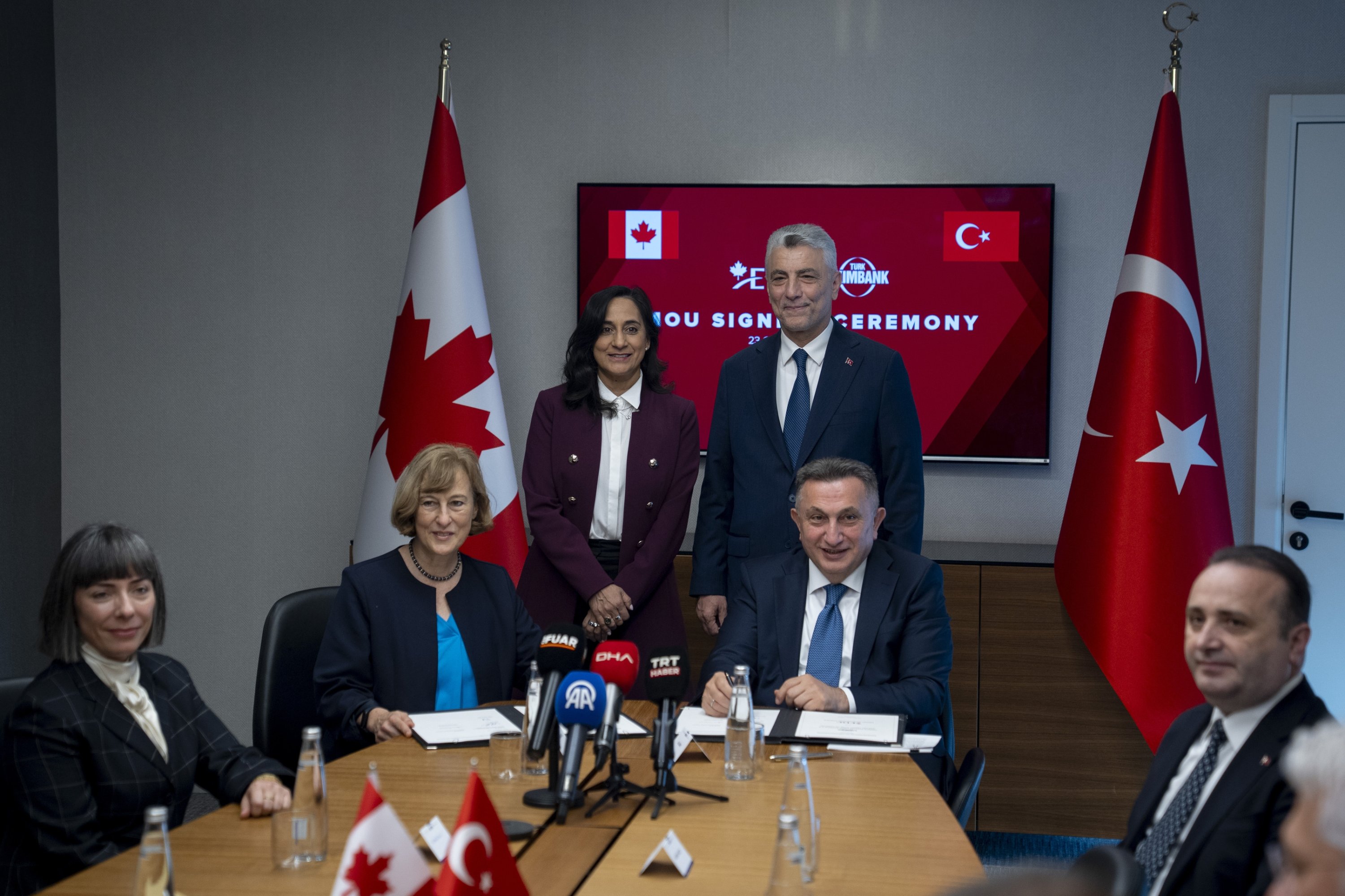
The agreement between Türk Eximbank and Export Development Canada (EDC) followed Bolat’s meeting with Canadian Foreign Minister Anita Anand in Istanbul.
In a statement on Turkish social media platform NSosyal, Bolat said the two discussed expanding bilateral trade and economic relations, alongside negotiations on a Türkiye-Canada free trade agreement.
Canadian and Turkish negotiators will kick off the first round of free trade talks next month in Ankara.
The memorandum aims to support Turkish and Canadian companies in developing joint projects in third-country markets, particularly in Africa, the Middle East, North Africa and Central Asia.
“We will continue our efforts to deepen trade and economic cooperation between our two countries and create new opportunities for our companies,” Bolat said.
Apple’s first folding phone, the iPhone Duo, hit stores around the world on Friday with a price tag of about $2,000 and less of the fanfare that accompanied previous launches.
From Singapore and Shanghai to London and Berlin, demand was strong, but with sales rationed, there were fewer of the round-the-block queues and overnight camp-outs that once marked new iPhone days.
Competitors such as Samsung Electronics and Huawei Technologies have sold premium foldable phones for years, and the Duo is a test of whether Apple can reinvent the small foldable mobile market the way the iPhone did for smartphones.
It is also an early challenge for Apple’s new CEO John Ternus, the former hardware chief who unveiled the phone barely a week after taking charge in September.
Apple’s estimated delivery dates for the Duo had slipped to late January within minutes of pre-orders opening a week ago, as demand outpaced supply. The U.S. company called the response “nothing short of extraordinary.”
Apple capped pre-orders at two handsets per customer and limited sales to walk-in shoppers. In China, France, Hong Kong, India and Japan, they were only available to those who had ordered online.
In Sydney, which was the first Apple store to sell the new passport-shaped phones on Friday, a queue formed outside before opening at 8 a.m. local time (2100 GMT).
“This is a bit of a luxury item for me, because it’s so expensive, but I just think, you know what? Life’s too short,” said Simon Krishnan, a 48-year-old engineer who paid A$3,899 ($2,734) for a 512GB Duo.
In China, a soft consumer market and rising memory costs have led to six straight quarters of declining smartphone shipments, although Apple’s market share has rebounded as some buyers trade up to premium devices.
Liu Wei, a 26-year-old healthcare professional, already has a foldable phone from Xiaomi, but still queued outside a Shanghai store from 6 a.m. for Apple’s first foldable.
“I’ve used Apple products for many years and I have more trust (in the brand), so I bought one on launch day to try it out,” he said.
Many queued to pick up pre-orders, while others hoped for limited stock or to browse display models.
Others were resellers.
In Hong Kong, May, 38, who declined to give his full name, bought a 256GB iPhone Duo, priced at HK$17,499 ($2,231.73), in an online pre-sale and planned to resell it for a profit of around HK$4,000. “A few meals’ worth of money,” he joked.
Paul Francis, 53, was one of several dozen fans who queued overnight outside London’s Regent Street store in pouring rain.
“Some people think it was mad. Including myself,” the charity manager said.
Mixed reviews
Early reviews have praised the Duo’s design as well as its sturdy and barely visible hinge, a major feat for phones whose prominent creased screen has long been a drawback and potential deterrent for buyers.
But reviewers said camera compromises, including no telephoto lens, and third-party apps still to be reworked for the new display size could disappoint some buyers.
They also said the folded Duo is less handy for the quick tasks most users do daily and several prominent reviewers recommended against it for many Apple customers.
“It’s been a lot of fun trying the Duo out for a week, but it feels like I’ve gotten to use an extraordinarily polished prototype – not a finished product that I’d want to buy and carry,” wrote longtime Apple commentator John Gruber.
Tech commentator Marques Brownlee said in a YouTube review that for a regular person who mostly texts and browses, “it is probably a no. But if the $2,000 doesn’t mean much to you, and you like the idea, after the learning curve and getting used to not having facial identification, it is a really fun phone.”
In Berlin, YouTube content creator Patrick Wolter was impressed that the Duo works as a phone and an iPad in one.
“I’ve always found it a hassle to carry around a separate tablet, especially since I already have a laptop and other gear,” he said. “In the long run, this will likely end up replacing those other devices.”
Tough to find
Apple’s entry into the relatively niche foldables market could bring the format to a much broader audience, said Francisco Jeronimo, vice president at market researcher IDC.
IDC expects Apple will take 44% of the foldable market value in 2026 on 31% of units. By 2027, it will become the market leader both in value and units shipped, IDC forecasts.
“Apple has made a convincing case for this form factor,” Jeronimo said after spending a week with the Duo.
“Now comes the next test: turning excitement into availability, adoption and a lasting new chapter for the smartphone market,” Jeronimo said.


-
 Economy2 days ago
Türkiye says waiting for Qatar sale contract for Eurofighter jets
-

 Sports2 days ago
Beşiktaş hold Palace with 10 men, Trabzonspor beat Hearts
-
 Economy2 days ago
Türkiye in advantageous position regarding global debt: Şimşek
-
 Economy2 days ago
Türkiye, Canada launch strategic partnership, eye $10B trade target
-
 Politics2 days ago
Erdoğan discusses regional security with Azerbaijan, Bulgaria leaders
-

 Economy2 days ago
French debt risk premium reaches eurozone sovereign crisis levels
-

 Sports1 day ago
Turkish clubs enjoy encouraging European week with 2 wins, 2 draws
-
 Economy1 day ago
Canada eyes Türkiye’s defense agency as model for domestic arms sector