
Politics
Türkiye seeks to ‘stop the war’ as Fidan travels to Ukraine

Foreign Minister Hakan Fidan visits Ukraine on 15-16 July for talks focused on strengthening bilateral relations, advancing diplomatic efforts to end the Russia-Ukraine war and expanding cooperation in trade, defense and reconstruction.
According to ministry sources, during the two-day visit, Fidan is expected to be received by Ukrainian President Volodymyr Zelenskyy and hold meetings with Foreign Minister Andrii Sybiha, National Security and Defense Council Secretary Rustem Umerov, Presidential Office chief Kyrylo Budanov, Crimean Tatar leader Mustafa Abdulcemile Qırımoğlu and Crimean Tatar Mejlis Chairman Refat Chubarov.
Speaking to reporters aboard the train, Fidan said the delegation would reach Kyiv after a 10-hour journey, adding that both the outbound and return trips were being made by rail due to the closure of Ukraine’s airspace.
Fidan recalled that he visited Moscow last month, where he conveyed messages from President Recep Tayyip Erdoğan and received Russia’s perspective on the war during meetings with Russian President Vladimir Putin and Foreign Minister Sergey Lavrov.
Fidan said ending the war remains one of the most pressing issues, noting that two different approaches have emerged in Europe.
“One track focuses on how to support the war effort, while the other focuses on how to end the war. Türkiye is primarily on the track of how to stop the war,” he underlined.
Fidan is expected to reaffirm Türkiye’s support for Ukraine’s independence, sovereignty and territorial integrity, while emphasizing the importance of sustaining diplomatic efforts toward a just and lasting peace. He is also expected to reiterate that Türkiye remains ready to help bring Russia and Ukraine back to the negotiating table.
“We hosted Russia-Ukraine talks in Istanbul last year. Before that, we carried out various facilitation efforts to bring the sides together. There was also the Black Sea Grain Initiative, which made safe navigation in the Black Sea possible at the time,” Fidan said.
“Building on all those efforts, I believe this visit will make a positive contribution to the ongoing diplomatic process,” he added.
Discussions are also expected to focus on regional security, particularly the Black Sea, where Ankara has repeatedly warned against further escalation. Fidan is expected to stress that attacks targeting ports, commercial vessels and fishing boats are unacceptable and underline Türkiye’s commitment to preserving the Black Sea as a region of peace, stability and cooperation.
Economic ties are also expected to feature prominently on the agenda. The visit follows Ukraine’s parliamentary ratification of the Türkiye-Ukraine Free Trade Agreement, originally signed in February 2022. The agreement is expected to enter into force after being signed by President Zelenskyy.
Turkish officials expect the deal to improve the competitiveness of Turkish exporters in the Ukrainian market and support the two countries’ long-term goal of increasing bilateral trade to $10 billion. Trade volume between the two countries rose from $6.2 billion in 2024 to $6.6 billion in 2025.
Fidan is also expected to discuss the role Turkish companies could play in Ukraine’s postwar reconstruction and reaffirm Türkiye’s long-standing rejection of Russia’s illegal annexation of Crimea. He is expected to emphasize the importance of strengthening the rights and welfare of the Crimean Tatar community.
The trip marks Fidan’s first visit to Ukraine since May 2025, while the latest ministerial-level visit from Ukraine to Türkiye took place during the NATO summit hosted in Ankara earlier this month.
Coalition of the Willing
Turkish minister also attended the leaders’ summit of the Coalition of the Willing on Ukraine on Monday, taking part on behalf of Turkish President Recep Tayyip Erdoğan, the ministry said in a statement.
The Coalition of the Willing summit in Paris brought together about 25 leaders from more than 30 participating countries.
French President Emmanuel Macron first announced plans for the joint exercises on Monday, during the group’s latest summit.
The Coalition of the Willing is planning a multinational force led by European countries and backed by the United States to help guarantee Ukraine’s security after an end to Russia’s war against the country.
Efforts to negotiate a cease-fire or broader peace agreement have, however, been stalled for months.

Authorities on Thursday detained 13 suspects and launched a manhunt for another in an investigation into a criminal gang that prosecutors claim was led by Istanbul’s former mayor, Ekrem Imamoğlu. Imamoğlu was arrested in 2025 and is currently on trial for allegedly running the gang, which prosecutors say thrived on bribery and corruption.
Thursday’s detentions focused on allegations of corruption in several tenders organized by the Istanbul Metropolitan Municipality (IBB), which was led by Imamoğlu of the opposition Republican People’s Party (CHP) between 2019 and March 2025. One tender allegedly tainted by corruption involved the acquisition of materials for İmamoğlu’s mayoral residence, according to investigators.
The suspects detained in the operation included former and current municipal staff. They include Mustafa Sökmen, head of the municipality’s department in charge of procuring materials for municipal services, and Rezzan Neslihan Vural, head of IBB’s financial services department.
The trial of the “Imamoğlu criminal gang” held its 74th hearing on Wednesday at the massive prison-courthouse complex where Imamoğlu and his alleged accomplices at IBB have been in custody since last year. A total of 407 people are defendants in the case.
An indictment against the defendants says Imamoğlu founded the gang in 2014, when he was mayor of Istanbul’s Beylikdüzü district, and that the gang was involved in 143 known offenses. The defendants are accused of causing losses to public coffers.
Imamoğlu’s associates named in the indictment include Murat Ongun, Fatih Keleş and Ertan Yıldız, municipal bureaucrats and advisers to Imamoğlu. Along with them, Adem Soytekin, a contractor who once worked for the İmamoğlu family’s construction business, is among the other defendants described by prosecutors as “senior members of the criminal gang.”
The indictment seeks a total prison sentence of between 849 years and 2,430 years and six months for Imamoğlu on charges including “forming an organization for the purpose of committing crimes,” “recording personal data,” “obtaining and disseminating personal data,” “concealing evidence of a crime,” “obstructing communications,” “damaging public property,” “bribery,” “publicly disseminating misleading information,” “extortion,” “fraud to the detriment of public institutions and organizations,” “laundering assets derived from crime,” “rigging public tenders,” “deliberate environmental pollution,” “violating the Tax Procedure Law,” “violating the Forestry Law,” and “violating the Mining Law.”
An indictment prepared against seven defendants, including İnan Güney, who was removed from his post as mayor of Beyoğlu, was also merged with this case.
The indictment seeks prison sentences ranging from nine years and eight months to 31 years and eight months for each of the seven defendants – Inan Güney, Ismail Akkaya, Seyhan Özcan, Veysel Eren Güven, Sabriye Akkaya, Mehmet Akif Bulut and Deniz Göleli – on charges of “aiding an organization established for the purpose of committing crimes without being a member of the organization” and “fraud to the detriment of public institutions and organizations.”
During the trial proceedings, 57 defendants, including those in the merged case, have been released, leaving 53 defendants in pretrial detention.
On Friday, the court is expected to announce its decision on whether to extend the defendants’ detention, although İmamoğlu is expected to remain in custody.
At the 74th hearing on Wednesday, Serdal Taşkın, a defendant and former director of Kültür AŞ, an IBB subsidiary, responded to allegations of tender rigging. Taşkın said he served as director for 13 months and did not violate any tender regulations or laws. He denied allegations that he enriched himself through bribes in exchange for awarding tenders.
Former Interior Minister Idris Naim Şahin was released under judicial control on Tuesday after testifying in a case concerning his alleged role in helping members of the alleged Alihan Kuriş gang evade capture.
Hilmi Tuna Kuriş, the brother of Alihan Kuriş, and two other suspects were captured in southwestern Türkiye on Aug. 21 in a rental vehicle registered in Şahin’s name. The suspects, who are accused of links to the gang associated with a religious community known as “Süleymancılar,” were attempting to flee the country at the time of their capture, according to authorities.
Şahin was questioned by prosecutors in Ankara and told them that he did not know Kuriş or Erhan Yılmaz, who were captured in the vehicle driven by Mehmet Özmen, although he acknowledged that he knew the driver. He claimed that the vehicle was registered in his name but that he had last driven it in June and was unaware of who had been using it afterward. He said he had leased the vehicle from a company owned by Özmen, while public records showed that he paid an annual lease fee of TL 1,000 for the vehicle, far below standard annual fees for such vehicles.
An Ankara court released Şahin after questioning but imposed a ban on traveling abroad.
According to investigators, Mehmet Özmen, who allegedly helped facilitate Hilmi Tuna Kuriş’s movements while he was evading authorities, transferred TL 2.4 million (about $50,000) to purchase a vehicle on behalf of Alihan Kuriş’s wife, Seda Kuriş.
A Financial Crimes Investigation Board (MASAK) report dated Aug. 20 and included in the investigation also examined financial and property transactions involving Kuriş and people in his immediate circle following the 2016 death of Arif Ahmet Denizolgun, who served as a transport minister and former leader of the Süleymancılar religious community.
Investigators allege that the period following Denizolgun’s death saw a significant increase in property and financial transactions involving Kuriş and his relatives. Denizolgun’s nephew, Fatih Süleyman Denizolgun, has claimed that his uncle’s death was suspicious and called on authorities to open a new investigation into his death.
Denizolgun said in a social media post that the investigation was expanded following the detention of former Council of Judges and Prosecutors (HSK) member Ahmet Gökçen on Aug. 13, 2026. He alleged that Gökçen was a suspect in the suppression of a murder report concerning the death of his uncle at the Council of Forensic Medicine (ATK), yet continued to serve as an expert at the ATK until Aug. 13, 2026. Denizolgun said prosecutors had requested the autopsy video three times since February 2026, but the ATK reported on July 16 that the footage could not be found. He claimed that the footage was subsequently sent ahead of the exhumation procedure and that the recordings were fragmented.
An expert assessment stated that the possibility of suffocation could not be scientifically ruled out if the victim’s mouth and nose were covered while pressure was applied to the chest. According to the allegations, the deceased was reportedly suffocated with a pillow. Denizolgun also alleged that physical samples had been destroyed at the ATK.
The group known publicly as “Süleymancılar” originated as a religious movement named after 20th-century Islamic scholar Süleyman Hilmi Tunahan, Kuriş’ great-grandfather.
Initially operating through informal religious instruction in homes and mosques, the group later expanded across Türkiye through Quran courses and student dormitories, largely financed by membership contributions and donations. Over time, its activities expanded into commercial sectors including food, health care, tourism, textiles, construction and real estate.
Justice Minister Akın Gürlek has asked Greece to extradite three suspects wanted by Türkiye, including the alleged leader of the Bayğaralar organized crime group, during talks with his Greek counterpart, Yorgos Floridis.
Gürlek raised the cases of Ramazan Bayğara, Nedim Sorguç and Ali Yeşildağ during the meeting on Tuesday, stressing the need for stronger judicial cooperation between the neighboring countries in combating transnational organized crime.
Floridis said Greek judicial authorities had approved the extradition of all three suspects and that the Greek government had endorsed the decisions. However, the extraditions of Bayğara and Sorguç have been suspended because of interim measures issued by the European Court of Human Rights (ECtHR), he said.
Bayğara, identified by Turkish authorities as the leader of the Bayğaralar crime group, was detained in Greece while being sought internationally under an Interpol Red Notice for allegedly establishing a criminal organization and intentional homicide.
Turkish judicial authorities subsequently requested his extradition.
Sorguç is also wanted under a Red Notice on charges of membership in a criminal organization and drug trafficking. His transfer to Türkiye had been scheduled for Aug. 20, but was halted following an application to the ECtHR, Gürlek said.
The minister also raised the case of Yeşildağ, whose extradition Türkiye is seeking on charges of intentional homicide and armed robbery involving multiple perpetrators.
Gürlek said transnational organized crime had become an increasingly important area of cooperation between Türkiye and Greece as criminal groups expand their operations across borders.
He said such organizations increasingly use technology and social media to recruit young people and engage in crimes ranging from drug trafficking and money laundering to homicide, robbery and threats.
Türkiye has issued a circular to chief public prosecutors’ offices at 75 heavy penal court centers across the country’s 81 provinces as part of efforts to accelerate and better coordinate investigations into organized crime groups, Gürlek said.
He stressed that the international networks of organized crime groups meant authorities could not effectively combat them solely within national borders.
“These organizations pose a serious threat not only to our country but also to public order and public security in the countries where they operate,” Gürlek noted, emphasizing the importance of mutual judicial cooperation.
Gürlek thanked Greek judicial authorities for their cooperation and said Türkiye would show the same sensitivity toward extradition requests submitted by Athens.
He also invited Floridis to an International Justice Summit scheduled for Oct. 8-9 in Istanbul.
Türkiye aims to make the current period a “Century of Justice” by accelerating judicial proceedings, improving access to justice and strengthening legal certainty, Justice Minister Akın Gürlek said Wednesday as the country marked the opening of the 2026-2027 judicial year.
Speaking at a ceremony organized by the Istanbul Chief Public Prosecutor’s Office, Gürlek noted Türkiye’s judicial reform agenda would go beyond legislative changes and focus on improving the speed and effectiveness of the justice system.
“In line with the goals of the Century of Türkiye, we want to make this period the ‘Century of Justice,’” Gürlek underlined.
He said the initiative was not merely a slogan but represented a vision in which citizens could obtain their rights more quickly, trials were concluded within reasonable periods and access to justice was made easier.
Gürlek also highlighted the “Alo Adalet 135” hotline, which was launched on Sept. 1 as a pilot program at courthouses in Ankara’s western district, Izmir and Kayseri.
The service allows citizens, particularly those involved in lengthy court cases and investigations, to submit their concerns directly to relevant judicial authorities. Gürlek said the hotline would be expanded to courthouses across Türkiye in October.
The government is also using Judicial Services Efficiency Offices to identify the causes of lengthy investigations and trials at an early stage, monitor target completion times and strengthen the administrative and technical capacity of the judiciary, he said.
Unsolved crimes, corruption
Gürlek reminded that authorities were also reviewing previously unsolved crimes using modern technology and forensic capabilities.
“Significant progress has been made in solving many previously unsolved cases,” he said, adding that the passage of time did not diminish the importance of establishing the truth.
The minister said authorities would continue efforts against drug trafficking, illegal betting, online gambling, organized crime, money laundering and digital offenses while ensuring investigations remained based on law and concrete evidence.
He also stressed that allegations of corruption involving public resources or authority should be thoroughly investigated regardless of where the evidence leads.
“We believe that every allegation of corruption that damages public conscience must be addressed within the law, meticulously and on the basis of concrete evidence,” Gürlek said.
He added that the state was not opposed to religious groups, national organizations or social initiatives serving the public interest, but would act against individuals or organizations that exploit social values, abuse public trust or use legal loopholes to obtain unlawful benefits.
The minister remarked that protecting innocent people was as fundamental to justice as punishing offenders and stressed that authorities must remain within the boundaries of the law even when combating the most serious crimes.
Referring to Türkiye’s “Terror-free Türkiye” initiative, Gürlek said the process was important for strengthening social peace and national unity, adding that the fundamental principles of the rule of law would not be compromised.
“I think they’d hear us from Greece if we shout from Kaş,” President Recep Tayyip Erdoğan told journalists when asked how Türkiye would respond to Greece’s arming of the Aegean islands.
Türkiye has recently declared an area between Kaş and Fethiye in the south, as well as several other areas in the Aegean Sea, as “marine parks” in a move that angered Greece, which has consistently contested Türkiye’s maritime borders.
Erdoğan answered questions while returning from Kyrgyzstan, where he attended a summit of the Shanghai Cooperation Organization (SCO) on Tuesday. In remarks published on Wednesday, he said Türkiye sought to advance relations with Greece on the basis of good neighborliness. “We have always been sincere and constructive, but this was not reciprocated most of the time,” Erdoğan said.
Türkiye opposes any Greek military deployment on the eastern Aegean islands, arguing that they should remain demilitarized under the 1923 Treaty of Lausanne and the 1947 Paris Peace Treaty. Greece, however, cites a “threat” from Türkiye and says it has the right under international law to defend its sovereignty. The two countries have recently been at odds over the declaration of marine parks to preserve marine biodiversity, with both accusing each other of attempting to violate their maritime borders.
Under Erdoğan’s leadership, Türkiye has pursued a rapprochement with Greece after decades of lukewarm diplomatic ties and nearly two decades after the two countries came close to an all-out war over their Aegean dispute. Erdoğan and Greek Prime Minister Kyriakos Mitsotakis have met several times over the past two years, but their warm meetings have done little to change the state of relations over the maritime dispute.
“Greece should know that Türkiye has no intention of grabbing the territory of any other country, but Türkiye also has no intention of allowing anyone to violate its rights. Ignoring international treaties will not benefit anyone. Anyone who interprets Türkiye’s level-headed approach based on common sense as weakness is making a grave mistake. Greece should reverse course and stop arming demilitarized islands. History is a good guide for those who can learn from the past,” Erdoğan said.
The Republic of Türkiye cemented its independence more than a century ago under the leadership of its founder, Mustafa Kemal Atatürk, after expelling invading Greek forces. “We will continue working for peace, security and stability,” Erdoğan added.
In a related development, Israel and Greece signed a 3 billion euros ($3.48 billion) defense deal on Monday under which Israel will build a “multilayered” defense system for Greece. A supplementary deal valued at 26 million euros will see Israel sell Greece Drone Dome systems to protect strategic sites against drones and reinforce existing defenses.
Both countries are at odds with Türkiye. Ankara has repeatedly warned against Israel’s expansionist goals across the region. President Recep Tayyip Erdoğan has previously warned that Türkiye may be the next target of Israel after the Netanyahu administration launched a genocidal campaign in Gaza.
SCO summit
Erdoğan also commented on Türkiye’s ambitions to advance relations with the SCO to a “higher level.” He said the summit he attended in Bishkek had been a concrete indicator of Türkiye’s will to diversify its economic, political and strategic options at the international level.
“We have bilateral trade and economic relations with SCO member states. In our relations with the Organization, significant progress has been made in recent years, reflecting our multidimensional foreign policy approach. Türkiye is a country capable of developing balanced relations with both the West and the East and deepening its ties with both sides accordingly. Türkiye’s approach also strengthens our aim of finding solutions to global challenges based on cooperation and effective multilateralism. From our perspective, it is possible to take our relations with the SCO to even higher levels in the period ahead,” he said.
Türkiye is a dialogue partner of the bloc, and Erdoğan said Türkiye’s perspective on membership in the SCO “does not in any way mean breaking away from one bloc or turning its back on the West. Our goal is to increase our own weight and influence with a 360-degree vision.”
Ties with Russia
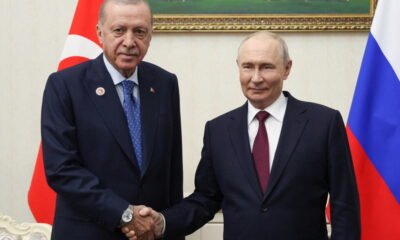
The Turkish leader also had a rare meeting with Russian President Vladimir Putin on the sidelines of the SCO summit. He said their talks were very fruitful and that they had particularly discussed the conflict between Russia and Ukraine. He hailed significant cooperation with Russia in fields ranging from tourism to energy.
“Concluding the conflict through peace is also Mr. Putin’s expectation,” Erdoğan said. “This conflict has had bad consequences for our region and the world, and Mr. Putin is not pleased with this. I conveyed to Mr. Putin that we were ready to do anything for peace,” he said. Türkiye is among the few countries that have achieved some progress toward partial peace between the two countries.
Maritime security in the Black Sea amid the Russia-Ukraine conflict was also on Erdoğan’s agenda. Several Turkish commercial vessels have come under fire over the past two months while sailing through the Black Sea. Erdoğan said the conflict should not “come to a point where the security of civilians and trade security erode.” “We have to resolve this issue because the damage is growing. We need a mechanism for lasting security in maritime shipping in the Black Sea,” he said.
Mecca alliance
Erdoğan also commented on Türkiye’s joint defense agreement with Saudi Arabia and Pakistan. The agreement evolved into the Mecca Defense Alliance as ministers from the three countries came together in Istanbul on Monday to discuss its future. Erdoğan said the meeting was very important.
“In line with our approach of taking concrete steps as soon as possible, we have identified the issues that need to be addressed from a technical standpoint. Chief among these is the establishment of the secretariat and making it fully operational. Military and political issues need to be addressed here. The defense industry is an important area of cooperation. In terms of military operational cooperation, technical issues such as military training, military standardization, and the sharing of information on military threats, capabilities and capacities were also discussed. Decisions were made on when and how these initiatives will be implemented,” Erdoğan said.
“There are very few countries that have openly opposed this alliance, but there are also countries that have expressed opposition behind the scenes. In particular, the balance among Saudi Arabia, Pakistan and Türkiye makes it difficult for many actors to openly criticize the alliance. This alliance was established to promote stability and security in our region. We will continue on our path together with our brothers, growing stronger,” he said.
Terror-free Türkiye
Asked about the terror-free Türkiye initiative aimed at the dissolution of the terrorist group PKK, Erdoğan said that the timetable for the process was not clear. “You can’t set a schedule on such issues,” he said. “This is not about timing anyway; it is about reaching our goal. Certainly, we have a road map, and our institutions work in coordination,” he said.
Türkiye’s Parliament earlier this month passed a landmark 12-article law supporting the initiative, following months of political efforts led by Erdoğan and Nationalist Movement Party (MHP) Chairperson Devlet Bahçeli.
The legislation outlines legal procedures for members of the PKK terrorist group who lay down their arms and surrender to Turkish authorities as the organization moves toward dissolution and disarmament. It includes provisions allowing the deferral of prosecution or prison sentences in certain circumstances, while establishing different legal procedures depending on an individual’s position within the organization and involvement in criminal activity.
The law does not constitute a general amnesty and does not eliminate existing convictions, change the legal classification of crimes, or broadly remove criminal liability, according to the justification accompanying the legislation.
“The monitoring board established under the leadership of Vice President Cevdet Yılmaz has begun planning the steps to be taken within the framework of the duties defined by law. For the law to begin to be implemented, however, the PKK must actually lay down its arms and disband. It is clear how the necessary assessments and verification will be carried out in this regard. The process is moving forward step by step. It has not been confined to rigid parameters in every respect. There is also a degree of flexibility in this regard. We are approaching the issue with the seriousness of the state and taking our steps accordingly. Our nation has also demonstrated its support for a terror-free Türkiye. Processes that are open to such provocations should not be allowed to drag on for too long,” he said.
Türkiye also links the initiative to stability in the wider region. In this context, the dissolution of the YPG, the Syrian wing of the PKK, is viewed as crucial by Ankara. After two years, the YPG reached an agreement with the new administration in Damascus on its integration into the Syrian army. Erdoğan said Türkiye welcomed the news and was following the implementation of the integration agreement.
“We want more than anyone else for Syria to remain united. This is important for achieving sustainable development and building capacity in Syria. We have always stood by our Syrian brothers and sisters to this end, and we will continue to stand by them going forward. In this regard, President Ahmed al-Sharaa has successfully navigated and continues to navigate difficult challenges. We are hopeful about both the integration process and the gains the Syrian people have achieved in a short period of time. I believe this process will open the door to a new era not only for Türkiye and Syria, but for the entire region. The chapter of terrorism must now be closed; the era of weapons and violence must come to an end,” he said.
The integration was also welcomed by the United States, Türkiye’s NATO ally, which controversially supported the YPG in Syria during the Baathist era. Washington has also modified its policy toward Syria and embraced the unity approach of the al-Sharaa administration. “Obviously, the United States eventually grasped the reality in Syria,” Erdoğan said.
F-35 deal
Erdoğan also commented on Türkiye’s pursuit of a return to the F-35 fighter jet program with the United States. “The talks are underway to achieve this. We believe we will put all these issues behind us. While we pursue diplomatic efforts, we won’t abandon the development of our Kaan fighter jet. We are committed to developing our own aerial defense systems. As a matter of fact, we are diversifying the options we have. This is how Türkiye becomes stronger,” Erdoğan said.
After declaring its dissolution, the terrorist group YPG, once militarily backed by the United States, has started handing over its heavy weapons to the Syrian army.
Syrian troops are receiving weapons in Hassakeh, once a stronghold of the YPG, following a key deal on the group’s integration with the Syrian army.
Among the weapons and equipment handed over to the Syrian army are armored vehicles, tanks, mortars and machine guns. Anadolu Agency (AA) reported on Thursday that the army also seized air defense systems that the YPG had looted from some military air bases following the fall of the Baathist regime in 2024.
Damascus and the YPG signed a memorandum on a cease-fire and the group’s gradual integration into the security forces on Jan. 29. Syrian forces recently entered Hassakeh, which had been under YPG control, and took over key institutions, including the governorate and courthouse. On Sept. 1, the Syrian Interior Ministry sent reinforcements to the city to help complete the takeover.
The new administration in Damascus has sought to restore central government control across the country after years of fragmentation during the civil war.
The dissolution of the YPG, the Syrian wing of the PKK, is crucial for Türkiye. Türkiye itself launched the “terror-free Türkiye” initiative aimed at the dissolution of the PKK. The PKK agreed and made a symbolic start to its disarmament process last year. In exchange, Türkiye offered leniency and deferred sentencing for PKK members not involved in acts of terrorism.


-

 Economy2 days ago
Bank of America vice president killed in Times Square stabbing
-
 Refugees3 days ago
Turkey’s Erdogan says Russia will help build more nuclear plants
-
 Politics3 days ago
Civilians injured in PJAK terrorist attack in Iran
-

 Sports2 days ago
Sultans of Net lock horns with Germany for EuroVolley semis spot
-
 Politics3 days ago
Syrian, Turkish armies complete floating bridge over Euphrates
-

 Politics2 days ago
Özel backs terror-free Türkiye law, says Parliament key to solution
-

 Politics2 days ago
Türkiye pushes new Russia-Ukraine Black Sea grain deal
-

 Sports3 days ago
Türkiye seal 2027 FIBA World Cup berth with 110-73 rout of Iceland