
Economy
Undeterred by midterms defeat, Trump set to add new sweeping tariffs

U.S. President Donald Trump is preparing to reignite global trade tensions by imposing fresh tariffs on major trading partners, according to sources, signaling that his Republican Party’s steep midterm election losses have not slowed his protectionist agenda.
The Trump administration’s announcement, expected imminently, will address what it argues is excess industrial capacity in 16 major U.S. trading partners, three people with knowledge of the matter said on Tuesday.
They include China, which is poised to rack up a record trade surplus of well over $1 trillion in 2026, though the tariff level is expected to remain within the range agreed under the current truce between Trump and his counterpart Xi Jinping.
On Wednesday, Beijing reiterated its opposition to “trade wars” and once again dismissed the notion of overcapacity, but stopped short of threatening retaliation.
“The so-called ‘overcapacity’ is a false issue, and China opposes using it as an excuse for political manipulation,” Foreign Ministry spokesperson Guo Jiakun said.
“Both China and the United States should jointly implement the important consensus reached by their heads of state and maintain the stable development of bilateral economic and trade relations,” Guo said.
Tariff wall
Analysts say, however, higher U.S. trade barriers against China and other economies are the direction of travel, even if the Democratic Party – which won majorities in both houses of Congress earlier this month – tried to curb Trump’s tariff impulses.
The tariffs have in part contributed to higher prices on consumer goods in the U.S., a major source of discontent among voters.
“Without the two-thirds majority needed to override a presidential veto, Democrats’ ability to dismantle the tariff wall will remain limited,” ING analysts said in a note.
“Either way, we don’t think the blue wave will mark a return to free trade. The Biden years already showed that tariffs in strategically important sectors enjoy support across political camps.”
The U.S.-China truce runs until Jan. 10, but many expect it to be extended – potentially as early as next month when Trump and Xi are set to meet again at a G-20 gathering in Miami – given the major impact a re-escalation of tit-for-tat hikes similar to those seen in 2025 would have on both economies.
The agreement caps Trump’s second-term tariffs on Chinese goods at 20%, in addition to duties of about 25% imposed during his first term. The U.S. has already imposed a 12.5% anti-forced labor duty on all Chinese imports, leaving only 7.5% to reach the 20% cap.
The U.S. and China are also working to cut tariffs on $30 billion of non-strategic imports from each side.
Tailored rates
One of the analysts said that the duties would be specifically tailored to each country, with goods from Mexico and Norway unlikely to see any immediate levies.
The White House is expected to honor capped tariff rates that were included in finalized U.S. trade deals with partner countries, the analyst also said. These include duty ceilings of 15% on goods from the EU, Japan and South Korea and 19% for Malaysia.
The U.S. is also expected to honor the 20% cap on Trump’s second-term tariffs on goods from China, as long as a trade truce with Beijing is extended. If it expires, the Chinese excess capacity rate would rise to a higher level.
Replacement tariffs
The trading partners included in the probe are China, India, Japan, South Korea, Mexico, Vietnam, Taiwan, Thailand, Malaysia, Indonesia, Switzerland, Norway, Singapore, Bangladesh and Cambodia, along with the European Union.
The U.S. Trade Representative (USTR) launched the excess capacity probe in March, under Section 301 of the Trade Act of 1974, along with a separate probe into weak or lax enforcement of anti-forced labor laws in 59 countries and the European Union. Together, the duties are meant to rebuild Trump’s global “Liberation Day” tariffs that were struck down by the U.S. Supreme Court in February.
The Trump administration has singled out China as the biggest source of excess industrial capacity, which it says is flooding global markets with steel, aluminum, electric vehicles, appliances, solar products and other goods. China says its exports reflect competitive advantages.
The probe is also partly directed at Chinese investment in Southeast Asian countries, including Vietnam, Indonesia and Cambodia, to manufacture goods for the U.S. market and avoid prior US tariffs.

The European Bank for Reconstruction and Development (EBRD) said on Wednesday it would be providing financing of up to $250 million to a leading soda ash producer in Türkiye to strengthen its operations and environmental performance.
The EBRD would extend an eight-year secured loan of up to $250 million (227.7 million euros) to WE Soda, a leading producer of industrial minerals and one of the largest producers of soda ash globally, to support a major investment program at one of its subsidiaries, Kazan Soda in Türkiye, the bank said.
The committed financing will support investments aimed at improving the sustainability, efficiency and resilience of the company’s existing operations, it added.
These will include the reuse of treated municipal wastewater, closed-loop cooling systems, the recovery and reuse of process materials, and a new rail connection to shift product transport from road to rail. The program will also include pilot facilities for higher-value grades of sodium bicarbonate, according to the EBRD.
“The investments will strengthen the resilience and competitiveness of Kazan Soda, particularly by reducing exposure to water scarcity and lowering the use of externally purchased materials and energy,” the bank said.
The agreement comprises a $110 million committed facility and a further $140 million uncommitted facility, WE Soda said in a statement.
The $110 million committed facility will fund the first set of approved investments at Kazan, near Ankara, Türkiye, covering projects such as wastewater reuse, closed-loop cooling, recovery of process materials, a rail connection and sodium bicarbonate pilot plants, the company said.
These investments are already part of WE Soda’s capital expenditure plans, so the facility does not add to the group’s planned net debt or leverage, it added.
WE Soda operates natural soda ash production facilities in Türkiye and the U.S. The company exports about 80% of its Turkish production to customers around the world.
Soda ash is an essential raw material used in glass manufacturing and a range of other industrial applications, including detergents, chemicals, water treatment and flue-gas treatment.
“We are pleased to support WE Soda in strengthening the resilience and environmental performance of its operations in Türkiye,” said Natalia Lacorzana, the EBRD’s head of Natural Resources.
“Making industry more competitive also means using water, energy and raw materials more efficiently. These investments will reduce freshwater use and reliance on externally purchased materials and energy, and advance more circular industrial production,” she added.
Didem Ciner, Chair of WE Soda, said: “This agreement marks the start of a long-term partnership between Kazan Soda and the EBRD. Their support will help us invest in water efficiency and decarbonization, strengthening Kazan’s position as one of the lowest-cost and lowest-carbon soda ash operations in the world.”
The EBRD is a key institutional investor in Türkiye, having committed more than 27 billion euros in the country since 2009, largely in the private sector.
Companies tied to Alice Huang, the Chinese businesswoman whose reported affair with Nvidia CEO Jensen Huang led to his short-lived exit, raised financing against powerful computing equipment for major AI data centers in China, Reuters reported exclusively on Wednesday, citing a review of records.
The central bank documents identify up to 764 AI servers and modules valued at $270 million, along with $31 million in equipment used to connect them into large computing networks, the Reuters report indicated.
Much of the hardware was listed as located at a sprawling Shanghai data center associated with an AI computing project launched under a strategic partnership between Chinese technology giant Tencent and Shanghai’s Songjiang district government.
The records show businesses connected to Alice Huang’s family and associates helped finance and equip China’s AI industry, even as U.S. authorities investigated whether her Singapore-based company Megaspeed helped Chinese customers obtain restricted Nvidia technology.
The arrangements also illustrate how companies can finance access to the costly computing infrastructure underpinning China’s AI ambitions, at a time when U.S. restrictions on advanced processors have made securing the hardware a growing challenge for Chinese technology businesses.
On Monday, the U.S. Commerce Department added Megaspeed to its trade blacklist. Megaspeed has denied wrongdoing and said Alice Huang left the company in August 2025.
Reuters examined dozens of filings in a Chinese central bank credit registry that tracks equipment used to secure loans and other financing.
Alice Huang formerly controlled Megaspeed, a major overseas buyer of Nvidia processors. Her relationship with Jensen Huang, who resigned as Nvidia’s CEO earlier this month before being reinstated to his post 11 days later, has intensified scrutiny of Nvidia’s business links to China.
The records do not establish that the servers contained chips prohibited from export to China or show how and when the equipment entered the country.
Financing hundreds of servers
A central business that raised financing was Century Litong, an Nvidia preferred cloud partner that rents powerful servers to customers needing large amounts of computing capacity.
Financial records show five leasing arrangements covering up to 512 servers with a declared value of 1.42 billion yuan ($200 million) between May and December 2024.
Four listed equipment at the Yangtze River Delta AI supercomputing center in Shanghai, part of a data-centre complex whose infrastructure developer was Shanghai Longrui. Gaming company Century Huatong previously held an interest in Longrui and counts Tencent as a roughly 10% shareholder.
Tencent and Shanghai’s Songjiang district government signed a strategic cooperation agreement in 2020 to jointly develop an AI computing center, according to a district government announcement. A June 2020 Century Huatong securities filing identified Shanghai Longrui as an infrastructure provider working with Tencent on the center’s construction and operation.
A 2023 disclosure from Jiangsu Lettall Electronic identified the Yangtze River Delta AI center as a location for Century Litong’s server-rental business.
“Tencent did not develop or co-develop the data center facility in question,” a Tencent spokesperson said.
The spokesperson also said Tencent has never owned or operated the Yangtze River Delta data center project and that its name and trademarks had been used without authorization. It also denied any commercial relationship with Megaspeed or its subsidiaries.
The records do not establish that Tencent bought, rented or operated the particular servers identified by Reuters.
One deal described 128 servers located at that data center containing eight graphics processors each, or 1,024 chips in total, with computing power of “989 PFLOPs,” valued at up to $450,000 apiece.
Another transaction involved 128 servers worth $57 million, financed by an arm of AVIC, a Chinese state-backed aviation and defense conglomerate, and leased to Century Litong.
Such arrangements allow businesses to obtain expensive computers without paying the full purchase price upfront.
A separate inventory listed more than 10,000 Nvidia ConnectX-7 networking cards and 730 BlueField-3 units at the Shanghai facility, equipment used to connect large numbers of computers for AI tasks.
Manufacturer Lettall Electronic invested in Century Litong in 2023 and took full ownership by mid-2024. Its disclosures show guarantees it provided for Century Litong’s equipment-leasing agreements with financial institutions.
Nvidia, Century Litong, Century Huatong, Shanghai Longrui, Lettall and AVIC did not respond to requests for comment. Shanghai’s Songjiang district government did not immediately reply to a request for comment sent by fax.
Family and business connections
Corporate records connect Century Litong, Century Longteng and Century Huatong to Alice Huang’s sister, Huang Yu, and Kang Wei, an investment executive who is Alice Huang’s husband. Alice Huang, Huang Yu, and Kang Wei could not be reached for comment.
Century Litong was initially established in 2023 as a subsidiary of Shanghai Century Longteng. The latter is now wholly controlled by Century Huatong, but a Shanghai state-backed investment fund and an investment company linked to Huang Yu and Kang previously held shares.
Kang was identified as Century Longteng’s executive director in a 2022 government announcement.
Century Huatong also owns 70% of a company where Alice Huang previously served as a director, and holds a stake in gaming firm 7Road Holdings (0797.HK), opens new tab, whose former overseas subsidiary was renamed Megaspeed in 2023, corporate records show.
The network also developed a large data center in Wuhu, about 300 kilometers (186 miles) inland from Shanghai.
Wuhu Century Longteng, majority-owned by Huang Yu through investment vehicles until early 2026, pledged another 252 powerful AI computing “modules” to Ping An Bank as collateral for a $70 million loan in April 2026. The documents did not disclose the servers’ location.
The dollar figures reflect the value of assets covered by financing arrangements, not necessarily new spending or distinct purchases.
Türkiye aims to complete the final round of interim payments of up to TL 1 million ($20,000) to investors in funds caught up in the September multimillion-dollar scandal by Friday.
A draft bill to raise penalties for market crimes and add early-intervention measures is also ready to go to the ruling party Justice and Development Party’s parliamentary group.
That’s according to a statement by the Directorate of Communications following Tuesday’s meeting of the Fund Coordination Board, set up to handle the liquidation of over 130 investment funds after several of them failed to meet withdrawal requests in mid-September.
The funds are said to have been used to artificially boost the prices of certain shares, vastly inflating their value and enabling those with insider knowledge to make huge profits. They had nearly half a million investors.
Tuesday’s statement said interim payments are continuing and the last part is targeted for completion on Nov. 27. President Recep Tayyip Erdoğan said last week that TL 161 billion had been paid and that at least one payment had reached 444,987 of the investors.
The directorate said work on a draft amendment to the Capital Markets Law is complete. It said the draft was prepared after earlier board work and developed with the Treasury and Finance Ministry, the Justice Ministry, the Central Bank of the Republic of Türkiye and the Savings Deposit Insurance Fund, as well as industry representatives.
It is ready to go to the AK Party’s parliamentary group, the directorate said.
The draft envisions new measures to allow early intervention against risks in capital markets. It also includes mechanisms to recover losses to fund assets caused by unlawful transactions from those responsible and return them to investors.
The directorate said penalties for market-disrupting acts, abuse of inside information and market fraud are to be raised significantly.
It said legal proceedings are continuing against people found, in inspections by the Justice Ministry and other institutions, to have made unjust and excessive gains through market-disrupting activity.
In an update this week, Justice Minister Akin Gürlek said prosecutors were now investigating 632 suspects, with trustees appointed to 91 companies, and the assets of 181 legal entities and 551 individuals seized and their bank accounts frozen.
Prosecutors also froze assets worth about TL 13 billion that had been “smuggled out of the country” to countries including the U.K., Switzerland, Luxembourg, Bahrain, Greece, Germany, the Czechia, Italy and the United Arab Emirates (UAE), Gürlek said.
Chinese tech giant Huawei was convicted by a jury in New York on Tuesday in a sprawling, nearly decade-old U.S. criminal case on charges that it deceived banks about its business in Iran and conspired to steal trade secrets from American companies.
The verdict came in a criminal case that began in 2018, with the U.S. government the following year placing Huawei on a trade blacklist that restricted its access to U.S. technology amid American concerns that Huawei posed national security risks.
The jury in Brooklyn federal court found Huawei guilty on 10 of the 12 criminal counts the company faced, including bank fraud, wire fraud, sanctions violations and conspiring to steal trade secrets. The jury acquitted Huawei of conspiring to obstruct justice and racketeering conspiracy, a charge alleging the company had acted as a criminal enterprise.
China’s Foreign Ministry said on Wednesday that Beijing opposed U.S. efforts to suppress Chinese companies.
“The Chinese government firmly opposes the U.S. suppression and containment of Chinese companies and firmly supports Chinese companies in safeguarding their legitimate rights and interests,” ministry spokesperson Guo Jiakun told a regular press briefing in Beijing, when asked about the verdict.
The trial lasted more than two months, with prosecutors calling more than 60 witnesses and the defense calling 15. It was not immediately clear what penalties Huawei will face when U.S. District Judge Ann Donnelly sentences it on Sept. 14, 2027.
Reuters reports from 2012 and 2013 helped disclose Huawei’s activities in Iran and were discussed during the trial.
“After the media started questioning Huawei’s operations in Iran, so did Huawei’s banks,” prosecutor Meredith Arfa told jurors during closing arguments in the case last week.
Brian Heberlig, a lawyer for Huawei, said the company was disappointed by the convictions but said the acquittal on the racketeering conspiracy charge vindicated its “good-faith compliance culture.”
“We fully expect to appeal,” Heberlig told reporters.
In a statement, U.S. Attorney Joseph Nocella said, “Few crimes are as serious as Huawei’s decades-long pattern of endangering U.S. national security, violating the sanctity of U.S. commerce, and impeding the enforcement of U.S. laws.”
China’s Embassy in Washington did not immediately respond to a request for comment.
Asked how much the company may have to pay in penalties, Heberlig said it was premature to comment, but the acquittal on the racketeering conspiracy charge could make a significant difference.
Huawei said in a statement it believed the remaining charges lacked legal or factual merit, adding that the five disputes related to trade secrets that prosecutors had cited were civil matters resolved over the past two decades.
The company said no court had previously found it liable for willful intellectual property misappropriation or ordered it to pay damages for trade secret misappropriation.
Experts have said the case did not undermine Huawei’s business, as the company diversified and emerged as a key player in China’s push for artificial intelligence.
Huawei said it remained focused on maintaining stable business operations and was committed to long-term investment in research and development.
Founder’s daughter was detained
In December 2018, Meng Wanzhou, Huawei’s chief financial officer and daughter of its founder, was detained in Canada on a U.S. warrant, prompting a diplomatic crisis involving the United States, China and Canada.
Meng had been secretly indicted on U.S. charges of misleading an HSBC banker about Huawei’s business in Iran, so the company could move dollars in and out of Iran in violation of American sanctions.
Meng fought extradition to the U.S. for nearly three years, before entering a deferred prosecution agreement (DPA) and flying home to China to a hero’s welcome. The charges against her were dropped.
Meng did not testify at trial, though an HSBC banker she met with in 2013 did testify.
The 2018 indictment alleged that Huawei misled HSBC, Standard Chartered and BNP Paribas about its business dealings in Iran.
Prosecutors added new charges in 2020, including allegations that Huawei conspired to steal trade secrets from U.S. technology companies over two decades.
Prosecution case
During the trial, prosecutors sought to prove that Huawei allegedly stole source code from Cisco Systems for its routers, stole wireless telecoms company Quintel’s antenna technology, and hired a professor to gain access to a circuit board developed by semiconductor company CNEX.
Jurors watched a video that prosecutors said showed a Huawei employee slipping a piece of a T-Mobile testing robot into his backpack, and heard about a Huawei engineer sneaking into a Fujitsu booth at a trade show to photograph a device.
Prosecutors gave jurors a statement attached to Meng’s deferred prosecution agreement in which she acknowledged making false statements to HSBC about Huawei’s operations in Iran.
The defense argued that HSBC and the other banks knew about Huawei’s business in Iran and were competing for Huawei’s business.
Heberlig accused prosecutors during his closing argument of having “cherry-picked” a handful of disparate incidents to support their claim of a 20-year conspiracy. Heberlig said Huawei succeeded through “hard work, innovation, and investment in research and development.”
The company has more than 200,000 employees and operates in about 170 countries.
French banking group BNP Paribas and Dutch lender ING have expanded their financial exposure to companies linked to alleged human rights abuses and genocide in the occupied Palestinian territories, the Don’t Buy into Occupation (DBIO) coalition reported Wednesday.
The coalition’s sixth report, compiled with contributions from 30 Palestinian and European nongovernmental organizations (NGOs), examines financial ties between 1,096 European financial institutions and 107 companies whose activities the report links to violations in the occupied Palestinian territories.
According to the report, BNP Paribas significantly increased its financing of several companies, including U.S. construction equipment manufacturer Caterpillar. The Israeli military has used Caterpillar bulldozers to demolish Palestinian homes and infrastructure in Gaza and the occupied West Bank.
The French bank’s loans to Caterpillar rose from $721 million to $984 million, while its investments in the company increased from $275 million in 2025 to $648 million in 2026, the report said.
ING also expanded its financial ties with companies identified in the report. The Dutch bank provided a new $110 million credit facility to Oshkosh, which makes military vehicles supplied to Israel’s Defense Ministry.
The findings highlight the continued financial involvement of major European banks in companies whose activities have been linked to Israel’s military operations and the occupation of Palestinian territory, despite repeated warnings from civil society organizations.
Between September 2024 and August 2026, European financial institutions provided a total of $361 billion in loans and underwriting services to 56 companies covered by the report.
As of Sept. 15, 2026, European investors held or managed a combined $1.74 trillion in shares and bonds in 90 of the companies, the report said.
The list includes major international arms manufacturers, technology firms, construction companies, energy groups and transport operators. Among them are Boeing, Lockheed Martin, RTX, General Dynamics, Caterpillar, Microsoft, Google, Amazon and Palantir Technologies.
U.S. authorities have barred Singapore-based tech group Megaspeed International from purchasing advanced chips, adding it to its black trade list following an alleged Chinese espionage scandal surrounding Nvidia CEO Jensen Huang.
Here are key facts about Megaspeed – whose former executive Alice Huang is suspected of being a Chinese spy and said to have had an affair with the Nvidia boss – and its regional network of subsidiaries and affiliated businesses.
Investigations
Megaspeed touts itself as a company at the heart of the artificial intelligence revolution, using Nvidia’s advanced silicon chips to power high-performance computing inside vast data centers.
The cloud computing company previously led by Alice Huang, was investigated by Singapore in 2025 over potential export control violations.
The U.S. is investigating Megaspeed on allegations it had allegedly bought processors from Nvidia and routed them to Chinese customers, circumventing U.S. export restrictions under the guise of acquiring hardware for its Southeast Asia data hubs.
Beijing has denied allegations of spying, and Megaspeed said it was investigating if it had complied with export controls on the sensitive chips.
Trade restrictions
On Monday, as Nvidia reinstated Jensen Huang as CEO, the U.S. Commerce Department added Megaspeed International, its parent company and subsidiaries in Malaysia and Thailand to the trade blacklist.
Prime Minister Lawrence Wong said Singapore was working with the United States to stop companies “exploiting” the city-state – a global transhipment hub – for illegal chip transfers.
Neighboring Malaysia, which was investigating Megaspeed’s local subsidiary Speedmatrix for possible diversion of AI chips, advised data centers on Monday to cut links with U.S.-blacklisted firms.
Empty offices
At Megaspeed’s office in the heart of the Singapore business district, no staff could be seen behind its locked glass doors. Neighbors told Agence France-Presse (AFP) they had not seen anyone come or go for months.
The registered address of a company listed as Megaspeed (Thailand) was a two-desk office in a coworking space in central Bangkok, which showed little sign of activity when AFP visited on Tuesday.
MSFusion: Malaysia data center
Another company, MSFusion, was also added to the U.S. blacklist.
Corporate records show it shares a common director with Megaspeed in Singapore, but is owned by a holdings company in the Cayman Islands.
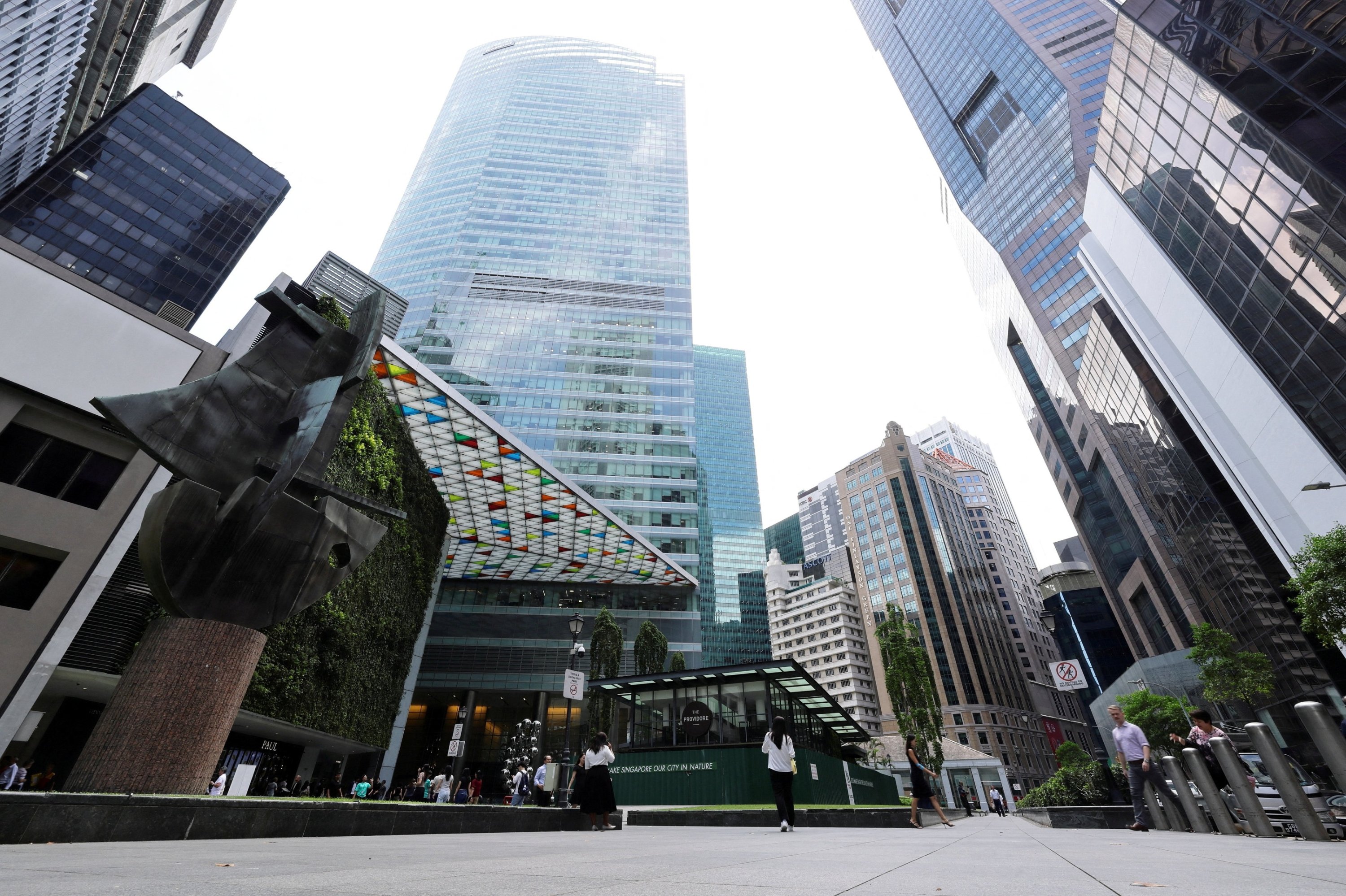
MSFusion has bought land to build a data center in Malaysia’s southern state of Johor, according to the company that sold the plot, with other documents pointing to MSFusion’s involvement in its development.
When AFP recently visited the site, there were no signs mentioning MSFusion’s involvement in the project.
A security post is stationed outside the compound, surrounded by low concrete walls with metal gates.
MSFusion has denied any “equity relationship” with Megaspeed International and its subsidiaries, saying that the firms “operate as separate and independent legal entities.”
Speedmatrix: Megaspeed subsidiary
Megaspeed International has two subsidiaries in Malaysia: Megaspeed International Sdn Bhd and Speedmatrix Sdn Bhd, both involved in data processing activities.
Speedmatrix “is a tenant at data centers in Malaysia” that can bring its own servers and AI chips into the country but cannot export them, according to the Malaysian trade ministry.
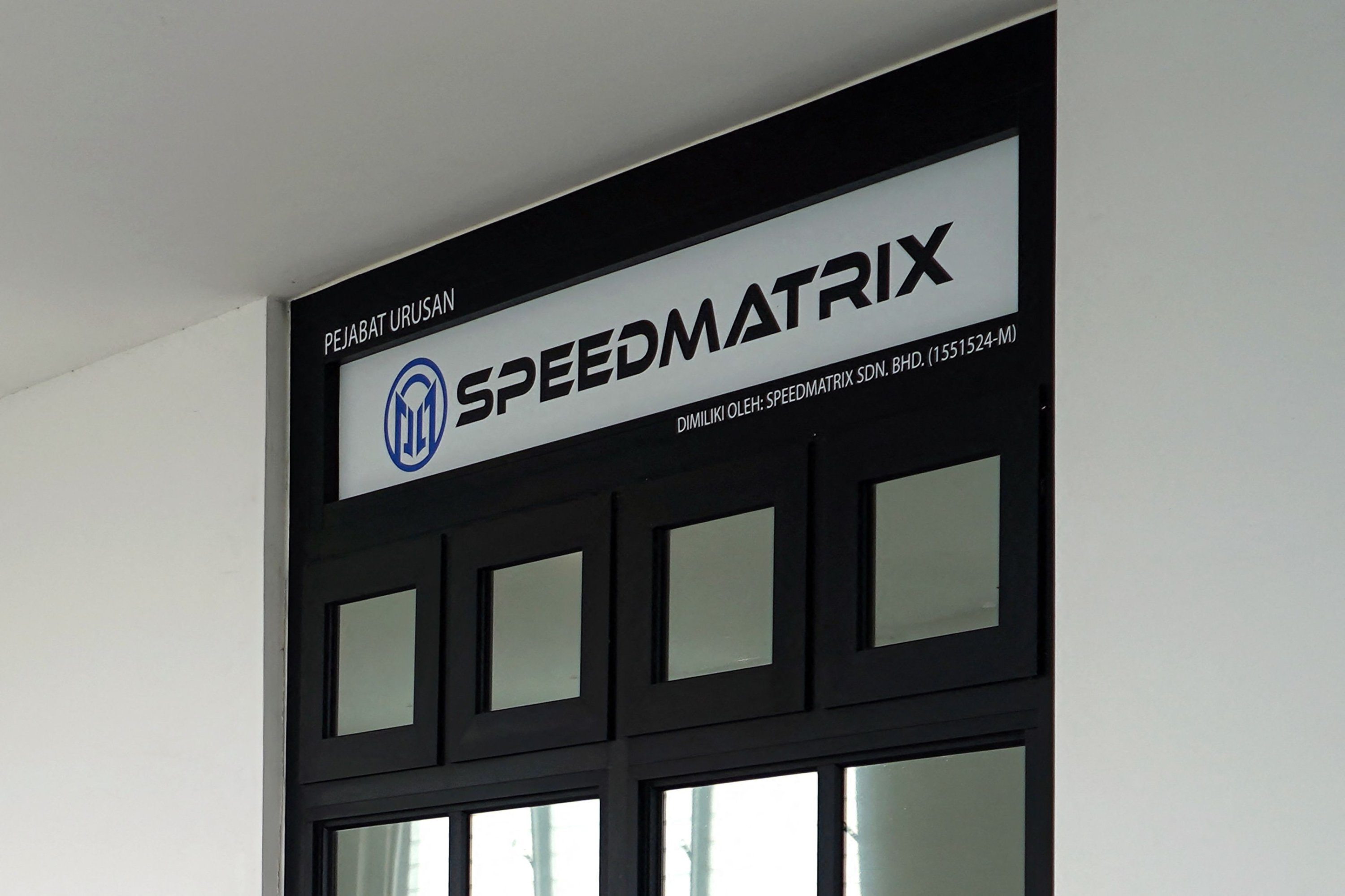
Speedmatrix, believed to be operating out of the Sedenak Tech Park in Johor, was also added to the U.S. list.
Speedmatrix, Singapore-based Megaspeed International and MSFusion share a common director, Tan Yong Pong, according to corporate papers.
Speedmatrix, MSFusion and Malaysia-based Megaspeed International Sdn Bhd share Ang Kong Siang as company secretary, as well as the same registered address in Johor state, documents show.
Seized shipments
Malaysian customs intercepted at least five illicit shipments of high-end chips from “one Asian country to another” this year, authorities have said.
After one of the raids at the Kuala Lumpur International Airport, AFP correspondents spotted the Nvidia logo on a picture of the confiscated goods.
AFP correspondents also saw a waybill on one of the confiscated containers, with the destination given as SZX, the code for Shenzhen Bao’an International Airport in China.


-
 Economy2 days ago
Türkiye, Russia to weigh new trade, energy cooperation deals
-

 Economy2 days ago
US expands Iran sanctions, targets ‘shadow-banking’ networks
-

 Politics2 days ago
20 detained in corruption probe into Turkish municipality
-
 Economy2 days ago
Türkiye’s central bank says could opt for tax measures to support lira
-
 Economy2 days ago
Home sales to foreigners in Türkiye hit 2026 high
-

 Sports2 days ago
Vlahovic, Trossard lift Beşiktaş past Konyaspor in 6-goal thriller
-

 Sports3 days ago
Greenwood saves Fener blushes as Galatasaray tighten grip on top
-
 Economy2 days ago
Alice Huang had contact with Chinese spy agency during Nvidia CEO affair: Report