
Economy
Apple overtakes Nvidia to become world’s most valuable company

Apple unseated Nvidia on Friday to become the world’s most valuable company, reshuffling the top ranks of tech heavyweights as investors reassess the outlook for artificial intelligence.
Apple was last valued at $4.88 trillion as its shares held steady, while Nvidia was roughly at $4.86 trillion, following a 3.5% decline.
The shift in the pecking order illustrates that investors are broadening their focus beyond the most obvious beneficiaries of the AI boom, such as Nvidia, which had been at the helm for nearly a year. Apple is reclaiming the top spot for the first time since April last year.
“Apple was seen as a laggard in the AI race because it wasn’t spending to develop models, but now sentiment has changed,” said Toni Meadows, head of investment at BRI Wealth Management.
“Apple is less exposed to capex intensity and better positioned to monetize AI via services, ecosystem lock-in, and hardware upgrades. The re-rating reflects confidence in earnings durability rather than speculative AI upside.”
For a company that was often seen trailing in the AI race, the milestone reflects Apple’s efforts to establish itself more firmly among the sector’s leading players, and could shape how CEO Tim Cook’s final months at the helm are viewed.
Cook is preparing to cede his role to hardware veteran John Ternus in September.
Last month, the company rolled out a long-delayed overhaul of Siri, betting the upgraded assistant would help close the gap with Big Tech rivals and new-age startups in the crucial AI race.
Some analysts say Apple is sitting on an AI gold mine in the form of the personal data that lives on every iPhone. The data could make Siri’s answers more useful and the assistant more capable.
The challenge is that such data is locked away in operating systems in the name of privacy and the company would have to find a way to unlock its value.
AI spending lifts new winners
Nvidia became the first company in the world to surpass a $5 trillion market valuation in October, a landmark that propelled it into a rarefied territory that was far beyond the reach of its rivals.
Being superseded by Apple does not necessarily signal a lasting change in the companies’ relative standing. The chipmaker remains a major beneficiary of AI-related spending, and its graphics processors are powering much of the generative AI frenzy.
Nvidia could also reclaim the top spot if sentiment shifts.
Besides, Apple is in a delicate position itself, having raised prices to offset rising costs – a strategy that could hurt demand.
“I don’t see any meaningful distinction. Nvidia likely to be a significant participant in whatever happens going forward,” said Benjamin Hall, vice president, alpha research at Segal Marco Advisors.
However, the AI enthusiasm has spread to other corners of the semiconductor industry. The bigger winners this year have been memory chipmakers such as Micron, which crossed $1 trillion in market value in May as investors embraced the significance of memory chips in AI infrastructure.
South Korea’s SK Hynix also listed on the Nasdaq earlier this month, adding another player to the race for investor attention.
“The new entrants to the market could spread out the focus away from the pure Magnificent Seven names into a wider number of names,” Hall said.
The eye-watering chips rally ran into turbulence in July as investors reassessed the sustainability of the artificial intelligence trade, knocking the Philadelphia SE Semiconductor index down almost 19% from its all-time highs.
Despite the steep fall, the index has performed better than Nvidia so far this year.

President Donald Trump was “p***** off” by Israeli Prime Minister Benjamin Netanyahu’s public criticism of a proposed U.S. sale of F-35 fighter jets to Türkiye, a report said Thursday.
Speaking alongside President Recep Tayyip Erdoğan before last week’s NATO summit, Trump said Washington would lift sanctions on Türkiye and signaled a willingness to sell the F-35 jets.
The move would be the biggest gesture yet from Trump to Erdoğan, whom he regularly praises and sees as a close ally. The two countries have enjoyed warmer ties since Trump returned to office last year. Erdoğan said he was confident Trump would resolve the issue and end the dispute.
Before Trump’s departure for Ankara, Netanyahu criticized the president’s intention to sell F-35 jets to Türkiye.
Trump was “p***** off” by the Israeli prime minister’s remarks during a Fox News interview, the Axios news site reported Thursday, citing a White House official.
A second official told Axios that Trump felt “Bibi had no right” to weigh in on that issue.
In 2019, the U.S. removed Türkiye from the F-35 program, where Ankara was also a production partner, following its purchase of the S-400 systems. It later also imposed sanctions on its NATO ally.
Washington claimed the system would endanger the jets and is incompatible with NATO systems, while Ankara has repeatedly said there is no conflict between the two and has proposed a commission to study the issue. Türkiye also said it fulfilled its obligations on the F-35s and that its suspension broke the rules.
Reports since Trump’s visit claimed Türkiye was poised to transfer the S-400s to an unnamed Gulf country. The Turkish Defense Ministry said on Thursday that “multilateral work” on the systems was underway and the public would be informed “once concrete steps are taken.”
Türkiye has long criticized Israeli genocidal operations in Gaza, as well as its attacks on Lebanon and Syria, and it has repeatedly accused Israel of trying to undermine the U.S.-Iran cease-fire.
Meanwhile, Israeli media claimed Trump would host Netanyahu next week, but Axios, citing White House officials, said no meeting had been scheduled.
The Israeli premier has reportedly sought a meeting with Trump for more than two weeks. He has visited the Oval Office six times since Trump returned to office in January 2025.
Reports in Israeli media had indicated that Netanyahu planned to travel to Washington this weekend to attend the funeral of the late Senator Lindsey Graham and meet Trump on Monday.
The trip was canceled on Thursday after Graham’s funeral service was postponed, Netanyahu’s office said in a statement.
Two White House officials reportedly said that Netanyahu wanted to see Trump but that no meeting had been confirmed or placed on the president’s schedule.
“Our impression was that Bibi was trying to will a meeting into existence,” Axios quoted an official as saying.
The news outlet said White House officials did not rule out a meeting when Netanyahu eventually travels to Washington for Graham’s memorial service.
The delay comes amid growing tensions between the Trump administration and Netanyahu’s government over the war with Iran.
U.S. Vice President JD Vance suggested Wednesday that members of the Israeli government were seeking to undermine Washington’s diplomatic efforts with Tehran in an effort to prolong the military campaign.
Home sales in Türkiye neared 130,000 units, driven by a sharp rise in mortgage-backed purchases, registering their strongest monthly performance of 2026 and the highest June figure in four years, official data showed on Friday.
According to the Turkish Statistical Institute (TurkStat), total house sales rose almost 16% year-over-year last month to 129,979 units.
Sales of newly built homes climbed 23.1% to 43,406 units, while secondhand home sales rose 12.5% to 86,573 units.
Mortgaged home sales surged 72.1% year-over-year to 25,993 units, accounting for 20% of all transactions and reflecting stronger demand despite elevated borrowing costs.
However, cumulative home sales in the first six months of the year fell 3.1% from the same period of 2025 to 699,516 units. Mortgaged sales increased 32.2% to 142,794.
Separate data from the central bank on Friday showed Türkiye’s nationwide house price index rose 24.5% annually in June, below consumer inflation of just above 32%, indicating a continued decline in real house prices.
Sales to foreign buyers rose 20.1% year-over-year in June to 2,015. They declined 9.2% in the first half of the year to 9,083.
Robust demand
Industry representatives said the June rebound reflected resilient housing demand, although they cautioned that financing conditions remain a key constraint.
“The strongest June performance in the last four years shows that demand for housing remains robust,” said Ziya Yılmaz, chair of the Housing Developers and Investors Association (KONUTDER).
He said some transactions delayed by the Eid al-Adha holiday in May were completed in June, contributing to the strong monthly figures.
Yılmaz also said the increase in firsthand home sales signaled improving demand for new housing, although such sales still accounted for around one-third of the market, well below levels seen before 2020.
He added that the sharp rise in mortgaged sales demonstrated that underlying housing demand and postponed purchases remained strong despite high mortgage rates.
Mustafa Kemal Şahin, head of the Real Estate Marketing and Sales Professionals Association (GAPAS), said the June figures suggested postponed demand was gradually returning to the market.
“The increase in firsthand sales is particularly encouraging because it points to renewed confidence in new housing projects and stronger sales performance by developers,” he said.
Şahin added that high interest rates and limited access to financing weighed on the first-half performance, but described June’s figures as an important sign of market normalization.
Sector representatives said a more sustained recovery would depend on easier access to financing, lower mortgage rates and policies supporting new housing supply, particularly for first-time homebuyers.
Developers also noted that installment plans and interest-free financing offered directly by construction companies have become an increasingly important alternative to bank mortgages.
Home prices extend real decline
Last month, the Central Bank of the Republic of Türkiye (CBRT) held its one-week repo rate steady at 37% for a third consecutive meeting as it monitored the impact of the Iran war.
Supply shocks mainly due to the fallout from the conflict had pushed Türkiye’s headline inflation higher in April and May, but June signaled the return of a downward trend.
The annual inflation eased to 32.1% last month from 32.6% in May. On a monthly basis, consumer prices rose 0.99% in June, slowing from 1.7% in May.
Since the conflict started, the CBRT has halted an easing cycle that began in late 2024 and taken other liquidity steps that pushed the Turkish lira overnight rate up to the 40% limit.
The CBRT raised its end-2026 inflation forecast to 24% from 16% in its quarterly inflation report published in mid-May, saying the short-term inflationary effects of the Iran war would remain “pronounced.” The bank projects inflation falling to 15% at the end of 2027 and 9% at the end of 2028.
Data from the bank on Friday showed the Residential Property Price Index (RPPI) rose nearly 2% month-over-month in June and was up 24.5% from a year earlier in nominal terms.
Adjusted for inflation, however, house prices fell 5.8% year-over-year, marking the seventh consecutive monthly real decline.
After recording a 1.4% annual real increase in January 2024, house prices slipped back into negative territory in February of that year and have remained below inflation ever since, except for a marginal 0.3% real increase in November 2025.
The pace of real declines has accelerated in recent months, widening from 1.4% in December to 6.1% in May. The annual real decrease stood at 2.3% in January, 3.9% in February, 3.4% in March and 4.3% in April.
COP31 co-host Türkiye on Friday called on member states of the Developing Eight Organization for Economic Cooperation (D-8) to strengthen cooperation, saying the bloc’s collective weight gives it a transformative role in the global climate agenda.
“The D-8 family, with its geography stretching from Asia to Africa and the Middle East and a population exceeding 1 billion, has a special place and transformative power in the global climate agenda,” Environment, Urbanization and Climate Change Minister Murat Kurum said.
Kurum was speaking at a meeting of D-8 in Istanbul, which gathered environment and climate ministers and senior officials from Bangladesh, Egypt, Indonesia, Iran, Malaysia, Nigeria, Pakistan and Azerbaijan as Türkiye prepares to host this year’s U.N.-sponsored climate talks.
“The common will to be demonstrated by the D-8 is of particular importance for COP31’s implementation-oriented approach,” Kurum, who’s also the COP31 president, said.
The conference will start on Nov. 9 in Antalya, southern Türkiye, while Australia will oversee the formal negotiations.
Kurum said Friday’s gathering was particularly significant as Türkiye prepares for its COP31 presidency and that cooperation among D-8 members would strengthen the role of developing countries in the global climate agenda.
Climate change is no longer a future risk but a global challenge directly affecting economic development, cities, food security, energy systems and public welfare, he said.
Despite numerous commitments, a significant gap remained between climate pledges and implementation on the ground, he added.
‘Dialogue, consensus, action’
Kurum said Türkiye was ready to share its experience in post-disaster reconstruction, Zero Waste practices, resilient cities, energy efficiency, the circular economy and sustainable infrastructure.
“We see COP31 as an implementation platform where climate adaptation is accelerated, access to finance and technology is strengthened, urban resilience is enhanced and nature-based solutions are expanded,” he said.
He said the COP31 presidency had adopted three main principles: “dialogue, consensus and action.”
Türkiye’s COP31 Action Agenda includes 10 priority areas, including reducing methane emissions, accelerating electrification and energy efficiency, promoting sustainable agriculture, supporting green industrialization and building climate-resilient cities.
It also prioritizes youth participation, resilient systems and stronger cross-sector cooperation.
Global targets for 2035
Kurum said Türkiye had proposed measurable global implementation targets extending to 2035.
These include raising the global electrification rate to 35%, halving the growth rate of global waste generation, reducing energy-use intensity in buildings by at least 25% and increasing circular material use in production and manufacturing to at least 15%.
The targets also seek to expand climate education and improve the speed, effectiveness and inclusiveness of climate finance.
Kurum said one of the main COP31 initiatives would be the Climate Implementation Bridge, designed to help developing countries turn climate commitments into investable projects and gain access to financing.
The meeting was expected to address climate adaptation, loss and damage, climate finance, a just transition and stronger cooperation among D-8 countries.
Kurum said the Istanbul Declaration would set out the group’s common environmental and climate vision and make an important contribution to COP31.
Trade Minister Ömer Bolat said Friday that Türkiye is engaged in intensive negotiations with the European Union to ensure the bloc’s new industrial policies and its “Made in EU” strategy do not undermine bilateral trade and investment.
Bolat’s remarks came following his two-day visit to Brussels, where he held a series of meetings with EU officials and European automotive industry representatives.
Ankara is closely monitoring the EU’s industrial policy initiatives, including the bloc’s Industrial Acceleration Act and the “Made in EU” agenda, as well as broader protectionist trends in global trade, Bolat said.
“We are conducting intensive efforts to ensure these developments do not harm Türkiye-EU trade, investment, economic relations or the future of the automotive industry,” he told Anadolu Agency (AA).
Bolat said opinions within the EU remain divided, with some member states favoring greater protectionism while others support deeper economic integration with partners such as Türkiye.
Although bloc membership talks have been stalled for years, both Ankara and Brussels say they want to modernize their customs union and boost economic ties.
Türkiye’s interests
Bolat said the Turkish government and private sector are working together to expand support among European policymakers for maintaining open trade and strengthening economic cooperation.
“We are working to protect Türkiye’s rights and interests, deepen Türkiye-EU economic relations on the basis of mutual benefit, attract more investment and further increase bilateral trade,” Bolat said.
Bilateral trade between Türkiye and the EU reached $233 billion in 2025, with the automotive sector, including finished vehicles and components, accounting for about $62 billion.
“The EU is Türkiye’s most important export market, while Türkiye is the EU’s fifth-largest trading partner,” Bolat said.
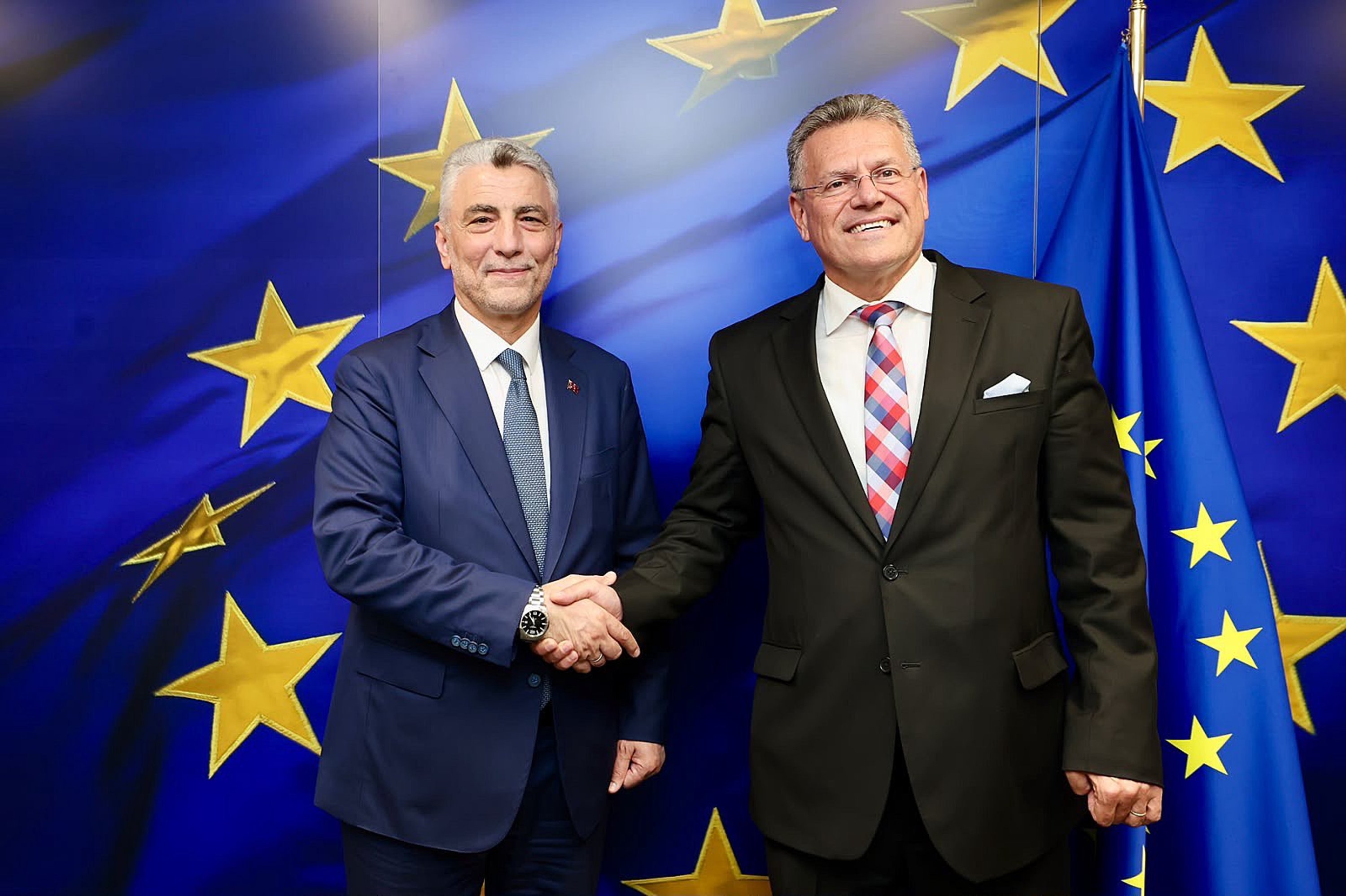
He reiterated Ankara’s call for negotiations to modernize the 30-year-old EU-Türkiye Customs Union, saying both sides recognize the need to update the agreement, although talks have yet to begin because of objections from some EU member states.
For decades, Türkiye and the bloc enjoyed good trade ties and cooperation on migration. However, relations have been strained over multiple issues, including the prolonged process of expansion of the scope of the customs union agreement and maritime issues with Greece and the Greek Cypriot administration.
The deeper 1990s-era trade agreement would be expanded to services, farm goods and public procurement. The current deal only covers a limited range of industrial products. Business groups have long argued that the deal is outdated and ill-suited for today’s trade environment.
‘Sweeping’ protectionism
Although the pact has enabled their economic ties to reach unprecedented levels, Bolat said new global developments require close coordination between the two partners.
“Protectionist winds are sweeping across the world,” he noted.
Bolat pointed to rapidly increasing imports from East Asia, changes in U.S. trade policy, and the EU’s own industrial initiatives. “We are closely monitoring these developments,” he said.
Bolat also said discussions covered visa issues, noting that the EU’s Cascade visa system, introduced last year, had shortened appointment waiting times and improved application processing in some member states, although technical constraints continued to cause delays in others.
Frustration has been growing in Türkiye over Schengen visa delays and rising rejections. Last year, Turkish nationals submitted 1.25 million visa applications for the Schengen zone, up from 906,000 in 2019, European Commission figures show.
Of that number, 1.07 million were approved. But the rejection rate has also risen – from 9.7% in 2019 to 14.6% in 2025.
Bolat added that Turkish road transport operators still face quota restrictions despite growing trade volumes, with road freight accounting for more than half of Türkiye-EU trade flows.
Moving relations forward
The minister acknowledged that advancing negotiations requires navigating the complex political structure of the EU.
“The European Union is not a single, compact entity,” Bolat said. “It consists of 27 countries, hundreds of political parties, different governments and different economic interests.”
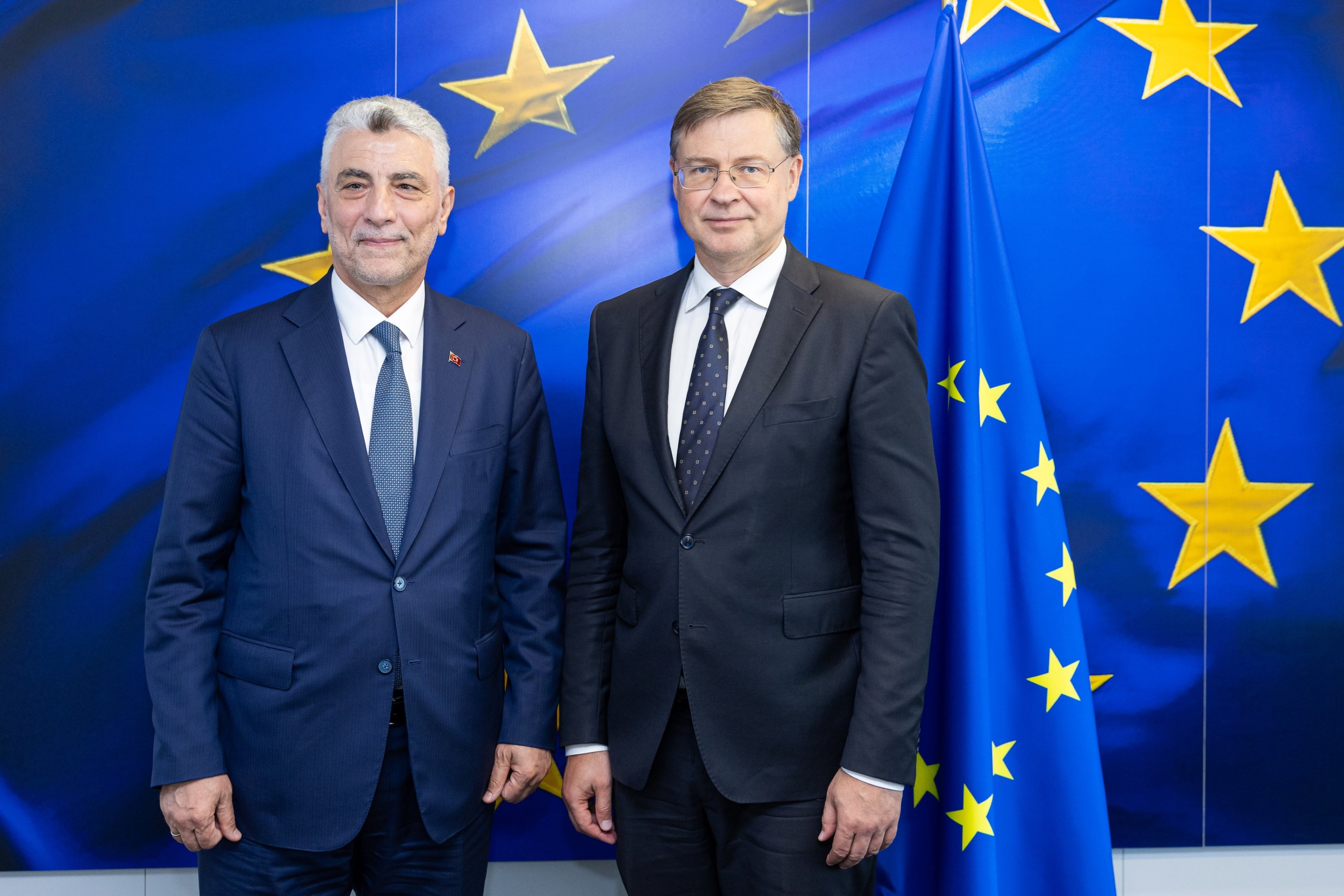
Some member states favor more open trade and stronger economic cooperation with Türkiye, while others advocate greater protection of domestic industries, he noted.
Bolat said Türkiye continues to engage with EU member states through ministerial and leadership-level diplomacy, including contacts involving President Recep Tayyip Erdoğan, while maintaining dialogue with European institutions and the private sector.
“Our objective is to move Türkiye-EU relations forward on the basis of a balanced win-win approach, attract more investment to our country and further increase bilateral trade,” he said.
He said Ankara’s priority is to increase support among European partners for closer economic cooperation and secure decisions that will strengthen Türkiye-EU relations in the coming period.
“I can confidently say that we have seen positive and constructive approaches from many different groups,” Bolat said.
“Our efforts are focused on increasing the number of those who support Türkiye’s views and strengthening our circle of friends so that future decisions will further advance Türkiye-EU relations in a positive direction.”
Trump Media & Technology Group (TMTG) has unveiled a paid-for, licensed data feed that will give banks and trading firms “the fastest” access to posts from influential Truth Social accounts, such as U.S. President Donald Trump’s, whose posts often move global markets.
The product, called “Truth API,” will deliver posts from the 10 most influential accounts to customers at a significantly faster pace than a regular push notification on the Truth Social platform, a spokesperson said.
The feed is designed for organizations “most impacted by the cost of a delay in information,” such as algorithmic trading firms, the company said in a statement. “Until now… firms that prioritize tracking influential Truth posts have relied on manual monitoring. Truth API closes the gap.”
The move is TMTG’s first step into data-licensing, and opens up a new revenue stream for the company, which has faced challenges in scaling its media business amid stiff competition from larger social media firms.
“Markets already move on Truth Social posts … As adoption grows, we expect Truth API to become a meaningful, ongoing source of revenue for the company,” TMTG’s interim CEO Kevin McGurn said.
Trump has made several announcements through his Truth Social handle that have jolted markets worldwide, including his “Liberation Day” tariffs and posts regarding trade restrictions on China, making the platform a crucial feed for traders, businesses and financial institutions.
On April 9, 2025, Wall Street’s main indexes turned sharply higher after Trump said in a Truth Social post that he would pause many of his new tariffs for 90 days.
Market-moving poster
“As far as I know, the only market-moving poster on Truth Social is Trump himself and his posts definitely move the market,” Mark Spiegel, managing member and portfolio manager at Stanphyl Capital Partners, said.
Asked if the move would create uneven trading opportunities for traders with deeper pockets, Spiegel said there are always uneven trading opportunities – this would be just one more.
The Donald J. Trump Revocable Trust holds roughly 114.75 million shares, representing about 41% of all outstanding stock in Trump Media & Technology Group, Truth Social’s parent company, according to regulatory filings.
Robert Frenchman, a partner at the Dynamis law firm in New York who has defended clients in federal government trading probes, said public companies had to be careful about how they disclose information on such platforms. But such platforms are allowed to offer clients early access even if it disadvantages some market participants.
“It certainly does not seem fair, but yes, a tech platform can tier its distribution of information without violating federal securities laws,” said Frenchman.
TMTG did not immediately respond to a request for comment on whether the move would create uneven trading opportunities.
Democratic Senator Ron Wyden criticized the program, saying that selling access to the president’s statements makes Wall Street traders rich.
Round-the-clock coverage
The product will provide round-the-clock coverage of influential posts and include an archive of posts dating back to 2022. The company said it has already signed up customers ahead of the Aug. 1 launch.
Some of the most-followed accounts on Truth Social belong to Trump himself and those closely aligned with him, including his sons Donald Trump Jr. and Eric Trump, as well as prominent supporters like Dan Bongino and Sean Hannity.
Firms have been scraping Truth Social data for months, in violation of TMTG’s terms of service, according to a spokesperson.
“We’re going to create a lot of friction for those folks that aren’t coming to us directly,” McGurn said in a statement.
The outbreak of the war in the Middle East has boosted real estate investments by foreign investors in Türkiye by 28.3% on an annual basis in March, April and May, according to a report on Thursday citing data from the Turkish central bank.
At the same time, Turkish nationals’ real estate investments abroad, which reached a record high of $2.6 billion in 2025, have dropped in recent months, the data shared by Central Bank of the Republic of Türkiye (CBRT) in its recent balance of payments data shows.
The figure rose 44.4% year-over-year in January to $208 million and climbed 18.4% in February to $225 million.
However, the war, which broke out at the end of the month, caused overseas residential property purchases by Turkish nationals to decline from March onward. Turkish nationals’ real estate purchases abroad declined 18% year-over-year to $187 million in March.
In April, that figure decreased 19.4% to $187 million and in May, it dropped by a whopping 40% to $143 million, the lowest level in 29 months.
Accordingly, the total value of overseas real estate investments by Turkish nationals in March, April and May fell 26% to $517 million, while real estate investments by foreign nationals in Türkiye increased.
Non-residents paid $590 million to purchase real estate in Türkiye, marking a 29.3% year-on-year increase.
The figure rose 62.4% to $242 million in March, 17.1% to $164 million in April, and 7.6% to $184 million in May despite the nine-day Eid al-Adha holiday.
Bayram Tekçe, president of the Istanbul-based Real Estate Services Exporters’ Association (GIGDER), told Anadolu Agency (AA) that in recent years, Turkish nationals have traditionally invested in residential property abroad, particularly in Dubai and Greece, but the war in the Gulf and Athens’ stance toward Ankara have affected those investments.
“The attacks in Dubai in March virtually halted real estate purchases, leading to a decline in sales, while Greece’s hostile stance against Türkiye and its cooperation with Israel and the Greek Cypriot Administration, as well as its efforts to deploy armed troops on the islands, affected the Turkish appetite for purchasing real estate in the country,” he said.
Tekçe said Russian nationals made more real estate purchases in Türkiye than last year, as bureaucratic processes have been streamlined to facilitate the process.
Burak Ustaoğlu, a global real estate expert, meanwhile, said that investors adopted a more cautious stance toward overseas purchases and postponed their investments following the war in the Gulf, particularly in Dubai, where Turkish investors had shown strong interest prior to the outbreak of the conflict.
“The war and the risk perception led to a temporary hesitation, not only in Dubai but across all overseas real estate investments,” he said, noting that investors have yet to fully abandon their overseas investment plans and are instead waiting for uncertainties to subside.
Ustaoğlu stated that Türkiye’s recently implemented economic policies and steps taken to strengthen its financial stability encouraged some domestic investors to opt for opportunities at home, rather than abroad.
He said Türkiye still offers attractive opportunities for foreign buyers because housing prices are competitive in foreign currency terms compared with many other countries, while Ankara’s diplomatic engagement on the global stage has reinforced confidence in the country.
“The perception of Türkiye as a stable and trustworthy country prompted foreign visitors to monitor the country more closely,” he said.
Ustaoğlu noted that Türkiye’s real estate market currently offers significant price advantages at present as many construction firms offer their completed and immediately available homes for highly competitive prices due to a slowdown in demand, creating opportunities for long-term investors.
He added that recently, investors from the Gulf, Russia, Azerbaijan and Kazakhstan, in particular, have exhibited increased interest in Turkish real estate offerings.


-

 Economy3 days ago
US inflation eases to 3.5% in June on lower energy costs
-

 Daily Agenda3 days ago
The nation cannot bend, Türkiye cannot be surpassed! Epic victory is 10 years old
-

 Daily Agenda3 days ago
10 years have passed since FETO’s coup attempt: July 15 messages from members of the Presidential Cabinet
-
 Daily Agenda2 days ago
Breaking news | President Erdoğan: Those who lost their enthusiasm for July 15 are still waiting for an opportunity
-
 Daily Agenda3 days ago
July 15 message from Minister Yaşar Güler: One of the most meaningful epics in our history
-
 Economy2 days ago
China’s Q2 growth slows to lowest since 2022, misses estimates
-

 Daily Agenda2 days ago
Lawyer Ece Güner’s statement was revealed: He went to the office with flowers in his hands
-

 Daily Agenda3 days ago
Directorate of Communications hosts 41 foreign journalists from 21 countries in Türkiye on the occasion of July 15