
Sports
For all his greatness, Ronaldo fails to conquer World Cup

Cristiano Ronaldo built one of football’s greatest careers over more than two decades, deciding matches, inspiring teammates and defying age to remain among the sport’s elite long after his celebrated spells at Real Madrid, Manchester United and Juventus.
But the one trophy that always eluded him remained out of reach on Monday, as the 41-year-old saw his sixth and final World Cup end in heartbreak. Portugal was eliminated 1-0 by Spain in the round of 16, leaving Ronaldo in tears at the final whistle.
Portugal’s campaign came to a crushing end when Mikel Merino scored in the 91st minute to seal Spain’s victory in Arlington, one day after Ronaldo calmly confirmed that this tournament would be his last World Cup.
As he walked out of his final prematch news conference to applause from reporters on Sunday, Ronaldo said he had no regrets about a career that pushed the limits of excellence and endurance for more than two decades.
Portugal coach Roberto Martinez praised Ronaldo’s commitment after the match, describing him as an icon of the sport.
“We will always be grateful for what he tried to do at this World Cup because the dream was to win the World Cup, and he led by an incredible example as captain,” Martinez said.
“This is not the moment to look beyond what we’re talking about: a football icon. There are not many Cristiano Ronaldos.”
27 matches, 11 goals
Ronaldo’s World Cup record includes 27 appearances and 11 goals. Fittingly, his only knockout-stage goal came last week to help Portugal eliminate Croatia, briefly keeping alive the dream that had accompanied him since his debut in 2006.
That first World Cup also produced his deepest run. At 21, Ronaldo was part of the Portugal team that reached the semifinals before losing to France.
In the quarterfinals, he calmly converted the decisive penalty in a shootout victory over England, a moment that still lives in Portuguese memory and seemed at the time to foreshadow greater triumphs. They never came.
For much of his international career, Ronaldo appeared to carry the weight of Portugal’s ambitions on his shoulders.
But the landscape changed as a new generation of talent emerged, and by this tournament, questions persisted over whether he should still be a guaranteed starter.
Against Spain, the veteran played the full 90 minutes and had three shots but was unable to make the decisive breakthrough.
Opponents paid tribute to one of the game’s greats, who against Spain produced what was arguably his finest World Cup performance in 2018, scoring a hat trick in a 3-3 group-stage draw that included a stunning free kick in the 88th minute.
“I’m a great admirer of him, of his values, of what he stands for, of how he approaches the sport, and I think he’s a role model for young people,” Spain coach Luis de la Fuente said after the game.
“Whenever we have the chance to be together, we acknowledge our mutual admiration and the pride we feel at knowing him.”
Messi rivalry
Ronaldo largely avoided questions throughout the tournament about comparisons with Lionel Messi. Still, as his World Cup story comes to an end, the contrast is difficult to ignore. Their rivalry defined an era but never fully extended to the World Cup stage.
Messi guided Argentina to the 2014 final before winning the title in 2022, while Ronaldo’s World Cup campaigns repeatedly ended in disappointment.
There was, however, the possibility of a World Cup meeting.
Had Portugal topped its group instead of finishing behind Colombia, and had both teams continued advancing, Ronaldo and Messi could have met in the quarterfinals.
“It would be top,” Ronaldo said of the potential showdown after scoring twice in Portugal’s 5-0 rout of Uzbekistan in the group stage, his best performance of the tournament in North America.
For a player who conquered nearly every other challenge the sport had to offer, that sense of what might have been will accompany Ronaldo’s World Cup farewell.

Germany’s Alexander Zverev is set to finish the season as world No. 1 for the first time in his career after Carlos Alcaraz’s surprise exit from the Shanghai Masters third round on Monday.
The career-first will cap a stellar season for the 29-year-old, the current world number two, after he won the French Open in June and the U.S. Open in September.
The French Open was his first-ever Grand Slam title.
“It’s been a fantastic season for me winning in Paris and New York and knowing that I will finish the year on top of the rankings is just a dream come true,” Zverev said in a statement shared by the ATP Tour website.
“So much work and effort have been put into achieving this goal, especially after coming back from the ankle injury,” Zverev added.
He suffered a career-threatening ankle injury in his French Open semi-final in 2022.
Zverev will be the first German male player to finish his season as top-ranked in the world, and the oldest to lift the trophy, set to be presented in November, for the first time.
Germany’s Angelique Kerber and Steffi Graf have both been the year-end number one women’s tennis player.
Zverev’s achievement comes in a year where the previous two players to hold the top ranking, Italy’s Jannik Sinner and Spain’s Alcaraz, have skipped months of competition due to injury.
Sinner, the current number one, has not competed since Wimbledon, where he beat Zverev in the final. He announced last week his season was over due to a knee injury.
Alcaraz, ranked third, was sidelined for months with a wrist injury from April until the U.S. Open.
Zverev, 6-foot-6 (1.98m), had been destined for the top from a young age, hailing from a tennis family where his mother and father both played the sport to a high level in the former Soviet Union.
But he plays in the shadow of domestic violence allegations made by two former partners, which he has strenuously denied.
The ATP Tour investigated one claim and found insufficient evidence to punish Zverev.
Another led to a 2023 penalty order and fine from a German court, which later dropped the case after a settlement was agreed in June of 2024, hours before he was due to play in the French Open semi-finals.
Turkish champions Galatasaray will host Spanish giant Barcelona Tuesday in the UEFA Champions League, seeking a signature home victory while manager Okan Buruk aims for his 150th win in charge of the Istanbul club.
The Lions enter the fixture looking to recover from a 3-1 opening-match loss at Sporting CP, while Barcelona opened their continental campaign with a commanding 5-1 home win over Feyenoord.
For Buruk, the high-stakes match presents a historical parallel. During his playing career, Buruk came off the bench in the 58th minute on Nov. 23, 1994, to help Galatasaray rally from a goal down to defeat Barcelona 2-1 – the Turkish club’s only historical victory over the Spanish side. Now managing Galatasaray since the 2022-23 season, Buruk holds a 149-29-33 record across 211 matches in all competitions.
“It was very difficult to beat Barcelona in those years as well,” Buruk said. “In 1994, I was on the pitch as a player. Being here as a manager is a completely different feeling. I trust my players implicitly. With the support of our fans, hopefully, we can experience another victory.”
Barcelona arrive in Istanbul in formidable form, holding a perfect 8-0-0 record in La Liga with 24 points and having scored 39 goals across nine official matches in all competitions this season.
Hansi Flick’s side enter the match following a 3-0 league victory over Getafe, featuring goals from Anthony Gordon, Gabriel Jesus, and Jules Kounde. Furthermore, Barcelona has avoided a goalless draw in its last 44 Champions League fixtures dating back to November 2021.
Despite Barcelona’s dominant run, Buruk stressed that his team will not adopt a purely defensive posture.
“We are going to play against one of the most in-form teams in the world,” Buruk said. “We won’t just defend; we will attack as well. We have to consider both together. Against Barcelona, you need to execute your best both defensively and offensively, applying intense pressure regardless of where you meet the opponent.”
Galatasaray midfielder Lucas Torreira echoed his manager’s sentiments on the challenge that lay ahead.
“We are going to compete against what is currently the best team in the world,” Torreira said. “We will try to win the match. We need to be at our absolute best. Our identity will not change. We will defend when we need to defend, and steal the ball when we need to steal it. We step onto the pitch to win every match.”
The Istanbul powerhouse, however, will have to make do without their Ivoirian defender Wilfried Singo, who remains sidelined due to injury.
Meanwhile, 35-year-old midfielder İlkay Gündoğan is available to face his former club, where he scored five goals in 51 appearances during the 2023-24 season.
Barcelona also carry notable injury absentees of their own, with winger Raphinha, Roony Bardghji and defender Andreas Christensen all ruled out. Dutch midfielder Frenkie de Jong has returned to team training after a long-term injury but is not expected to play.
Galatasaray’s recent home record in European competitions offers a foundation for optimism. The Turkish side have lost only once in their last 11 European home matches (7-3-1), dating back to a 3-1 victory over PAOK in the 2024-25 UEFA Europa League.
In Champions League play specifically, Galatasaray have recorded four wins, four draws and two losses in their last 10 home fixtures at RAMS Park.
“Everyone will call Barcelona the favorite,” Buruk said. “But we have a group of players who hold that belief. A positive result against a team like this would elevate our momentum significantly.”
The Champions League match kicks off at 10 p.m. local time (7 p.m. GMT) and will be officiated by Italian referee Marco Guida.
Zizou Bergs defeated Carlos Alcaraz in straight sets at the Shanghai Masters on Monday, halting the former world No. 1’s successful return from a monthslong injury layoff.
The 39th-ranked Belgian beat the second-seeded Spanish star 7-5, 7-6 (7/4) in the third round to land the tournament’s biggest upset yet, and will play either Tommy Paul or Valentin Vacherot next.
“It’s a little disbelief and not feeling too much,” Bergs, 27, said afterward.
“You’re just really in the moment, being focused on the points you have to play,” he added.
“I’ll be very happy.”
Alcaraz started with more quality until Bergs broke the Spaniard’s serve to go up 3-2 in the first set.
The 23-year-old grabbed back that break in the next game but was uncharacteristically off-target, sending a mess of shots into the net.
He double-faulted to hand Bergs a critical break point in the 11th game, and lost the first set when a volley went short.
Alcaraz was visibly frustrated during the second set as he vented to his corner following a series of misfired shots that left him with no points in the fourth and eighth games.
The Spaniard forced a tie-break but could not reach a third set as Bergs closed things out just past the two-hour mark on his first match point.
Fritz fumbles
Earlier, Stefanos Tsitsipas came back to beat Taylor Fritz 3-6, 7-5, 6-3 and earn fourth round meeting with Daniil Medvedev, who brushed aside qualifier Dalibor Svrcina 6-2, 6-3.
A wardrobe malfunction delayed victory for the Greek world number 43 when a tennis ball tumbled out of the American’s pocket a second time and forced the men to replay a match point.
A tired-looking Fritz, seeded 11th, hung on for a bit longer to save the eighth game but could not stick around beyond that, with Tsitsipas holding serve to win at the fifth time of asking.
“I could have done a few things easier, but I ended up being my biggest enemy,” Tsitsipas told the crowd afterward.
“I turned things around really well towards the end and became friends with myself and played some incredible tennis,” he said.
Felix Auger-Aliassime, Casper Ruud and Rafael Jodar also went through to the last 16.
Manchester City defeated Liverpool in their first match since being found guilty of breaching Premier League financial regulations, though the long-term implications of the ruling remain uncertain.
Enzo Maresca’s men are top of the table with six wins out of six after their impressive 3-0 win at Anfield Sunday.
Yet those points could count for nothing unless City are successful in their appeal against the findings of an independent commission that found them guilty of more than 100 breaches of Premier League rules.
No sanction has yet been decided, but the club could face a severe points deduction leading to relegation, or even expulsion from the English top flight.
There is even speculation that City could be stripped of the three Premier League titles they won between 2009 and 2018, the period to which the charges relate.
The Premier League, which has a huge global reach, faces an appeal process likely to drag on for months, putting a question mark against every City result, and with huge potential implications for other clubs.
“We’re sat here not knowing what it means,” likeer Manchester United captain turned pundit Gary Neville told Sky Sports Sunday.
“City supporters will be delighted (with the win), but I don’t think they recognize right now the stain, the stigma and the damage this is going to do to them.”
The BBC’s chief football writer, Phil McNulty, said the team’s impressive win at Anfield had been overshadowed by what was happening off the pitch.
“Every victory, every league table, will come with a metaphorical asterisk until clarity and finality comes,” he said. “No one knows when this will be.”
Andoni Iraola’s Liverpool are ninth in the table, nine points behind leaders City.
But even if Liverpool fail to challenge for the title, the three points lost Sunday could cost them dearly in the battle for a place in the Champions League.
Potential sanctions against City could also have an impact on the battle for relegation.
“That today, what does it mean going forward?” former Liverpool defender Jamie Carragher said on Sky Sports.
“This has to be done before the end of the season. There’s no way this can carry on to the end of the season because we’re all getting kidded.”
Liverpool anger
The Premier League announced late last month that an independent commission had found that City had arranged “sham” deals to artificially inflate revenues and reduce costs by more than 900 million pounds ($1.2 billion) between 2009 and 2018.
Liverpool feel particularly aggrieved, having finished second behind the Manchester club in the Premier League three times in the past 12 years.
City’s rivals believe the Abu Dhabi-backed club’s spending in the 2009-2018 period built the foundations for a golden era that continues to bear fruit.
The Premier League leaders spent around 460 million pounds in the 2026 summer transfer window – a new Premier League record for a single window – as new boss Maresca reshaped the squad following the departure of Pep Guardiola.
One of City’s expensive new signings, midfielder Elliot Anderson, admitted the criticism of the club had galvanized the players as they stepped out at Anfield.
“We’ve got to stick together,” said the England midfielder. “I think it really brings us together. It gives you that determination to come out here, everyone is against you, and turn them over, which we did.”
Anderson and his teammates will have to get used to their new reality as the whole of English football waits for a definitive decision in a case that has rumbled on for years.
As chants, banners, flags and scarves at Anfield showed, City stand accused of cheating their way to the top – and opposition fans will not be silenced.
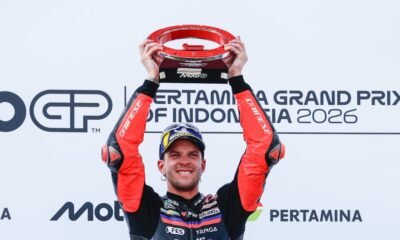
Marco Bezzecchi won the Indonesian Grand Prix on Sunday after overtaking an injured Raul Fernandez, while Jorge Martin finished third to recapture the championship lead from Marc Marquez.
Fernandez, racing with fractured fingers from a Saturday crash, appeared untroubled in the opening half of the race as he and Bezzecchi pulled away from the chasing pack.
However, Fernandez began to fade, and Bezzecchi overtook him with nine laps remaining to take the lead and secure victory. Martin’s third-place finish completed a podium lockout for Italian manufacturer Aprilia.
Bezzecchi’s win, the 300th victory for an Italian in MotoGP, also kept his faint championship hopes alive.
“I’m very happy to be back on the top step of the podium,” said the 27-year-old, who led the standings early in the season but has struggled recently.
“It was a nice battle with Raul. I think my team and I deserve a result like this, especially because they never stop working. They’ve been through tough times with me.”
Fernandez detailed his injury after the race.
“Yesterday, when I crashed and I saw my hand, I knew before going to the clinic that I had my finger broken – the one I normally use to brake,” the Spaniard said.
“This morning, when I woke up, I realized I had not one, but two fingers broken. No one knew. I tried to say nothing, just keep the pain to myself and keep my focus on the race.”
“This morning, I tried to find a solution on the brakes, because I was not able to use the finger I normally use. I started everything from zero. It was a very difficult job for me,” he said.
Martin back on top
A close duel unfolded behind the top three, with Marquez battling KTM’s Pedro Acosta.
Marquez had a strong start and moved into third place on the opening lap, but his Ducati struggled to keep pace with the Aprilias around him, and Martin easily overtook him on the third lap.
Acosta then quickly overtook Marquez, but for the second straight day, Marquez benefited from his opponent’s tire pressure issues, regaining fourth.
Once Acosta was clear of a penalty, he again battled Marquez, but as they dueled, Trackhouse’s Ai Ogura capitalized and passed both riders to secure Aprilia’s first-ever 1-2-3-4 finish.
Martin, who leads the 2024 championship, moved to 355 points to top the standings. Marquez, Saturday’s sprint winner, had 353 points after finishing sixth, his first complete race at the Mandalika circuit.
“The last few laps, I was struggling with the tires, physical condition, but I was able to finish on the podium, so really happy,” Martin said.
“We are still in the fight. We are still in the lead. It will be a tough championship, but I will give my all.”
Barcelona’s rising English star Anthony Gordon scored his first goal for the Catalns Saturday, helping the Spanish champions extend their perfect start in La Liga with a 3-0 victory over Getafe.
Real Madrid finished with 10 men against Villarreal after Vinicius Junior was sent off for hair pulling in a 1-0 victory. Yan Diomande’s goal kept Jose Mourinho’s side third and on Barcelona’s trail.
Los Blancos are six points behind Barca, who also lead second-place Atletico Madrid by five points after Diego Simeone’s team snatched a late 2-1 win at Alaves.
Winger Gordon opened the scoring for Barca in the second minute and Gabriel Jesus added another after half an hour for the league leaders, who have won every match they have played this season.
France defender Jules Kounde tucked home the third from Lamine Yamal’s cross to cap Barca’s solid win against Jose Bordalas’ side at Camp Nou.
Barca were without their top scorer Raphinha, who sustained a hamstring problem during the international break with Brazil.
Flick replaced him with former Arsenal striker and Brazil compatriot Jesus. His side came roaring out of the blocks.
“Being at Barca is a dream … playing with these players is very easy too, everyone plays very well,” Jesus said after his first start and third goal for the club. “That makes it easier for me as a striker, to have chances and I’m ready to score the goals. But I hope Rafa can recover quickly because the team miss him.”
Gordon, who has impressed since joining this summer, grabbed his first Barca goal with a low deflected effort after bundling his way past three players.
He was Barca’s brightest spark in the first half, continuing his fine goalscoring form for England in the recent Nations League matches.
“He’s doing very well,” Flick said of Gordon. “He scored with England. He has a lot of confidence. He gives us a lot.”
Getafe defender Zaid Romero gave the ball away in his own box for Barca’s second, passing it straight to Jesus, who stroked into the bottom corner.
The otherwise quiet Yamal supplied Kounde for the third as Barca secured their ninth win in nine games across all competitions.
Diomande, Real Madrid’s record 140-million euro ($157 million) signing, scored his first goal for the club to help them beat Villarreal. Vinicius’s dismissal, however, marked the game.
The Brazil international, on as a substitute, scored, but officials disallowed his goal and he was sent off after a VAR review showed he pulled the hair of Villarreal’s Nathan Saliba in the buildup.
“Sorry to my team and the fans,” Vinicius posted on Instagram.
Mourinho’s Madrid battled through the final stages with 10 men but held on to their slender lead, which 19-year-old winger Diomande earned.
Despite Madrid’s victory, Vinicius’ red card left a bitter taste for Los Blancos. The winger risks a potential ban that could keep him out of the Clasico on Oct. 25.
“I don’t know what’s going on with the referees, with this red card, I don’t understand, but the most important thing is the victory,” Madrid midfielder Aurelien Tchouameni said.
Mourinho declined to attend his post-match press conference in protest at the refereeing, a club source said.
The Madrid coach had complained bitterly about refereeing decisions that did not go his team’s way in the derby defeat against Atletico before the recent international break.
Striker Kylian Mbappe was fit to start the match for Madrid and hit the post in a largely dull first half.
Home fans were not happy with the team at halftime, but after 63 minutes they celebrated Diomande’s first goal, a sharp low finish into the far corner after Federico Valverde set him up.
The drama with Vinicius followed, but thanks in part to goalkeeper Thibaut Courtois, Madrid clinched three important points.
Earlier, Cristian Romero’s header in the 87th minute earned Atletico Madrid a narrow win at 10-man Alaves.
Alejandro Grimaldo put Atletico in front before Lucas Boye equalized from the penalty spot for Alaves before halftime.
Officials sent off Angel Perez for the hosts in the second half. Romero’s header from Alex Baena’s cross then secured the victory.
“It’s always important that the goal comes from wherever it comes, as long as it comes,” Simeone said.


-

 Economy2 days ago
Can diesel prices fall after Trump-Russia deal?
-

 Politics3 days ago
Turkish Defense Ministry marks 7 years since Operation Peace Spring
-

 Politics2 days ago
Türkiye-France defense cooperation spark concern in Greek media
-

 Politics2 days ago
Türkiye presses Greece to hand over FETÖ members, crime bosses
-

 Economy2 days ago
Tehran’s once-bustling bazaar struggles as war dampens demand
-
 Sports2 days ago
Bezzecchi wins Indonesian GP to hand Martin championship lead
-

 Sports2 days ago
Deadly Houthi strike on Riyadh airport draws int’l condemnation
-

 Economy22 hours ago
Top oil execs drop from major event schedule after Riyadh attacks