
Economy
With Iran war, foreign workers in Middle East bear double brunt

He had met his 6-year-old son only once. A few days close to each other in a life otherwise spent miles apart.
For 15 years, Mohammad Abdullah Al Mamun worked in Saudi Arabia, sending money home to his family in one of Bangladesh’s poorest areas. This year, he had planned to return, build a larger house with his savings, and spend time with the child he barely knew.
Then, on March 8, a missile struck his workers’ camp. He suffered severe burns and later died. He was among more than two dozen foreign workers killed across the Mideast after the U.S. and Israel went to war with Iran in February.
Tens of millions of foreign workers have helped build the Gulf Arab states’ modern, oil-fueled economies, with many not fully sharing in their prosperity.
Now they face an even sharper dilemma: Keep working in the Mideast, where wages are far higher, hoping that a shaky ceasefire endures; or return to already poor countries where prices have soared because of the conflict.
Mamun’s choice was made for him. He arrived home in a coffin earlier this month.
“We don’t know what we will do next,” said his widow, Sadia Islam Sarmin.
Migrant workers make up a majority of the population in many Gulf Arab states. Westerners, Arabs and Indians dominate business and finance, while laborers from poor countries in Asia and Africa toil for long hours in scorching temperatures at oil facilities and construction sites – often with few protections.
The Coalition for Labour Justice for Migrants in the Gulf, an advocacy group, says few had access to bomb shelters and many were stranded by the conflict. It says attacks killed at least 24 foreign workers in the Gulf and four in Israel as Iran and allied armed groups launched waves of missile and drone strikes. Their count includes eight mariners killed at sea.
“It’s a very precarious situation for migrant workers,” said Udaya Wagle, who studies labor and migration at Northern Arizona University.
A cease-fire was announced in early April, but negotiations to end the war have repeatedly stalled. Iran has effectively blocked the Strait of Hormuz, a key waterway for global oil and gas, and says it will only reopen it if the war ends and the U.S. lifts its blockade.
Remittances in question
The resulting spike in the price of gas, fertilizer and other goods has hit Asian countries particularly hard.
Remittances from the Gulf make up about 1% of India’s gross domestic product (GDP), 3% to 5% of the GDP in Bangladesh, Pakistan and Sri Lanka and nearly 10% in Nepal.
Now they are more vital than ever, as household incomes are strained and governments seek foreign currency to buy oil and gas.
The Gulf economies also face a bleak outlook, with exports bottled up and key energy facilities in need of repair after missile strikes. The fighting could resume, as Iran rejects U.S. President Donald Trump’s demands.
Mamun’s family awoke on March 9 to phone calls saying the 35-year-old had been hurt. Video footage shot by another worker showed him sitting in the open, badly burned and bleeding, crying out for help.
“He never imagined he would be hurt. That a missile would fall on him,” said Maruf Hasain, his younger brother.
Workers like Mamun are the most vulnerable since they do the “most dirty, dangerous and difficult” jobs, said Shariful Islam Hasan of the Bangladeshi development organization BRAC.
In Qatar, a 27-year-old Bangladeshi factory worker labored through 12-hour shifts as missiles flew overhead. Shrapnel from one strike fell near his living quarters. When alarms sounded, he said, workers went to a designated room.
He earns less than $400 monthly and sends two-thirds home. “We have no choice but to keep working,” he said on condition of anonymity for fear of angering the authorities.
Qatar enacted several reforms in the run-up to hosting the 2022 World Cup, including the partial dismantling of a system that tied workers to their employers. But activists say abuses are still widespread and that workers have few avenues to pursue justice.
Ahmed al-Aliyli, a taxi driver in Qatar, has not sent money home to his family in Egypt for two months. He once earned as much as $3,000 a month, but his income has plunged to a third of that as the war has disrupted travel. “We are the collateral damage of this war,” he said.
A slowdown in key sectors like real estate and construction will hit migrant workers directly, said Hasan of BRAC. Workers from Bangladesh and Pakistan are especially vulnerable, as they are often employed informally and without fixed contracts, he said.
Despite reforms in some countries, work permits are also often tied to a single employer and, in some cases, workers are effectively stranded, according to the labor coalition. It warned that some employers may use the conflict to withhold wages, deny leave, or carry out arbitrary dismissals.
When the war began, Mamun’s mother, Shahida Khatun, urged him to come home.
‘No words to describe the agony’
He had been saving up since November. In his last call home, he promised his younger brother and sisters he would pay for their studies, that he would build a larger house for his parents and return for good this spring.
Now, his family is struggling to recover his wages and piece together a life without him.
“The pain of losing a child. There are no words to describe the agony,” Kathun said.
For many workers, going home would mean giving up a steady income and much higher wages.
Marlene Flores, a Filipina worker in Qatar, said she felt the shudder each time a missile was intercepted. But the tax-free pay and health insurance made it feel safer – in a way – than the Philippines, which has declared a ″ national energy emergency.”
“It’s not easy for me to say,” she admitted, “But I would really stay here.”
Israel also has a large population of foreign workers. Filipino caregiver Jeremiah Supan continued caring for his two elderly charges despite near-daily missile alerts, sometimes dashing out for food or medicine despite the danger. He questions whether his own family could survive if he returned to the Philippines.
“I know that in the blink of an eye, one can die,” he said. “But what life shall we return to?”
Money leaving the investment funds now being liquidated in Türkiye has largely moved into bank deposits, the country’s central bank chief said Tuesday, adding that the risk of the turmoil spreading to the wider financial system remained limited so far.
Regulators last month ordered the liquidation of over 130 investment funds managed by seven asset managers following warnings by some that they could not meet redemption payments.
Authorities have widened their investigation into suspected market manipulation in stocks and fund markets. Eighty-five suspects have been arrested so far in the probe, Justice Minister Akın Gürlek said Tuesday.
The funds ordered to be wound down had reached more than $20 billion in assets over just three years. About half a million investors have been affected.
There have been sharp outflows from funds undergoing liquidation, and part of it came from foreign-resident investors, Central Bank of the Republic of Türkiye (CBRT) Governor Fatih Karahan said Tuesday.
He was answering lawmakers’ questions at Parliament’s Planning and Budget Commission.
For domestic residents, Karahan said, where the money goes matters for dollarization.
“We see that a significant portion of this amount has moved into deposits,” he said. He added that total commercial and savings deposits rose by more than TL 800 billion ($16.27 billion) over the same period.
Karahan said there had also been outflows from foreign-currency funds, and that some of that money could be expected to flow into foreign-currency deposit accounts. Even so, he said, overall deposit preferences were in line with the current Turkish lira share.
He put the lira share of investment funds at about 61% to 61.4%, and said it was holding steady.
Connection to wider system ‘weak’
Karahan said the link between the funds in liquidation and the rest of the financial system was critical for assessing contagion risk, and that current data pointed to a weak connection.
“We can say that the shift toward the Turkish lira in the financial system is continuing in some form, at least based on the data we have at the moment,” Karahan said.
He credited coordinated measures by the central bank and other institutions for keeping the risk of contagion limited so far.
He said the impact so far was mostly confined to the portfolio management companies concerned and their investors.
“We assess that the contagion risk is under control based on the data,” Karahan said. “But this does not mean everything is over. If we see the need, we will continue to take the necessary steps in every way.”
He said there had been a risk of volatility and disruption in lira markets, which was why a number of measures had been taken.
3 areas to watch
Karahan said the liquidation process was only at its start, and that a firm assessment of its macroeconomic effects would need to wait to see how it unfolds.
He said the central bank would track the impact in three areas: wealth, reserves and the real sector.
Karahan said financial wealth could decline somewhat, but that the effect on spending was expected to be smaller than that of the recent fall in gold prices.
For reserves, he said, what matters is where investors leaving the funds put their money. So far the data show a strong preference for the lira.
The third area is indirect effects through household and corporate balance sheets. Karahan said the central bank’s first analyses showed that real sector companies hold only a limited share of the liquidated funds, and that these are mostly large firms with strong liquid assets.
Any balance-sheet impact would therefore be expected to feed less strongly into the real economy. He stressed that these were initial findings and would be updated as data come in.
Cautious stance to continue
In his presentation before the commission, Karahan also said that disinflation is expected to regain momentum provided that supply pressures ease
He stressed that the bank would keep a cautious monetary policy to preserve gains achieved so far in lowering inflation.
Türkiye’s annual inflation dipped below 30% for the first time in almost five years in September, official data showed Monday.
Consumer price growth eased more than expected to 29.73% from 31.51% in August.
That marked the fourth consecutive month of decline, after the downward trend that started in mid-2024 stalled earlier this year following a sharp rise in energy prices caused by the Iran war.
Monthly price growth also came in below expectations at 1.84%, the same as in August.
Some analysts said the September reading raises the prospect of an interest rate cut at the Oct. 22 meeting.
The bank has kept its benchmark one-week repo rate at 37% this year, as it monitored the inflation impact of the Iran war.
Karahan said a slowdown in the disinflation process had been caused by war-related energy price volatility. But he added that “the main trend in inflation remains below annual inflation,” signaling that disinflation would continue if supply pressures fade.
He noted that upside risks to energy prices are being evaluated and that tight policy is seen as important in limiting the inflationary impact of supply shocks.
Karahan said a weaker-than-expected improvement in inflation expectations poses a risk to the disinflation process.
On the other hand, a slowdown in services inflation is continuing despite supply shocks, with weaker domestic demand also contributing, he noted.
Leading indicators show that a slowdown in rent inflation is expected to continue, Karahan said.
A slowdown in domestic demand has become marked, with indicators confirming a weakening of consumption activity, he noted.
Karahan also said the current account deficit-to-GDP ratio in 2026 is seen below long-term averages.

Türkiye’s combined electricity generation from solar and wind sources reached a record 9.9 billion kilowatt-hours (kWh) in August, the highest level on record, according to the Energy and Natural Resources Ministry.
Solar power generation stood at 5.16 billion kWh in August, while wind generation reached 4.74 billion kWh, the ministry said Tuesday.
Solar accounted for 14.1% of total electricity generation during the month, while wind’s share was 12.9%. Combined, the two sources generated a record 9.9 billion kWh.
Hydropower remains largest source
Türkiye generated 36.71 billion kWh of electricity in August, with hydropower maintaining its position as the largest source.
Hydropower accounted for 24.7% of total generation, producing 9.08 billion kWh during the month.
Renewable sources accounted for 56.4% of total generation, at 20.7 billion kWh, while domestic sources accounted for 69.7%, or 25.58 billion kWh.
Daily electricity generation also reached its highest level of the year so far in August. The daily record was set on Aug. 13, when generation reached 1,241,291 megawatt-hours.
Domestic generation reaches record share
During the January-August period, hydropower generation reached 75.2 billion kWh, wind generation 30.4 billion kWh and solar generation 29.8 billion kWh, marking the highest levels recorded for the corresponding period since 2000.
Domestic sources accounted for 73.2% of electricity generation during the period, producing 181.8 billion kWh. Both the volume and share were the highest for the corresponding period since 2000.
Renewable sources accounted for 60.3% of generation, at 149.8 billion kWh, also representing the highest volume and share for the corresponding period since 2000.
Energy and Natural Resources Minister Alparslan Bayraktar said Türkiye aimed to build a strong energy infrastructure through long-term investments in renewable energy.
“Our long-term investments in renewable energy infrastructure continue to translate into record generation figures,” Bayraktar said.
“Our goal is not only to meet today’s energy demand, but to build a strong, sustainable and innovative infrastructure that is completely free from external dependence,” he said.
Bayraktar added that Türkiye would continue integrating its substantial solar and wind potential into the grid using advanced technologies as it pursues its goal of achieving full energy independence.
Justice Minister Akın Gürlek said Tuesday that 85 suspects had been arrested so far in the investigation into Türkiye’s fund turmoil, and that five people had already handed back money they made through what he called “unjust gains.”
Gürlek said authorities would recover such profits from others who made them through market manipulation.
Regulators last month ordered the liquidation of over 130 investment funds managed by seven asset managers following warnings by some that they could not meet redemption payments.
Authorities have widened their investigation into suspected market manipulation in stocks and fund markets.
Legal action has been taken against 207 people in total, with measures imposed on the assets of many of them, Gürlek told Anadolu Agency (AA).
The funds ordered to be wound down had reached more than $20 billion in assets over just three years. About half a million investors have been affected.
Türkiye’s Savings Deposit Insurance Fund (TMSF) has opened accounts for investors seeking to return what authorities describe as “excessive gains” from fund sales.
Gürlek said five people had returned their unjust gains so far. Reports said among them was Fatma Betül Sayan Kaya, who resigned as a deputy chair of the ruling Justice and Development Party (AK Party) after she and her husband were alleged to have made substantial profits trading shares ahead of the turmoil.
Profits made by people who earned excessive gains over a short period would be transferred to a fund set up within the TMSF, the minister said.
“We will pursue our rights to the end within the framework of the law,” Gürlek said.
Gürlek drew a line between two kinds of earnings. Legitimate profit, he said, comes from citizens putting their savings into stocks and the stock market. The other kind came from so-called “bubble” stocks, where traders made abnormal profits by moving in and out quickly.
He said investigators had found that some people in closed and open funds had acted on tips and inside information, and used manipulative trades to make “extraordinary” profits over a short time.
He said the Istanbul Chief Prosecutor’s Office, working with data from the Capital Markets Board (SPK), Borsa Istanbul Stock Exchange and the Central Registry Agency, had frozen the assets of people who made abnormal gains.
Some of them had been arrested, he said, and others had fled. He said the process was continuing.
Gürlek said his ministry first noticed unusual movement in some funds and shares in February 2025 and wrote to the SPK about it. Citizens’ complaints then increased sharply in August 2026. Permission to investigate was granted later that month, he said.
Gürlek said the State Supervisory Council (DDK) had been tasked with examining whether any public institutions were negligent.
He said the Turkish market and economy were very strong and that a problem in a small part of the market should not be generalized.
The U.S. trade deficit surged more than analysts expected in August, government data showed Tuesday, hovering at its widest level since March 2025, driven by imports of oil and advanced tech products like chips.
The trade gap in the world’s biggest economy jumped 13.7% to $105.6 billion, according to Commerce Department data.
This was larger than the $102 billion projected in a consensus forecast released by MarketWatch.
U.S. trade flows have swung significantly since President Donald Trump returned to the White House in January 2025, as businesses rushed to get ahead of his sweeping, and fast-changing tariffs on trading partners.
The latest figures, which are adjusted for seasonality but not inflation, also reflect a surge in global energy prices from the war in the Middle East.
U.S.-Israel strikes targeting Iran in late February had triggered Tehran’s response in blocking the Strait of Hormuz, a key waterway for energy transport, which sent oil prices soaring.
Both sides remain locked in conflict.
In August, U.S. imports rose by 4.3% to $420.8 billion, driven by crude oil, gold, semiconductors and industrial machinery.
U.S. exports climbed by 1.4% to $315.2 billion, partially driven by energy exports too.
German factory orders dropped sharply in August, more than forecasted, as large-scale orders for aircraft, ships, trains and military vehicles declined, official data showed Tuesday, underscoring the fragility of a recovery in Europe’s biggest economy.
New orders, a key indicator of future business activity, were down 10.6% from a month earlier due to a drop in large-scale domestic orders, according to provisional data from Destatis.
It was the first decline in four months and more than the 1% decrease forecast by analysts surveyed by the financial data firm FactSet and Reuters.
The long-stagnant German economy has been slowly recovering on the back of massive public spending, with some recent data generally pointing to signs of growing strength.
The economy ministry said August’s order data thus represented a “marked setback.”
The decline was entirely attributable to a 61.5% slump in what the statistics office classifies as “other transport equipment,” a category that more than doubled in July due to an exceptionally high volume of large-scale orders of ships, railway rolling stock and aircraft.
When large-scale orders are excluded, new orders in August were 0.1% lower than in the previous month.
Weak figures likely to drag on Q3 growth
The weak figures suggest industry will weigh on third-quarter economic growth after helping to drive expansion in the first half of 2026, although analysts expect a rebound in the fourth quarter as government contracts pick up.
The German economy grew by 0.3% in the second quarter, prompting the government to raise its full-year forecast to 1.3%.
Much of the momentum seen in German industry so far this year has been driven by defense spending.
“Excluding these highly volatile large orders, bookings in the manufacturing sector have been treading water for months,” said Jupp Zenze, economic expert at the German Chamber of Commerce and Industry.
“Broad-based economic momentum remains absent.”
Economist points to full order books
The three-month comparison, which strips out some of the month-on-month volatility, showed that new orders in the period from June to August were 1.3% higher than in the previous three months.
Based on the figures available so far, the industrial sector likely slowed growth of the German economy in the third quarter, in contrast to the first half of the year, said Commerzbank senior economist Ralph Solveen.
However, Solveen expects this trend to reverse in the fourth quarter, as the government is likely to issue more contracts, which should have a positive long-term impact on sales and production.
“This outlook is also supported by the significant improvement in business sentiment over the past few months,” he said.
After revision of provisional data, new orders in July increased by 3.2% compared with the previous month, up from the previously estimated 2.5%.
According to the latest data from July, the order backlog provided coverage for a record nine months, said Marc Schattenberg, economist at Deutsche Bank.
“The disappointingly weak August figures should be viewed in the context of already very full order books,” Schattenberg said.
Foreign orders were down 5.4% in August on the month, with orders from the euro zone registering a decline of 5.4% and orders from outside the eurozone decreasing by 5.5%. Domestic orders declined by 17.3% on the month.
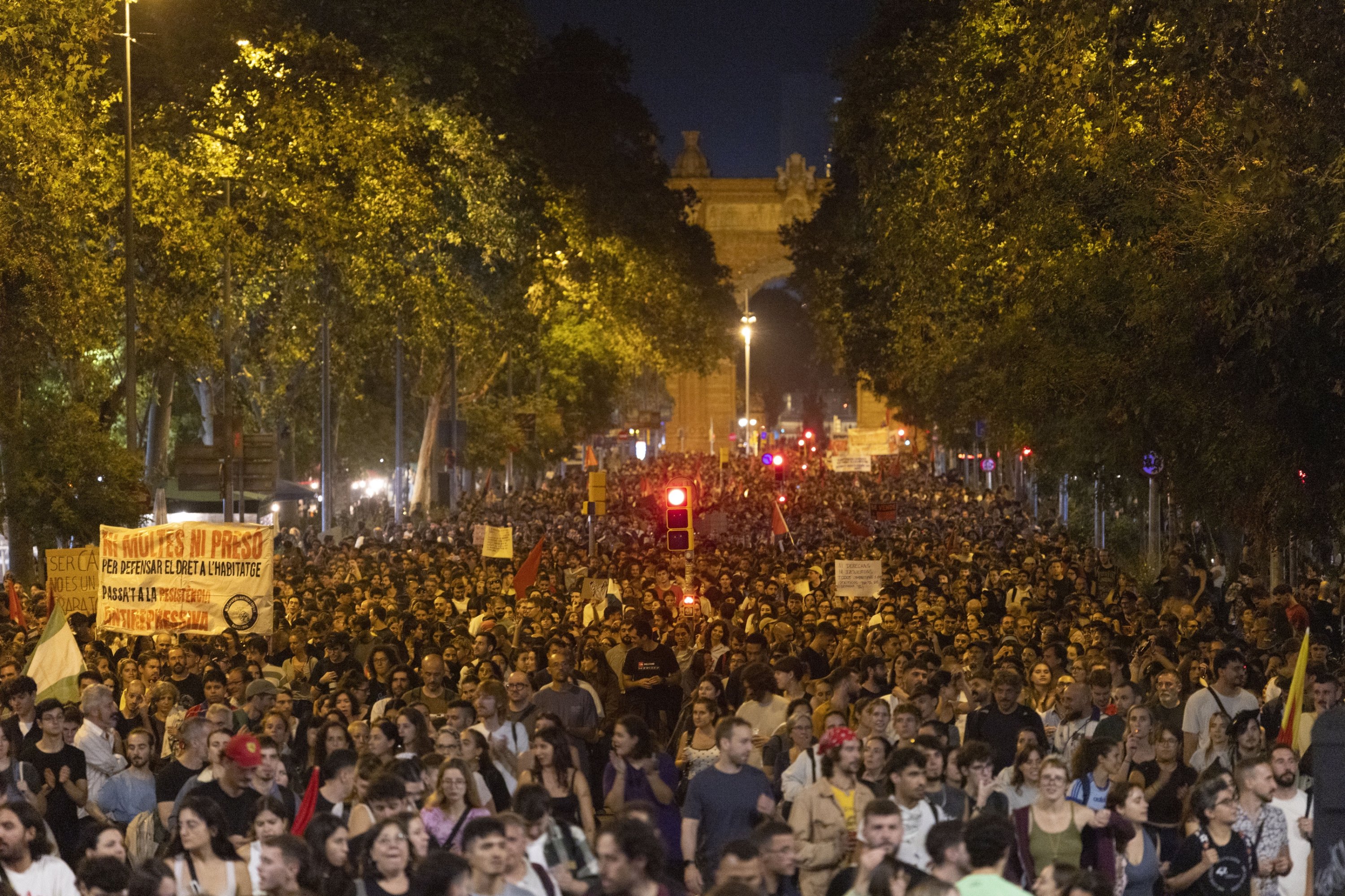
Spain’s government on Tuesday approved emergency measures to address the housing crisis, after an outbreak of violence in the coastal city of Barcelona the previous night that drew tens of thousands of people into the streets.
The Barcelona turmoil late on Monday followed protests across the country over the weekend that demanded measures to resolve a crisis sparked by the eviction of an 87-year-old woman in Madrid, the country’s capital.
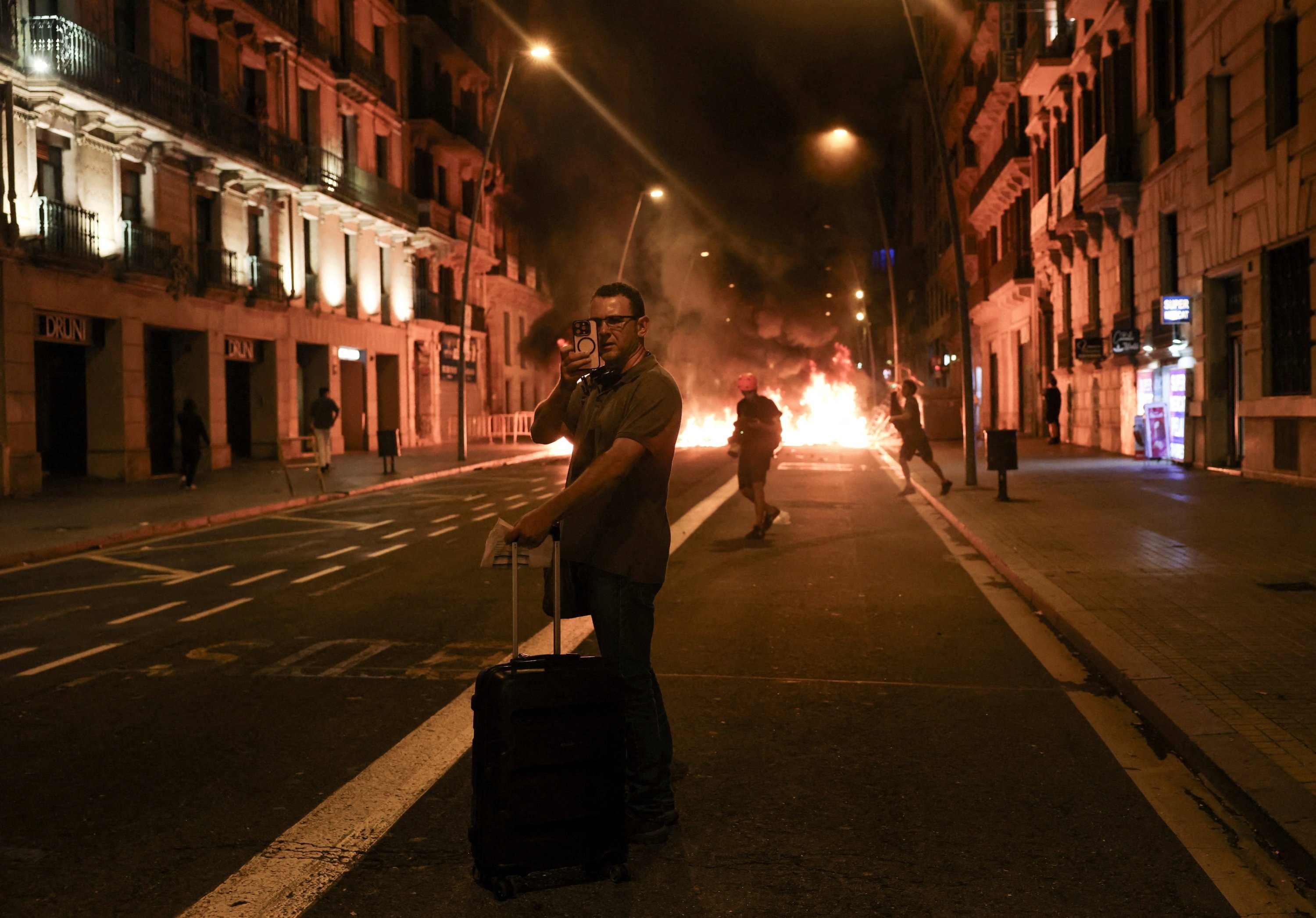
In Barcelona, Spain’s second-largest city, a severe weather alert over the weekend had forced organizers to reschedule the protest for Monday. What began as a massive peaceful march turned violent when groups of hundreds of hardcore activists clashed with police, throwing stones and setting fire to trash containers.
Prime Minister Pedro Sanchez’s government approved measures similar to those rejected by Parliament last Friday, which prompted his call for early elections on Nov. 29. The measures will be sent for ratification by an interim legislature, which remains active until the elections.
The smaller, interim legislature – known as “permanent commission” – is composed of 69 members, compared to the 350 that sit in the regular Parliament.
Alejandro Quiroga, professor of political science at Madrid’s Complutense University, said the maneuver of having decrees approved by the interim legislature was constitutional but also a necessary political move by Sanchez.
“I don’t think Sanchez had an alternative,” Quiroga told the Associated Press (AP). “If you are calling early elections so you can keep the public’s focus on housing, you can’t just sit back and do nothing about it. That wouldn’t have been smart.”
The new measures are to extend protection against evictions for vulnerable Spaniards until 2030, regulate room rentals, impose a new tax on seasonal rentals, ban speculative real estate purchases and give tax breaks to landlords, Housing Minister Isabel Rodriguez told reporters last week.
Rising costs and a housing shortage are pricing many Spaniards out of the housing market, despite strong economic growth in Europe’s fourth-largest economy.
The protesters have been demanding stronger protections for tenants, measures to combat fraud and a ban on evictions when alternative housing is unavailable.


-

 Economy3 days ago
Revolut: $115 billion fintech taking on Europe’s biggest banks
-

 Economy2 days ago
Brazilian assets rally as Flavio Bolsonaro tops first-round vote
-

 Economy3 days ago
Global M&A deal rush slowed down in Q3 as borrowing costs bite
-
 Economy2 days ago
Türkiye’s Halkbank after secondary offering amid strong interest: CEO
-

 Politics2 days ago
MP hints at more access for Öcalan amid terror-free Türkiye bid
-
 Economy1 day ago
Türkiye says Development Road could become $80B ‘energy corridor’
-
 Economy1 day ago
Top central bankers due in Istanbul to discuss policy challenges
-

 Politics1 day ago
Türkiye’s CHP seeks removal of mayor with divided loyalty